Niladri Saha Saccha - 2025 Falling Walls Lab Finalist
Falling Walls Lab Winner: Singapore (DAAD)
The PHD researcher developing quantum–bio hybrid systems to turn atmospheric CO₂ into sustainable fuels
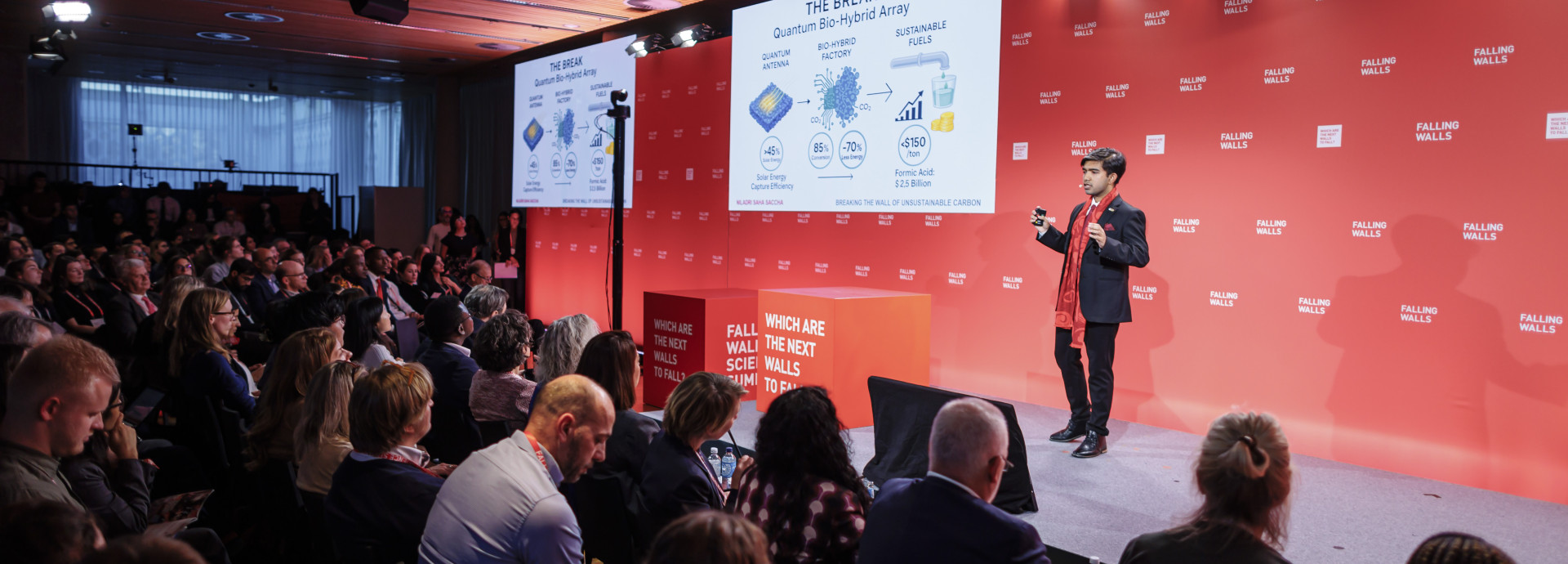
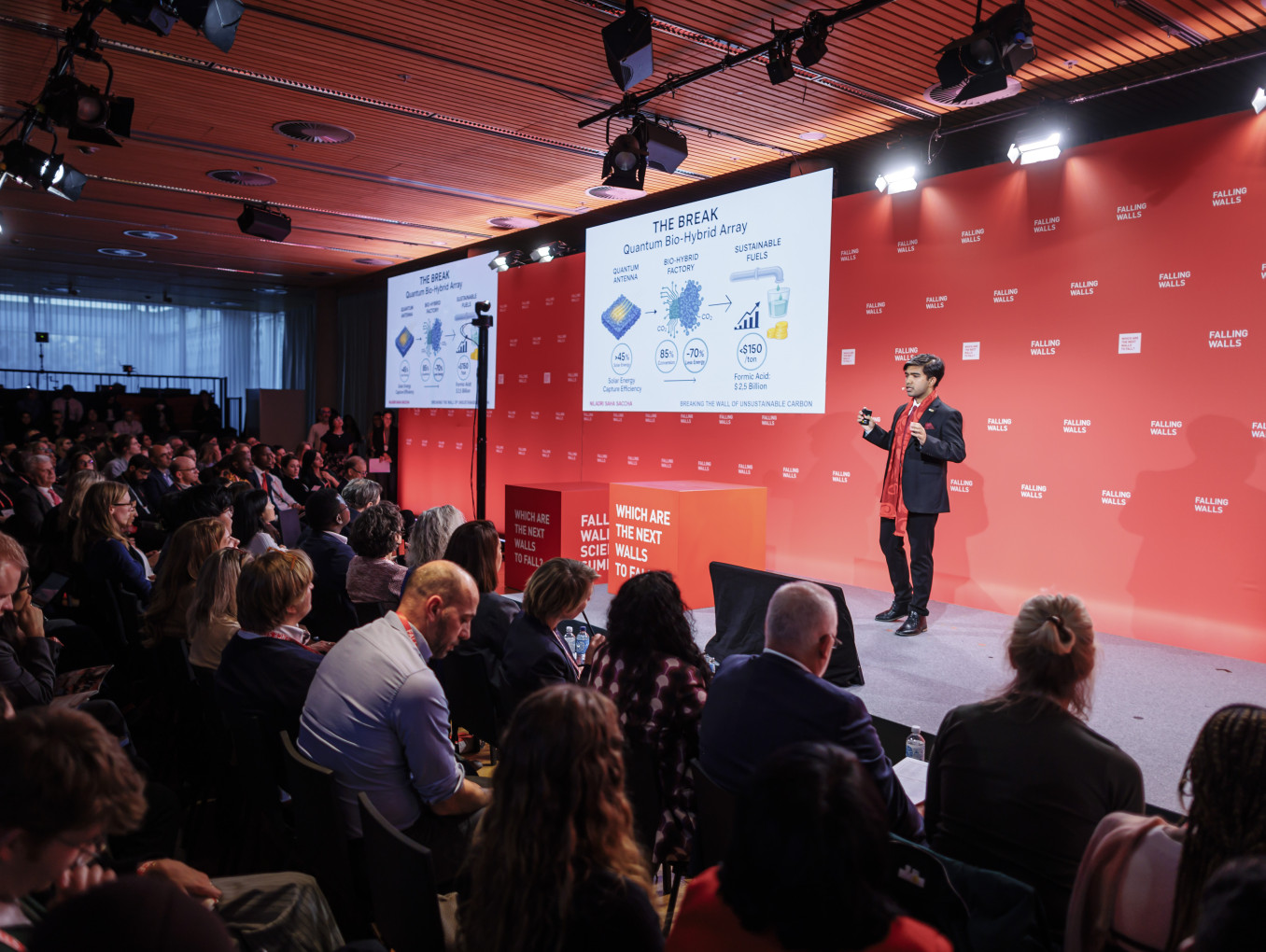
Niladri Saha Saccha is a researcher working at the intersection of quantum materials, synthetic biology and energy science. His breakthrough explores how biological systems and quantum materials can be combined to create new forms of artificial photosynthesis. Through his project, he is developing hybrid systems that use engineered bacteriophages to precisely position quantum dots alongside synthetic enzyme networks, enabling sunlight to be converted into fuel while capturing atmospheric CO₂.
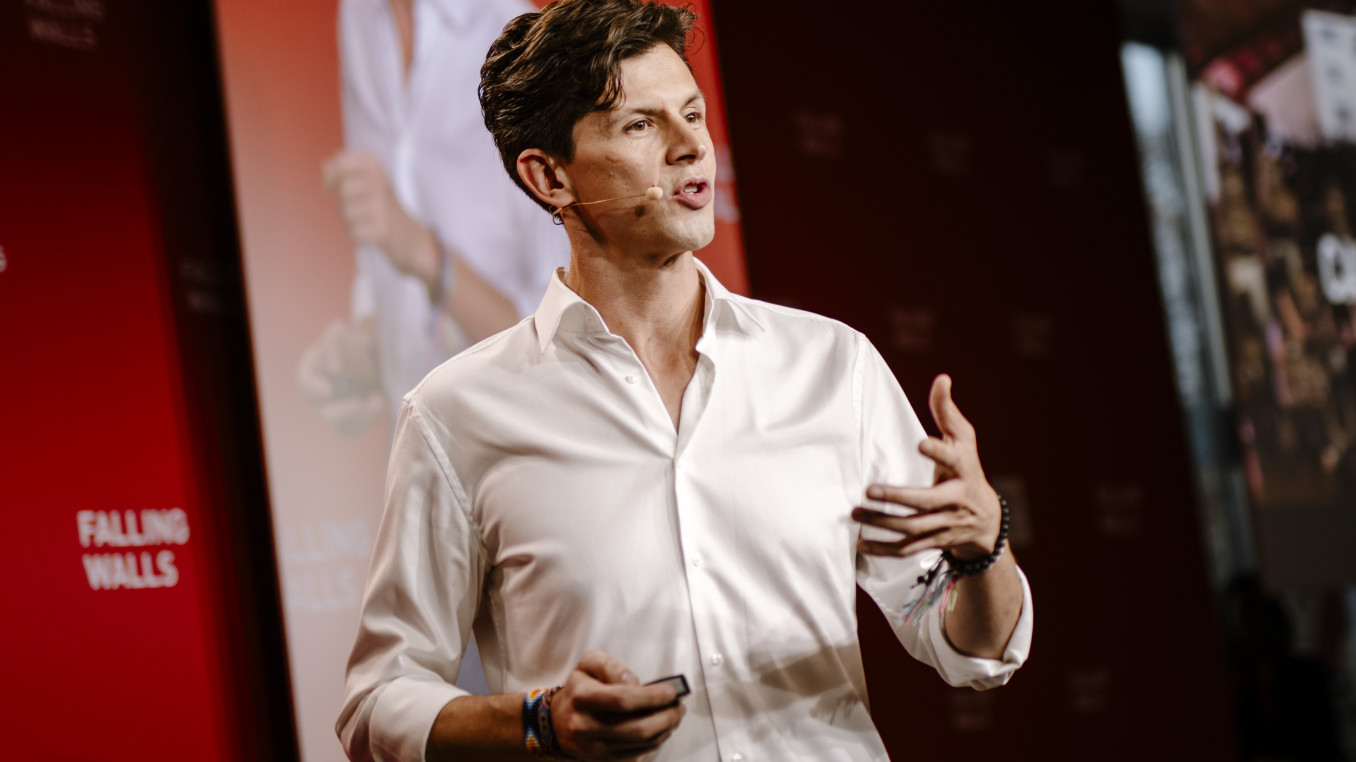
Niladri was the winner of Falling Walls Lab Singapore (DAAD) in 2025 and invited to the Falling Walls Science Summit in Berlin to present his work. In front of an international audience of science, policy and innovation leaders, he shared his vision for programmable quantum–bio energy systems that could transform carbon from a pollutant into a valuable resource.
We spoke to Niladri about the inspiration behind this breakthrough, the future of quantum biomimetic energy systems and what keeps him awake at night.
Can you tell us about your breakthrough and the inspiration behind it?
The inspiration for my breakthrough struck after I made a simple observation: nature's photosynthesis is brilliant but slow, while quantum materials are fast but lack biological precision. Our breakthrough fuses these worlds: using engineered bacteriophages as programmable scaffolds to perfectly position quantum dots next to synthetic enzyme networks. This creates a hybrid system that captures sunlight with quantum coherence and converts atmospheric CO2 directly into fuels at unprecedented speeds. It's nature, redesigned.
How do you see the future of quantum biomimetic energy systems? What are the next big things to happen in this field?
The future lies in moving beyond mimicking nature to enhancing it. We will see the emergence of designer bio-hybrid systems where quantum materials and biological components are integrated at the molecular level for specific functions. The next big breakthrough will be achieving efficient quantum energy transfer across living-nonliving interfaces, enabling self-repairing, adaptive energy systems. Ultimately, we will create programmable matter that harvests energy and synthesises chemicals with near-perfect efficiency.
What real-world impact do you hope your breakthrough will have in the next 5–10 years?
Within five years, I envision a lab-scale prototype demonstrating continuous CO2-to-fuel conversion at 10x natural efficiency. Within a decade, we aim for modular arrays deployed at industrial emission sources, converting waste CO2 into valuable chemicals and fuels. This would transform carbon from a liability into an economic asset, creating a circular carbon economy. The ultimate goal is gigaton-scale atmospheric CO2 sequestration while producing sustainable energy carriers.
In your view, what should investors/funding bodies be focusing on right now?
Investors must fund high-risk, convergent research at the intersection of quantum physics, synthetic biology, and materials science: precisely where our breakthrough lies. The greatest returns will come not from incremental improvements, but from platform technologies that enable entirely new capabilities. Funding should prioritise proof-of-concept demonstrations of functional quantum-bio interfaces, as solving this integration challenge will unlock countless applications beyond carbon conversion.
How has participation in the Falling Walls Lab supported or influenced your work?
Falling Walls Lab forced me to distill complex science into a compelling narrative: a skill essential for translating research into impact. The process clarified my thinking about the wall we must break: not just technical hurdles, but the conceptual wall separating scientific disciplines. Connecting with fellow innovators across fields has sparked new ideas about applications and collaborations. The Lab's ethos of breaking barriers now defines my entire research approach.
What are the next walls to fall? And, in your view, what are the next walls which should fall?
The next great walls lie between disciplines. We must break the wall separating biology from physics, computation from chemistry, and fundamental science from societal application. Specifically, the wall of scalable quantum-bio integration must fall: moving from lab curiosities to manufacturable systems. And the wall of public perception must fall: helping society see CO2 not as pollution, but as a resource waiting to be harvested.
Is there another question you would like to be asked?
Question: "What keeps you awake at night about this work?" Answer: The thought that we might solve the technical challenges but fail to deploy solutions at the speed and scale the climate crisis demands. My greatest fear is not scientific failure, but that our breakthroughs remain in the lab while the planet burns. This urgency drives every decision I make: to build not just elegant science, but implementable technology.
Unsubscribe any time. You’ll find our data privacy policy here.