
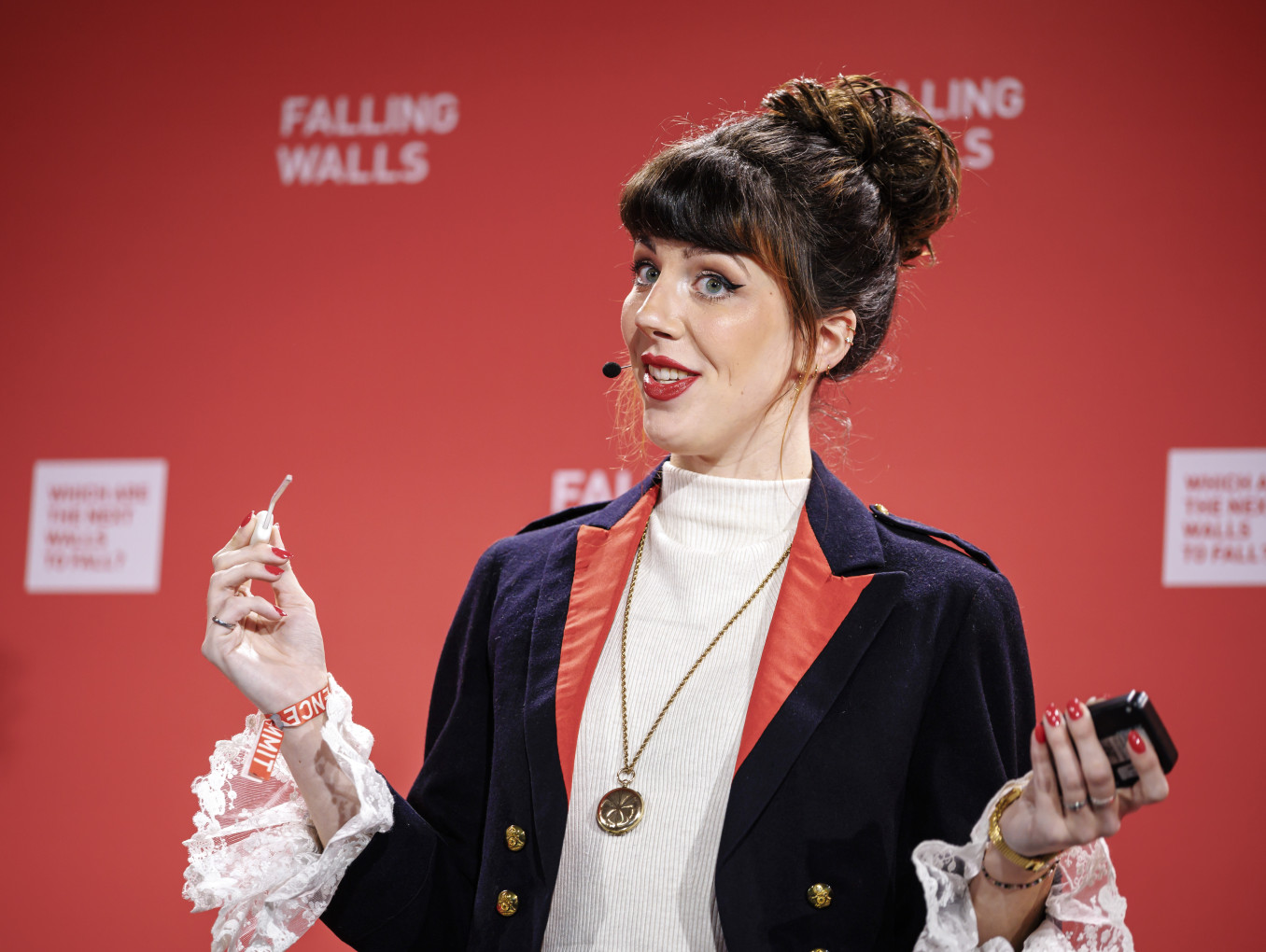
Annika Benson - 2025 Falling Walls Lab Finalist
Falling Walls Lab Winner: Atlantic Canada
Advancing AI-Powered Precision Medicine for the Future of Brain Health
Annika Benson is a PhD student in Biomedical Engineering at Dalhousie University, supervised by Jeremy Brown. Her research focuses on the development and testing of a miniature, high-resolution, tracked ultrasound probe for brain surgery. She holds a Bachelor’s degree in Electrical Engineering from Dalhousie and is currently an Engineer in Training. Outside the lab, Annika is active in science outreach and enjoys creating art, historical costuming, and doting on her roommate’s very cute cat.
Can you tell us about your breakthrough and the inspiration behind it?
With standard surgical guidance tools, neurosurgeons are often unable to accurately locate and remove brain tumours, frequently placing patients’ outcomes at risk. We have developed a novel device that uses brain tumour neurophysiology to guide patient biopsies, minimise side effects, reduce tumour regrowth, and improve patient outcomes. This approach could ultimately improve the understanding and treatment pathways of glioma patients.
How do you see the future of your field? What are the next big things to happen in this field?
There is a lot of exciting potential for AI in medicine right now. I believe we are going to see more AI-assisted approaches that truly impact patient care and outcomes.
What real-world impact do you hope your breakthrough will have in the next 5–10 years?
Ultimately, I hope this technology will extend the lives of patients affected by glioma. If our technology can help surgeons more accurately identify and remove tumour tissue while reducing the risks associated with standard surgical guidance methods, the goal is to reach a point where we no longer lose testing opportunities due to challenges during surgery.
In your view, what should investors/funding bodies be focusing on right now?
I believe investors should continue supporting cancer research, as it remains incredibly important. Progress in this field would not be possible without sustained support from investors and funding bodies.
How has participation in the Falling Walls Lab supported or influenced your work?
In preparing for and participating in Falling Walls Lab, I Iearned to communicate my project in a succinct and accessible manner. This has been an extremely valuable skill as a researcher, and has allowed me to more effectively engage others with my work, whether that be in general science outreach or advocating for support from members of parliament. It also helped me to see my project in the context of a global network of innovation and make valuable connections from across the world.
What are the next walls to fall? And, in your view, what are the next walls which should fall?
Wealth disparity. This event highlighted how our global scientific community is filled with brilliant ideas that have the potential to revolutionize healthcare, sustainability, and society as a whole. However, meaningful change will remain difficult unless we prioritize people and the planet over profit.

Unsubscribe any time. You’ll find our data privacy policy here.