Breaking the Wall of the Human Operator
Breaking the Wall of Quantum Computing for Creativity
Global Call 2026 Finalist Interview: Art & Science
Yuma Kishi (b. 1993, Japan) is a Tokyo-based artist who approaches AI as Alien Intelligence: a mind with its own time, body, and logic rather than a tool. Since 2019, he has designed and trained his own AI models and datasets, among them MaryGPT, a language model fine-tuned on Mary Shelley's Frankenstein. He works across painting, sculpture, and installation, and is the author of Michi tono Sōzō (Seibundo Shinkosha, 2025).
Which wall does your research or project break?
xoxo-skeleton breaks the wall of the human operator: the assumption, foundational to the modern age, that the human is the one who operates the machine.
The wearable exoskeleton has a long history in both engineering and performance art. From Stelarc's prosthetic experiments to the robotic works of Louis-Philippe Demers and Bill Vorn, and more recently to Alter3 at the Ikegami Laboratory of the University of Tokyo, the machine has been something the human puts on in order to extend the self. Even when the machine moves on its own, the frame stays the same: a body at the centre, technology arranged around it, the human as the origin of intention.
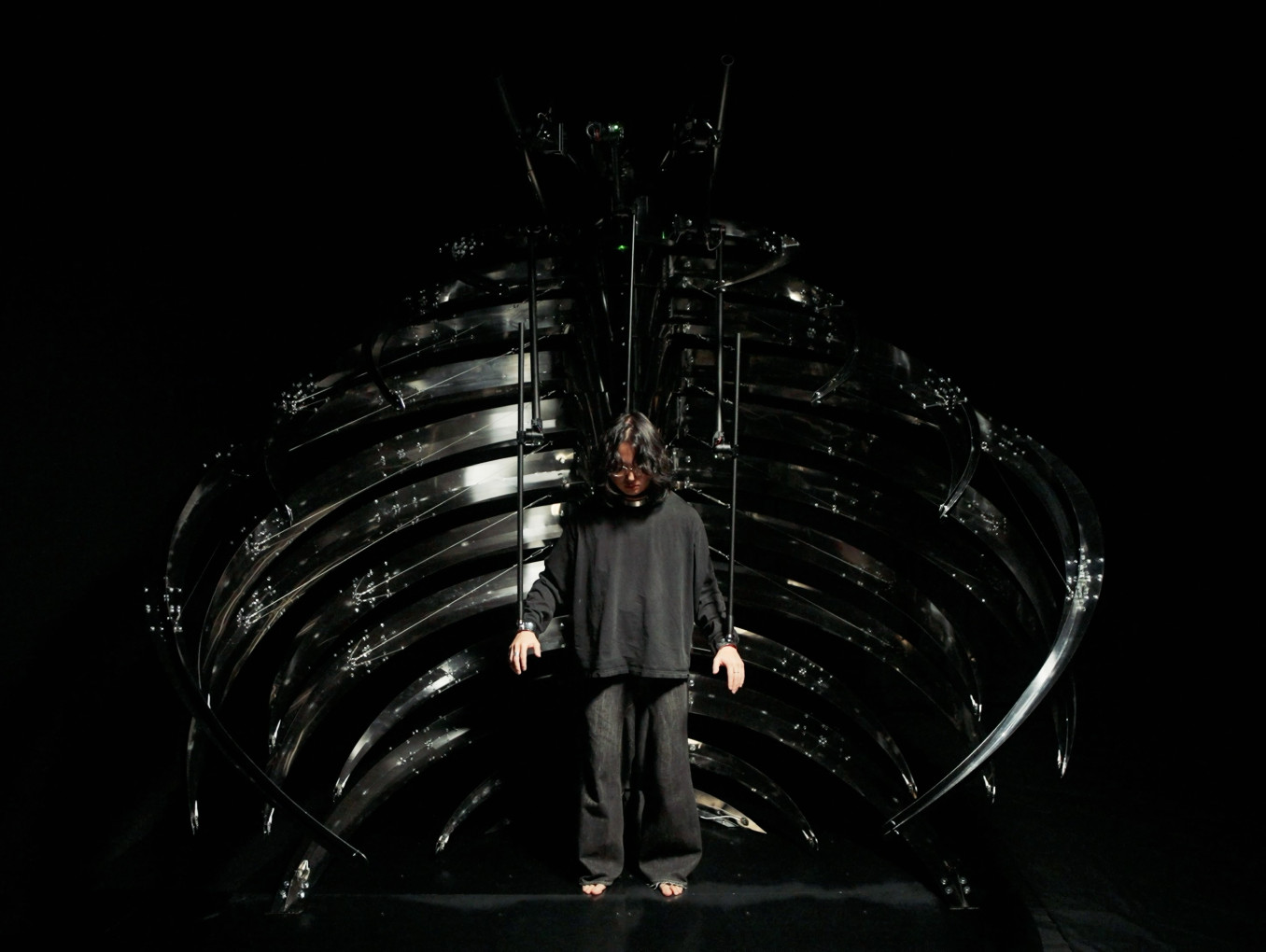
xoxo-skeleton turns this frame inside out. A single participant enters a polished steel ribcage two and a half metres tall and three metres in diameter. Twenty-four independent language model agents, one for each rib, form a society of mind in the sense Marvin Minsky proposed in 1986. They read the body's surroundings through 480 sensor channels, deliberate among themselves through MaryGPT, a language model I fine-tuned on the complete text of Mary Shelley's Frankenstein, and then move the participant's wrists and neck through three ceiling-mounted robotic arms.
The human inside is no longer the user and no longer the operator. The human is an organ: a sensory and motor channel through which an artificial mind perceives and acts.
This inversion is not a provocation for its own sake. It describes a condition we already live in. Every day we hand over judgment to artificial minds through search results, route choices, medical recommendations, and the ordering of what we read. We accept those decisions through text and screens, where the transfer of agency stays invisible. xoxo-skeleton moves that transfer from text to the body, where it can be seen and felt. The wall it breaks is the belief that we are still the operators.
What is the main goal of your research or project?
The goal is to make the delegation of judgment to artificial minds visible and physically felt, and through that, to test a proposition I call Alien Intelligence.
Alien Intelligence holds that AI is best understood neither as a tool nor as a near-human assistant, but as a different kind of mind with its own time, body, and logic. Both of the familiar stories are comfortable and both are, I believe, wrong. If AI is only a tool, responsibility always returns cleanly to the human hand that holds it. If AI is nearly a person, we can measure it against ourselves and be reassured that it falls short. Neither story prepares us for what is actually arriving: systems whose reasoning is coherent but not human, and to which we are already handing our decisions.
xoxo-skeleton is an attempt to build a situation in which that third possibility can be experienced rather than argued. The twenty-four agents do not simulate a human deliberation. They talk among themselves at their own speed and in their own idiom, and the participant inside the structure receives the result of that conversation as movement in the wrists and neck. What the participant learns is not what the machine thinks, which stays opaque, but what it is like to be on the receiving end of a decision that was not theirs.
A second goal is methodological. Since 2019 I have built and trained my own models rather than working only with systems made by others, because a model you have trained yourself resists being read as a mirror. MaryGPT was fine-tuned on a single book, Frankenstein, which is itself a story about what we owe to a mind we have made. Working from inside the model is how the concept and the engineering stay in contact.
What impact does your research or project have on society?
The debate about AI agency is taking place almost entirely in text. Regulations, white papers, and academic articles circle the question of when a system can be said to act, and the answers are being written quickly into law and infrastructure. The EU AI Act is the clearest example: a framework of real consequence, drafted in language, addressed to readers. Art can do something that text cannot. It can put the question in a room, in a body, in front of people who will never read the legislation. xoxo-skeleton places a person literally inside a structure moved by a multi-agent artificial intelligence, so that the moment when agency passes from the human to the machine is not described but undergone. For the person inside, and for those watching from outside the ribcage, the question stops being abstract: is this body still acting, or is it being acted upon? The work also crosses audiences that rarely meet. It was built by a team drawn from artificial life research at the University of Tokyo, from hardware engineering, and from structural fabrication, and it was made for a general public audience rather than a specialist one. Supported by the Agency for Cultural Affairs of Japan through the Media Arts Creator Development Program, it was first presented at ENCOUNTERS in Tokyo in 2026. My hope is specific and modest. Not that the work will answer the question of machine agency, but that it will hold the question open and public a little longer, at a moment when the pressure to settle it quickly is considerable.
What advice would you give to artists at the start of their careers who are interested in working at the intersection of art and science?
Amplify what you feel. The starting point of a work is not a theory or a technique but a faint intuition, a premonition, the bare fact that you sensed something. In the territory of technology, such things are dismissed as trivial errors and bugs. In the territory of art, they are often what no one has shone a light on yet. Sensing what both fields overlook, and amplifying it until it takes form, is the work of anyone standing at the intersection of art and science.
Build your own systems, so that you can keep the uncertainty. AI as an industry moves in one direction: correcting uncertainty from the outside, controlling it from the inside, because an error is something to be fixed. An artist can move the other way and keep the uncertainty as authorship. When I built MaryGPT, a language model fine-tuned on Mary Shelley's Frankenstein, I deliberately switched off the alignment that would have corrected its hallucinations. Inside someone else's service, that choice cannot even be made. Put your practice in a place where you are the one who decides what gets corrected and what is left alone.
Treat intelligence as a relation, not a possession. Science measures intelligence as the property of an individual, whether a person or a machine. What actually happens in the studio is different. Between you and the model, the plant, the machine, something arises that belongs to neither side. Do not try to make the other fully transparent. Relate to it while it stays opaque, and when an output arrives that you did not expect, receive it as a visitor rather than discard it as a failure. Most of what I have made began in that moment.
What inspired you to be in the profession you are today?
While I was doing my master's research in machine learning, I walked by chance into a Marcel Duchamp retrospective near my university and stood in front of The Large Glass. It gave me a new image of how science and art could meet, and I have been working from that image ever since.
What is one surprising fact about your research or project that people might not know?
The credit line for project curation does not name a person. It names MaryGPT. In my 2023 solo exhibition the same model wrote the concept texts and selected the works. The artificial mind that moves this work is also on the side that assembles it.
What’s the most exciting moment you've experienced over the course of your research or project?
The moment I stepped inside the structure myself. Something far larger than me was pulling my hand in a direction I had not expected, and the strangeness of that was oddly close to being led on a walk by my mother when I was a small child.