Breaking the Wall of Biological Opacity
Breaking the Wall of Biological Opacity
Global Call 2026 Finalist Interview: Physical Sciences
Sylvain Gigan is a Full Professor of Physics at Sorbonne University and serves as Deputy Director of the Kastler Brossel Laboratory in Paris. He co-leads the Photonics, Information and Complexity (PICo) Lab, where he explores the propagation of light in complex and disordered systems, at the crossroads of optics, wave physics, and computing. His research combines experimental approaches, computational techniques, and theoretical insights to address fundamental questions in quantum and classical optics, as well as emerging applications in imaging, sensing, and optical computing for AI.
Which wall does your research or project break?
The wall we break is the wall of biological opacity: the barrier that stops us from seeing inside the living body with light.
To understand it, think about why fog, milk or an eggshell are opaque. None of them truly swallows light; they are white, not black. They scatter it. Each tiny particle deflects the light a little, and after countless deflections it loses all memory of the straight line it was following. Living tissue behaves the same way: skin, muscle and brain are opaque the way fog is opaque. A beam entering the body is bounced thousands of times, and after about a millimetre any image it carried dissolves into a shapeless glow.
This is a real limit for medicine. Light is our gentlest and most informative way to probe living matter, yet the optical microscope essentially stops at the surface. Below a millimetre the image is lost, which is why we still rely on slicing samples or on heavier techniques such as X-rays and MRI.
For more than a century this scattering was treated as hopeless, because the scrambling looks utterly random. Our work rests on a different observation: it only looks random. Scattering does not destroy information, it merely shuffles it, and it does so in a way that is both deterministic and linear. Deterministic, because a given medium always scrambles incoming light in exactly the same way. Linear, because its effect on a complicated beam is simply the sum of its effects on each part of that beam. Together, these properties mean the whole process can be captured by a single mathematical object, which we introduced in 2010 and called the transmission matrix.
That changes everything, because a matrix can be measured and inverted. Once we know it, we can craft a beam that looks completely distorted going in but reassembles into a sharp focus deep inside.
Over the following fifteen years we built an entire toolbox around this idea. The most recent of these methods exploit fluorescence, the faint light that biological structures naturally emit and that biologists actually use to observe living cells. Learning to work with that faint, incoherent light rather than a clean laser was the hardest step, and the one that connects our physics to real biological imaging. In short, we turn disorder from something we merely suffer into something we can learn, and then command.
What is the main goal of your research or project?
Our overarching goal is to make the invisible visible, to see, and to deliver light, deep inside scattering media such as living tissue, at the highest possible resolution and in the least invasive way.
Concretely, this ambition breaks down into several intertwined objectives. The first is to focus and image light through and inside opaque biological tissue, well beyond the current optical depth limit, without cutting or damaging the sample. If we can focus a beam at depth, we can also illuminate, stimulate, and photo-activate structures, neurons, tumours, individual cells, that today lie out of reach of light.
The second goal is to do this non-invasively and in real time. Living tissue moves and evolves, so the scrambling it produces changes constantly. We therefore develop fast wavefront-shaping methods, smart algorithms, and computational imaging techniques that can measure and correct scattering on the fly, ideally without any physical probe inside the body.
A third goal is more fundamental, and to me equally exciting: to turn scattering from an obstacle into a resource. A complex medium mixes light in an enormously rich way. That same complexity, once we can control it, becomes a powerful instrument, for high-resolution imaging, for miniature endoscopes no thicker than a human hair, for information processing, and even for manipulating quantum states of light. The medium that ruins conventional imaging can become a lens, a spectrometer, or a computer.
Underlying all of this is a unifying scientific aim: to understand, at a deep level, how light and information propagate through disorder, and to build the physical and mathematical framework that lets us command that propagation at will.
Ultimately, the goal is not a single device but a change of paradigm, establishing that opacity is not a hard limit of physics but a solvable problem. Success means giving biologists and clinicians optical access to the depths of living systems, and giving physicists a new playground where complexity is harnessed rather than avoided.
What impact does your research or project have on society?
The most direct impact is on biomedical imaging and medicine. Optical methods are safe, label-rich, and extraordinarily precise, but their reach into the body has been capped by scattering. By pushing light deeper into living tissue, our research opens the way to observing cells, blood vessels, and neural activity in their native environment, rather than in biopsies or thin slices. This matters for early diagnosis, for guiding surgery, and for understanding diseases as they actually unfold in the living organism. A striking example is endoscopy. The same principles that let us image through tissue allow a single hair-thin optical fibre to act as a microscope. Such minimally invasive probes could one day reach deep organs or delicate regions of the brain with far less trauma than today's instruments, turning exploratory procedures into gentle, precise interventions.
The impact reaches well beyond medicine. Learning to control light in complex media feeds directly into neuroscience, where light is used both to observe and to stimulate neurons, and into fundamental biology. It also drives new imaging technologies for industry, security, and environmental sensing, seeing through fog, smoke, or other opaque barriers.
Perhaps more unexpectedly, the mathematics of controlling disorder connects to information and computing. A scattering medium performs, in a single passage of light, an immensely complex transformation of data. This insight underpins new approaches to optical computing, using light and complexity to process information far more energy-efficiently than conventional electronics, an increasingly urgent concern as artificial intelligence consumes ever more power. It also touches secure communication and quantum technologies.
What advice would you give to young scientists or students interested in pursuing a career in research, or to your younger self starting in science?
My first piece of advice is the one I most needed to hear myself: rejection and failure are the norm, and success is the exception. Rejected papers, declined grants, experiments that stubbornly refuse to work, these are not signs that you are on the wrong path. They are the ordinary texture of a research life, and every success is the result of a lot of patient, hard work. My own most cited paper came from a project that was turned down twice before it was funded. Take the long view, and be kind to yourself along the way.
Second, let go of the image of science as a lone genius at a blackboard. Almost everything worthwhile is deeply collaborative. Cultivate openness, curiosity and generosity, with your time and with your ideas. The friends and colleagues at your own career stage, with whom you share your doubts and your solutions, will teach you as much as any formal supervisor.
Third, follow your enthusiasm, because it is a reliable compass. For me, a project is worth pursuing when I can communicate it with genuine excitement, not only to a funding agency but to the young researcher who will carry it forward. If an idea makes your curiosity grow rather than fade, scale it up. And do not be afraid to walk away from crowded, fashionable races toward quieter questions where you can actually think. That freedom is what academic research is for.
Fourth, drop the false wall between fundamental science and applications. I started in very fundamental physics, and I have seen again and again how short the distance to real-world impact can be, and how much the two enrich each other. Your generation understands this faster than mine did, but it is worth repeating.
Finally, a lesson I owe to being an amateur musician rather than a physicist: getting good takes time and practice, there is real joy in improvising once you have the technique, and there is never-ending pleasure in listening to and learning from others. The same is true in science. Protect that pleasure. It is the real reason to stay.
What inspired you to be in the profession you are today?
I was drawn to physics very early, but what really decided me was discovering during my studies that I enjoyed the open-ended part of research most: not learning the answers, but living with a question nobody had solved yet.
What is one surprising fact about your research or project that people might not know?
When light gets lost in fog or in tissue, the information it carried is not destroyed, only scrambled. Opacity is not a wall of chaos, it is an encrypted message, and we can learn to read it.
What’s the most exciting moment you've experienced over the course of your research or project?
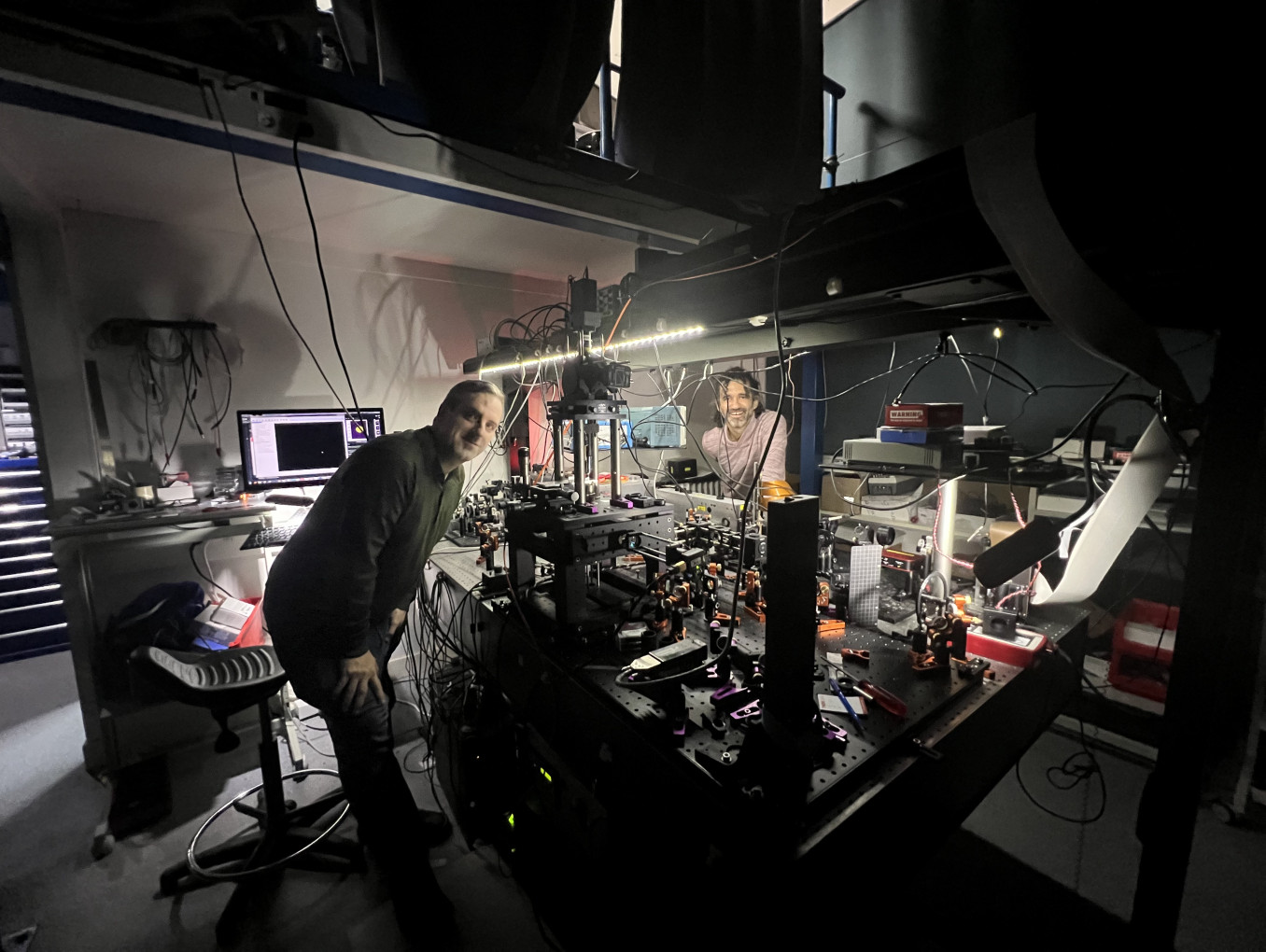
The first time we saw a sharp point of light form behind a layer we knew to be completely opaque. We had shaped the beam into what looked like pure noise, and out of that noise came a perfect focus, that we knew couldn't be there by chance. Every time a student perform this experiment for the first time, I can see the same amazement.