Breaking the Wall of Quantum Simulation: Quantum Twins
Breaking the Wall of Quantum Simulation: Quantum Twins
Global Call 2026 Finalist Interview: Physical Sciences
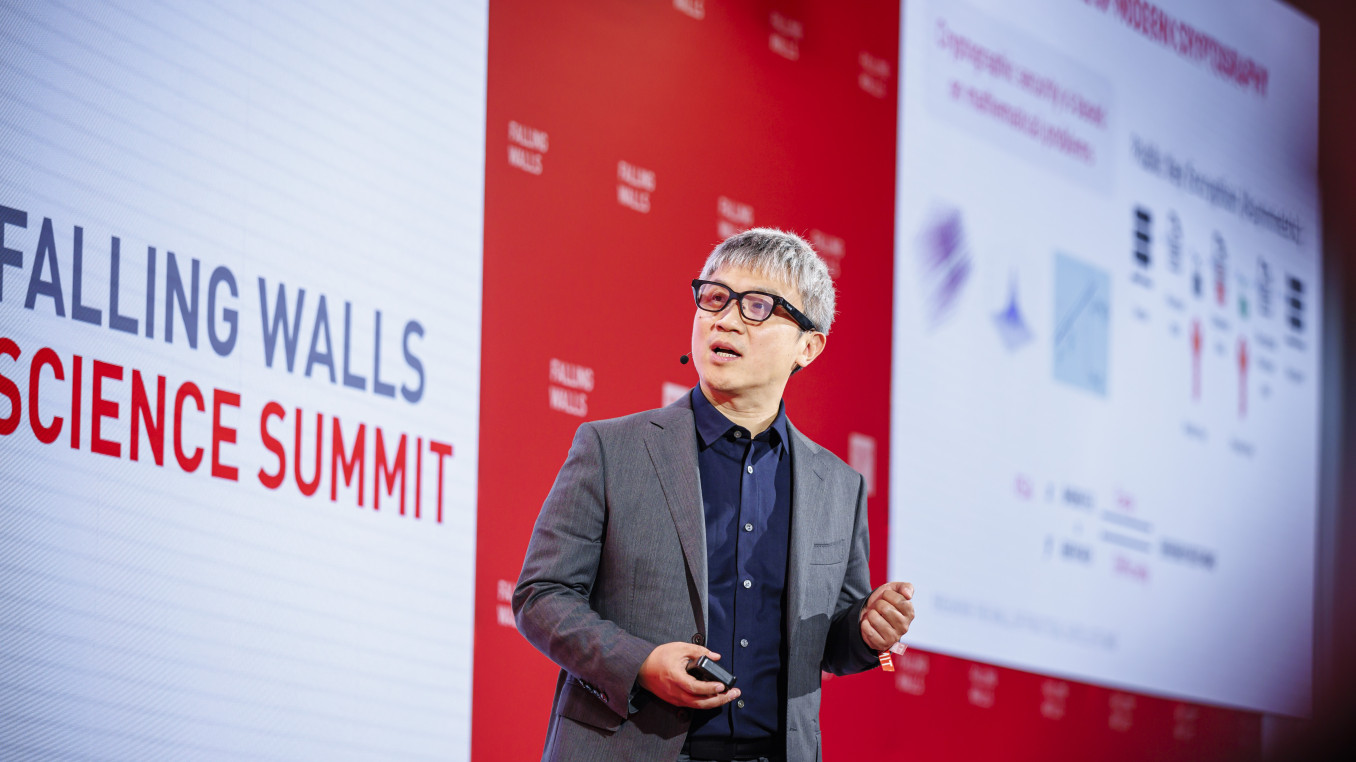
Michelle Simmons is the founder and CEO of Silicon Quantum Computing (SQC), a leader in the global race to deliver a universal, fault-tolerant quantum computer. She is credited with creating the field of atomic electronics, pioneering new technologies to build computing devices in silicon at the atomic (0.13nm) scale. A fellow of Royal Society and the American Academy of Arts and Science, Michelle was awarded the Prime Minister's Prize for Science in 2023 and was the 2018 Australian of the Year.
Which wall does your research or project break?
For decades, scientists have sought to understand how the quantum behaviour of electrons governs whether materials conduct electricity, form molecular bonds or exhibit phenomena like superconductivity. These questions sit at the heart of drug discovery, materials science and electronics, yet are too complex for classical computers to model at scale.
Our work addresses this challenge, demonstrating for the first time a quantum simulator with 2D arrays of 15,000 precision-placed qubit registers (quantum dots) in pure silicon. This unprecedented scale and control eliminates finite-size distortions that have undermined smaller simulations in the past. We can now create custom chips, Quantum Twins, that physically encode direct replicas of the physical systems and chemical interactions that customers wish to understand.
Building on our previous demonstration of the molecular simulation of polyacetylene (Nature, 2022), we have expanded the system size and application range by orders of magnitude. This enables us to simulate chemicals, drugs and materials relevant to a wide range of applications in electronics, industrial chemistry and pharmaceuticals.
What is the main goal of your research or project?
'Quantum Twins represents a window into the quantum world that customers and researchers can use for materials discovery today.
Our work for the first time realises the dream Richard Feynman articulated in his famous lecture, "there's plenty of room at the bottom." We have unlocked the ability to design materials in previously unthought-of ways by building their analogues atom-by-atom.
Analysing magnetism, atomic interaction and superconductivity at this scale paves the way for novel information storage, low-power electronics and broad materials discovery.
What impact does your research or project have on society?
The scale and controllability we have achieved means we are poised to tackle unconventional superconductivity and other exciting problems. Near-term, adaptations of our polyacetylene simulations offer a pathway to modelling benzene rings that mimic small drug molecules, opening new frontiers in pharmaceutical discovery. Our atomic precision 3D manufacturing means we are at the beginning of a journey where we can design and control simulators across a growing range of real-world applications.
What advice would you give to young scientists or students interested in pursuing a career in research, or to your younger self starting in science?
Throughout my life, I have lived by four mantras: do what’s hard, place high expectations on yourself, take risks and do something that matters. For young scientists entering the quantum computing field, I’d say learn to distinguish between reality and hype, and know that the greatest reward comes from hard work and attention to detail. In this field, the details really do matter.