Breaking the Wall of Quantum Interferometry
Breaking the Wall of Sugar Synthesis for Sustainability
Global Call 2026 Finalist Interview: Physical Sciences
Markus Arndt did his Ph.D. at the LMU Munich with A.W. Weis and T. W. Hänsch. He worked with Jean Dalibard at the ENS in Paris before joining the group of Anton Zeilinger. Together they demonstrated the first quantum diffraction of C60 at the University of Vienna in 1999. Arndt started his own team in 2001 and became a professor at the University of Vienna in 2004, tenured in 2008. He develops methods to explore and utilise the quantum nature of large molecules and nanoparticles.
Which wall does your research or project break?
Quantum physics is one of the best-confirmed theories of nature ever devised. Building on Erwin Schrödinger’s wave equation from 1926, quantum science has become the basis for modern technology, from semiconductor physics to superconductors, from lasers to atomic clocks. In recent years, the list of applications has been extended by advances in quantum sensing, quantum communication, quantum simulation and progress on the way towards quantum computers.
Despite this huge success and its enormous economic relevance, the foundational principles of quantum physics seem to defy our understanding of reality, locality, time or logic. This is particularly well illustrated in the quantum superposition principle, which allows a single object to contain two mutually exclusive conditions in the same state, such as ‘being here’ and ‘being there’ or pointing ‘up’ and ‘down’. This clearly contradicts our daily experience, where we usually find things in a well-defined state, and it seems to defy our common logic that is trained by Aristotle’s law of non-contradiction.
To describe this discrepancy, physicists and philosophers have introduced the notion of a “quantum world” to be contrasted with a “classical world”. On one side of this conceptual “wall”, the laws of quantum mechanics should hold with quantum superpositions and entanglement. On the other side of it, unambiguous reality would be restored as we see it every day.
Many physics textbooks suggest that the transition from one to the other side of the ‘wall’ may be induced by quantum measurement, which projects quantum potentialities onto classical realities. Others would ask if this transition may also occur spontaneously, as a function of the object’s mass and complexity. Conversely, decoherence theory would argue that this boundary is only fictitious and introduced to simplify our understanding, that all quantum measurements only generate larger quantum systems and that quantum physics is all there is.
The research projects of my group are dedicated to transforming these philosophical questions into experimental tests, to shift the experimentally confirmed boundaries of quantum physics to systems of larger size and complexity. In all experiments so far, we find that quantum physics is the valid model of nature and that we can understand the appearance of localised reality by simple scaling rules or a coupling to a larger system within the framework of quantum physics. All evidence so far suggests that there is no wall. New proposals aim to push the experimentally verified limits even further.
What is the main goal of your research or project?
For more than a quarter century, our QNP group at the University of Vienna has developed new tools to explore the quantum-to-classical transition. We were able to continuously shift the frontiers of experimentally tested quantum physics to ever more massive particles with ever higher complexity.
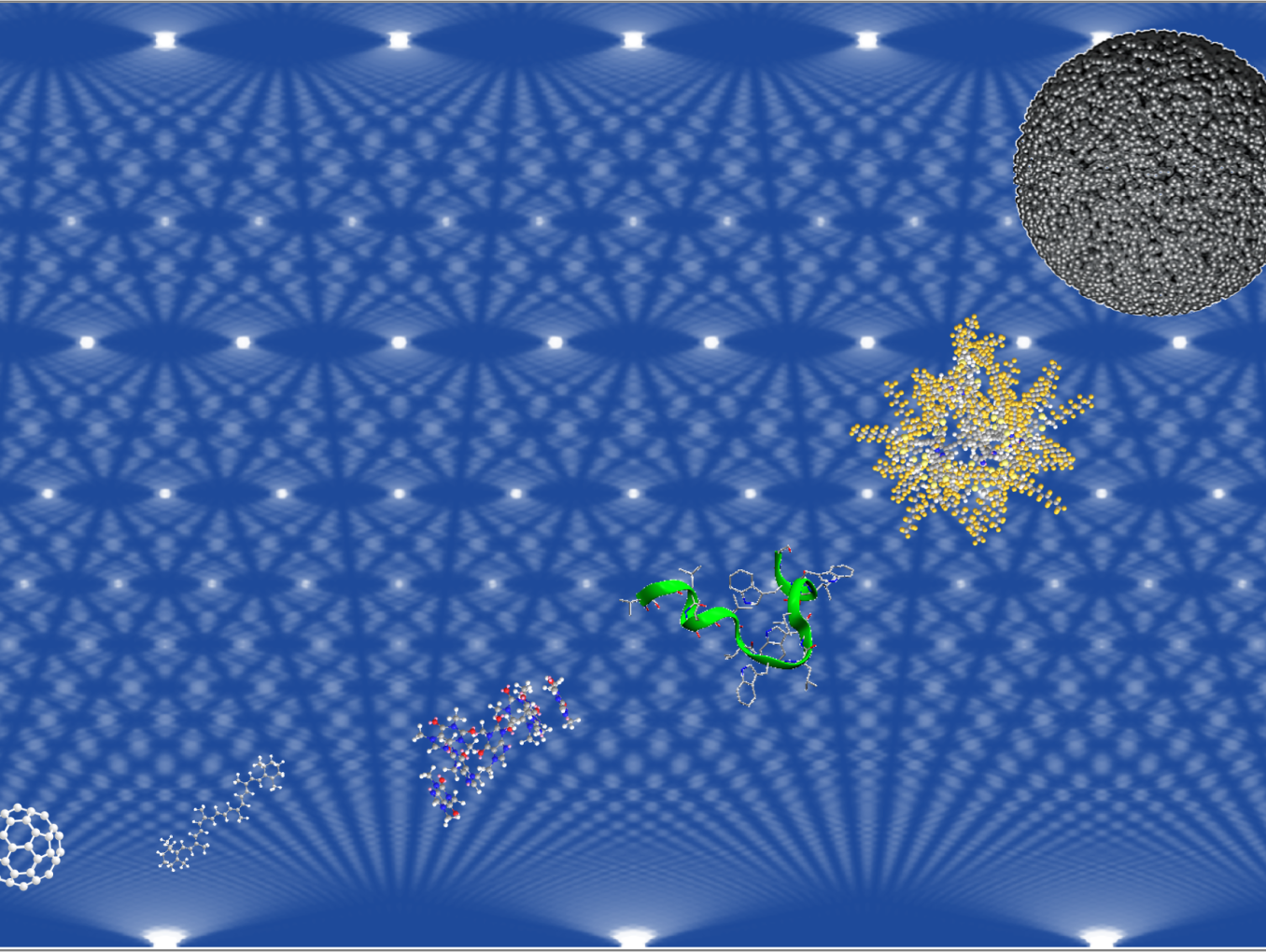
Starting with the demonstration of the quantum wave nature of hot fullerene molecules, even with internal temperatures up to 1500 K, we have demonstrated the quantum delocalization of individualized complex biomolecules in high vacuum - from vitamins to functional polypeptides. Our most recent experiments have shown that even massive metal nanoparticles composed of more than 7500 atoms and weighing more than 170,000 hydrogen atoms can be prepared in genuine quantum superpositions of widely separate locations.
Our current experiments hold the mass world record in matter-wave interferometry, and they realize the strongest test of macroscopicity – a measure of how well one can exclude hypothetical corrections to Schrödinger’s famous quantum wave equation.
We put philosophical questions to an experimental test, with large machines that are assembled and run by an international research team. Our goal is to push the limits of macroscopicity by another six orders of magnitude in the coming years.
Progress in this field depends on advances in molecular beam methods, cooling, and coherent manipulation schemes for (bio)molecules, metal clusters and dielectric nanoparticles. We develop ultraviolet light sources, quantum detectors and single-photon chemistry for mass spectrometry, matter-wave interferometry and quantum state manipulation – at the limits of the current state of the art.
The instruments that we built for tests of fundamental physics turn out to be exquisite quantum sensors for forces as small as 0.01 Yocto-Newton (a number with 26 leading zeros) today and likely a thousand times better in the future. This sensitivity can be used to determine optical, electric, magnetic and structural properties of individualized neutral molecules and nanoparticles, thus establishing a new tool at the interface between quantum science and (bio)physical chemistry.
What impact does your research or project have on society?
Our research is motivated by the desire to understand the philosophical basis and potential limits of modern quantum physics. If quantum physics is correct – and all experiments clearly support this view – we must accept that either one or several of our common notions of reality, locality, relations in space-time or classical logic do not generally hold. In that sense our work is a contribution to human culture, like art and music.
We explore how we can understand the world around us, what we can know with certainty and what we cannot know, not even in principle. As quantum physics gains increasing importance in modern technology, probing its boundaries is important to clear the path for even more complex applications.
As a university group we are also quantum educators and trainers for a profession that is increasingly sought after. Finally, studying questions around the foundations of quantum physics also requires us to develop unique technologies to launch, control and detect individual neutral biomolecules or isolated nanoparticles – in ways no one else has explored before.
What advice would you give to young scientists or students interested in pursuing a career in research, or to your younger self starting in science?
A career in science is amazing. It is a continuous adventure. Go for it. While some see it as a tour to a summit, to me it feels like an endurance run along a wild creek through a mountainous landscape. The fun of science is usually not to make a singular discovery, but to be on the move, to feel your strength and your weakness in the presence of hurdles that you can overcome, to find unexpected vistas around rocky corners, to feel how the weather changes and to adapt to it while moving forward. Science is an alternation between thoughtful preparation, engagement, exhaustion and enlightenment, and the shortest path between two points is almost never a straight line.
Journalists often emphasise the role of individual researcher personalities, but in the real world, the most successful and the most joyful research is almost always teamwork. It means meeting and working with inspiring people from different generations, different cultures and different value systems.
I cannot single out one specific character trait that guarantees success. What I am looking for in team members is intelligence and technical competence. But assuming this is a given, it is above all their curiosity, some stubbornness and the deep desire to feel that science is their second nature. A job in research requires an interesting combination of hubris, competence, humility and resilience. You need to have the hubris to believe that you can achieve an important research goal, the competence to start on a credible path, the humility to accept that nature does not care what you believe and the resilience to restart with a new strategy when your initial ideas have failed.
What inspired you to be in the profession you are today?
As a schoolboy, I liked reading physics books to fall asleep. Not because they were boring, but because I liked the comfort of order and clarity in a turbulent world.
When I grew up, my motivation was almost inverted: Today I am fascinated by how little we know, by the apparent contradictions quantum physics imposes on our classically educated minds.