Breaking the Wall of Silence: I Am Your Body

Breaking the Wall of Silence: I Am Your Body
Global Call 2026 Finalist Interview: Art & Science
Marco Donnarumma, PhD, is an artist, stage director, inventor and theorist. His oeuvre confronts normative body politics with uncompromising counter-narratives. He is best known for creating body-machines that use sound, AI, biosensors, and robotics to turn the body into a site of resistance and transformation. He has presented his work in thirty-eight countries across Asia, Europe, and the Americas and is the recipient of numerous accolades, notably the Prix Ars Electronica's Award of Distinction in Sound Art 2017, the German Federal Ministry of Research and Education's Artist of the Science Year 2018, and a Hyundai ZER01NE Creator grant in 2024. Donnarumma was named a pioneer of performing arts with advanced technologies by the national newspaper Der Standard, Austria. His writings are published in Frontiers in Computer Science, Computer Music Journal and Performance Research, among others.
Which wall does your research or project break?
I Am Your Body (2022–present) is an ongoing project investigating how normativity is enforced through the technological mediation of the senses. It engages artistically and scientifically with the relation between sound, AI, and the embodied knowledge enshrined in d/Deaf and hard of hearing bodies. Grounded in feminist theory and critical disability studies, I Am Your Body celebrates collaborative research and creation, while advancing the relations between contemporary performance, sound research, and interactive AI technologies.
The project originates from reflections on Donnarumma’s own late-deafness - due to a genetic, degenerative sensorineural condition in both ears - and builds on his 16 years of practice designing and hand-crafting biomachines, AI systems, robotics, and prosthetics across contemporary art, theatre, and performance.
Donnarumma's long-term focus on body technologies and AI prostheses is significantly renewed and expanded here. Where traditional cyborg and posthuman art offer conceptual, idealised, or hyperbolised perspectives on what a cyborg body truly means, I Am Your Body breaks with that tradition. Through artworks, sound art, performances, and film, the series confronts the lived experience of those using - or, importantly, choosing not to use - those very prostheses: people who live with them inside their bodies as an ambiguous mark of both their identity and the isolation imposed on them by a hearing world.
I Am Your Body breaks the wall of silence - the silence of a hearing society that treats sensory difference merely as a medical or engineering defect to be fixed. Combining the embodied knowledge of d/Deaf bodies with AI, biosensors, and biomechanics, Donnarumma designs, engineers, handcrafts, and programs AI body prostheses that, in his artworks, function as "artificial sonic organs", new bodily structures that trigger a radical reconfiguration of perception.
Navigating the tension between scientific research and artistic practice, the project attunes to bodies that dare to differ. I Am Your Body rejects the notion of the prosthesis as a passive, individualised aid, celebrating instead a new class of prosthetic technology: sonic organs that invite audiences into a vulnerable state of sensorial and communal awareness.
What is the main goal of your research or project?
The project I Am Your Body aims to expand the understanding of sound beyond the limits of normative perception and to celebrate the interdependence of bodily experience. Its goal is to leverage science and art to articulate a new understanding of listening and perception that moves past cochlear hearing - the hearing that happens inside the ear - opening up an infinite spectrum of sensing modalities. To do so, it employs performance and sound art, embodied technology, and AI.
To realise the artworks in the series, Donnarumma works with autoethnography, artistic and scientific inquiry to turn perception into a site for investigating the links between non-normative listening, technological innovation, and institutional power.
The project originated from a collective process of artistic research across social boundaries. Between 2022 and 2023, a working group of d/Deaf and hard-of-hearing individuals, selected through an open call, gathered in regular sessions. Mediated by Donnarumma, group members shared, analysed, and collected personal accounts of their experiences of d/Deafness.
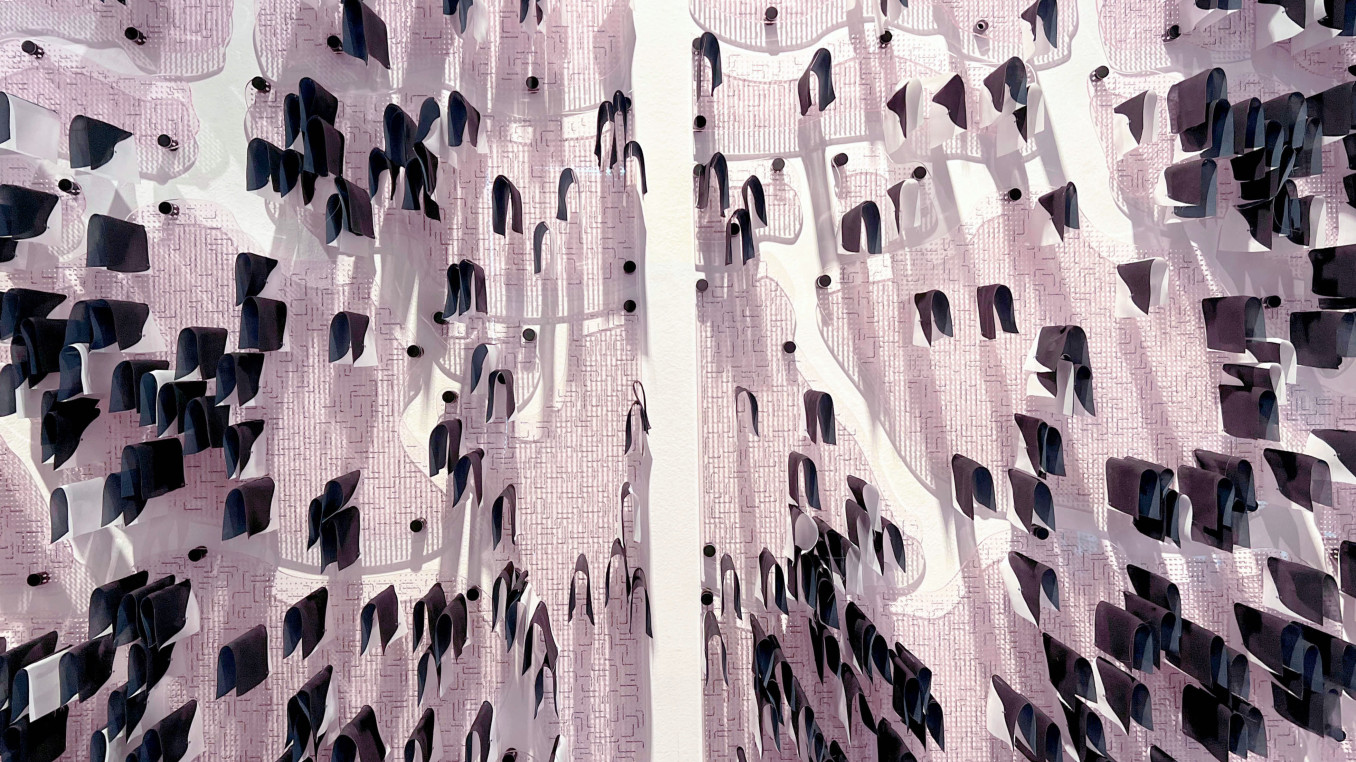
The group used sound diaries, embodied listening exercises, collective mind-mapping, and experimentation with custom technology developed by Donnarumma to gather situated knowledge about prosthesis, access, and power. The resulting film Niranthea (2023), the performance Ex Silens (2024), and the installation Lestes (2025–26) translate this research into sensory experiences that immerse audiences directly in these crucial ethical questions.
'I Am Your Body' is a project by Marco Donnarumma in collaboration with the Intelligent Instruments Lab at the Iceland Academy of Arts in Reykjavík. It has been funded by the Ministry of Culture and Science of the State of North Rhine-Westphalia as a media art fellowship and co-produced by PACT Zollverein. Successive work was supported through funding by Hyunday ZER01NE, Seoul, Korea and through a commission by LAS Foundation, Berlin.
What impact does your research or project have on society?
I Am Your Body radically re-frames how technology, bodily diversity, and sensory perception intersect. By combining critical disability studies and feminist theory with scientific research on AI hearing prostheses, the project dismantles deeply ingrained societal biases surrounding the human senses and their role in human-machine interaction.
At its core, the project directly challenges audism, the social bias that treats hearing as the norm and deafness as a medical deficit requiring correction. By positioning Deafness (with a capital D, intended as Deaf culture) as a unique mode of listening rather than a perceptual loss, I Am Your Body compels audiences to unlearn normative standards and recognise d/Deaf knowledge as a foundational form of sensory experience.
Commercial narratives of assistive technology are thus subverted. Rather than accepting standard cochlear implants or AI hearing aids designed for compliance, I Am Your Body repurposes these tools into custom sonic organs and biomachines. The artworks thus shift the cultural conversation from medical remediation to creative agency and human-machine interdependence.
The societal reach of the project is further amplified through its participatory approach. By co-researching with d/Deaf and hard-of-hearing communities, the project ensures that d/Deaf experience remains central throughout the artistic process, effectively shaping its film, performance, and installation components. But, beyond technological innovation and artistic breakthrough, I Am Your Body strives to foster empathy. In the performances and installations of the series, biosignals like muscle sounds and heartbeats are translated into tactile, corporeal vibrations, inviting both hearing and non-hearing audiences into a shared sensory experience of vulnerability. The project makes sound a multisensory, collective visceral experience and thus cultivates new forms of empathy. Against technological fetishism, the project demonstrates how human-technology encounters that celebrate corporeal diversity can be a gateway to know not only the “other”, but oneself too.
What advice would you give to artists at the start of their careers who are interested in working at the intersection of art and science?
Trust your ideas and pursue them with your full self, but remain ready to fail and to doubt yourself. Study the science and study the art in depth; one cannot do without the other. Be knowledgeable of the histories of your disciplines and build on them. Initiate collaboration with scientists and laboratories, but do not expect them to work for you; rather, strive to create a shared vocabulary. Remember that art and science share a lot, but serve very different purposes. Don’t always trust the science; what might be scientifically valid may not be artistically meaningful. Stay curious; everything around you can become the seed of inspiration. Do not follow the hype; it only leads to short-term results and distracts you from your strongest and most original intuition. Be proud of your achievements and of your failures. Do not copy and do not appropriate the work of others, especially of those who trust you; your ideas and skill are stronger than you think and stealing ideas will always eventually lead to your demise. Recognise the scope of your own contributions to a collective work and always acknowledge those of others; this is the only way to become a respected artist with impactful ideas.
What inspired you to be in the profession you are today?
The work of those artists before me who dared to refuse the norms.
What is one surprising fact about your research or project that people might not know?
Despite the high amount of technology involved in my projects, the strongest moments with my audiences are always the simplest ones: when my body and their bodies come into contact. Those fleeting moments are the most indelible memories.
What’s the most exciting moment you've experienced over the course of your research or project?
Receiving the feedback of my d/Deaf collaborators after experiencing the film Niranthea and the performance Ex Silens. Finding that all our work had coalesced into artworks that could speak for all those involved was magnificent.