Breaking the Wall of Ice Making
Breaking the Wall of Ice Making
Global Call 2026 Finalist Interview: Physical Sciences
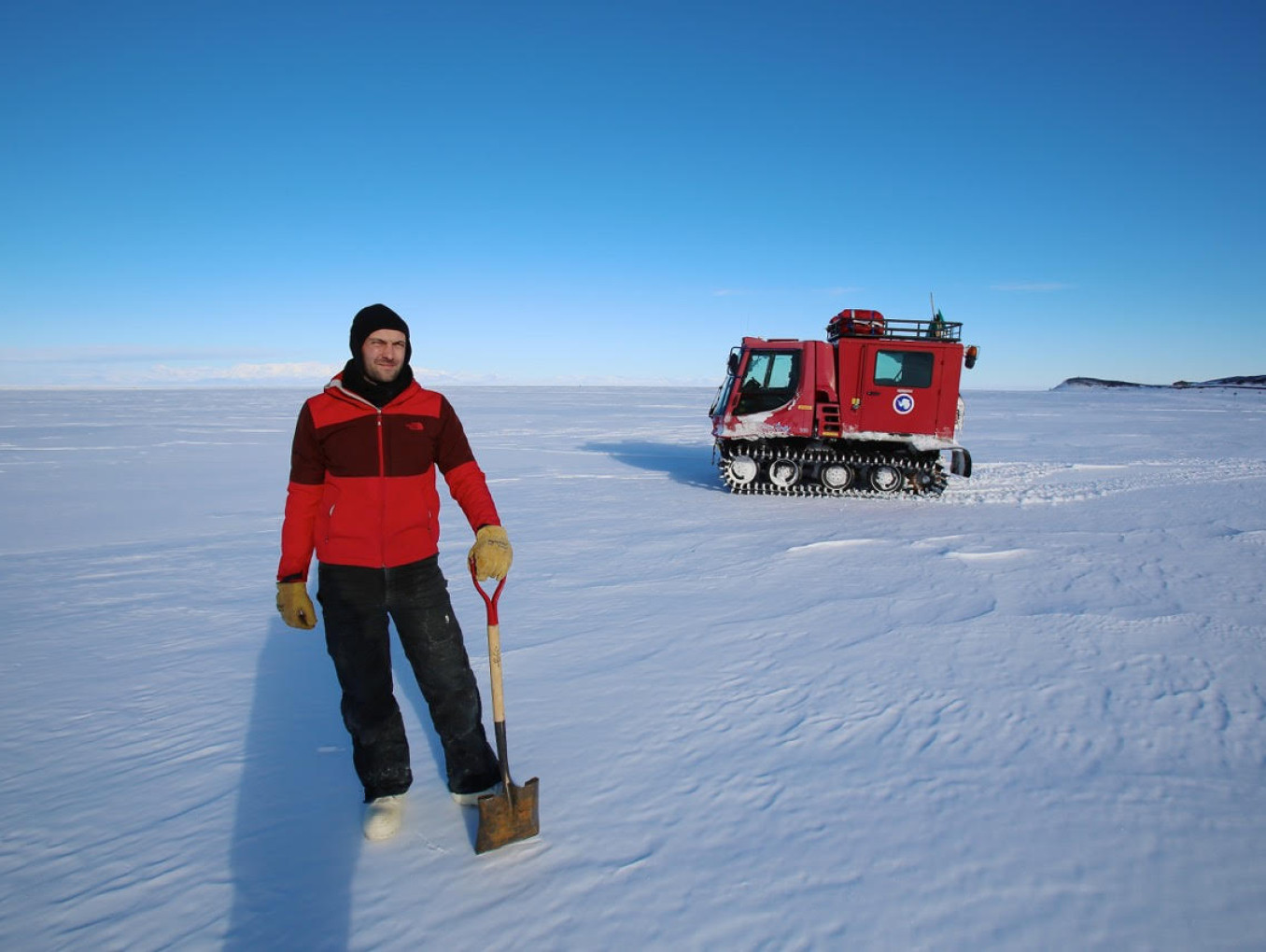
Konrad Meister is an Assistant Professor of Chemistry at Boise State University and an affiliated group leader at the Max Planck Institute for Polymer Research. His work asks how life thrives in freezing habitats: why some molecules prevent ice growth, while others initiate its formation. By uncovering nature’s strategies for dealing with extreme cold, he seeks to inspire new approaches to controlling ice across science, technology, society, and the environment.
Which wall does your research or project break?
Cooling water below 0 °C does not guarantee ice formation: without an effective nucleator, it can remain supercooled, and freezing may begin unpredictably. This lack of control affects technologies that depend on reproducible ice formation. In cryopreservation, uncontrolled nucleation can damage cells and tissues; in food processing, it can alter texture and quality; and in precipitation enhancement, it limits when and how efficiently ice can be produced.
Nature has evolved exceptionally effective ice makers: ice-nucleating proteins. However, the best-studied examples come from bacteria and are attached to cell membranes, making them difficult to isolate, formulate, and adapt for different uses. Our research now identified a new class of ice-nucleating proteins from fungi. These proteins are water-soluble, membrane-independent, highly active, and unusually stable, providing a new biological platform for controlled freezing.
By transforming a natural strategy into a controllable ice-making technology, the goal is to make freezing occur at the desired temperature, place, and time while reducing unnecessary supercooling and energy use. By learning how proteins initiate ice formation better than any other material, we aim to transform ice nucleation from an unpredictable event into a controllable process. This could enable more efficient freezing technologies and improve any process in which the timing and uniformity of freezing matter.
What is the main goal of your research or project?
We aim to understand how nature mitigates ice formation better than any other man-made material and thereby transform ice nucleation from an unpredictable event into a controllable process. This will enable more efficient technologies and climate mitigations and will improve any process in which the timing and uniformity of freezing matter.
What impact does your research or project have on society?
Water and ice are essential in shaping Earth's geology, atmosphere, and sustaining life. Ice nucleating proteins control water in all these contexts, including the surface water, the hydrological cycle, local and global climate, and vegetation. Ice nucleating proteins induce frost damage in plants, but can also promote vegetation growth by triggering rainfall. The unique capabilities of proteins to control ice formation are an integral part of our biosphere and understanding them is critical for climate models, weather prediction, and decision making in landscape design and agriculture.
What advice would you give to young scientists or students interested in pursuing a career in research, or to your younger self starting in science?
Study what genuinely interests you. Curiosity will sustain you through failed experiments and difficult periods. Do not blindly trust the literature or chase fashionable questions simply because others consider them important. Good science often begins with unusual observations!
What inspired you to be in the profession you are today?
I like asking questions and being a know-it-all!
What is one surprising fact about your research or project that people might not know?
to me that some animals can be frozen solid, thaw and be totally fine!
What’s the most exciting moment you've experienced over the course of your research or project?
The journey from seeing how organisms survive extreme polar environments to identifiyng the tiny molecules that enable it!