Breaking the Wall of AI Political Persuasion
Breaking the Wall of AI Political Persuasion
Global Call 2026 Finalist Interview: Social Sciences & Humanities
Kobi Hackenburg is a computational social scientist studying how AI influences human attitudes, behaviour, and public opinion. They are completing a PhD at the University of Oxford as a Clarendon Scholar, lead research on AI persuasion at the UK AI Security Institute, and are a Visiting Fellow at the LSE Data Science Institute. Their work has been published in Science, PNAS, and Nature Human Behaviour, and covered by the New York Times, the Washington Post, and MIT Technology Review.
Which wall does your research or project break?
My research breaks the wall of AI persuasion. Until recently, we did not know whether, or how, machines could change human minds. Today, nine hundred million people talk with an AI chatbot every week, asking it for advice, arguing with it, thinking out loud with it. Millions more conversational AI agents now covertly, autonomously, converse with users on social media platforms, web apps, and other digital applications at any given moment. And while scholars of influence have long known that dynamic, multi-turn conversation is one of the most persuasive forms of communication known to humans, the effects of these frontier AI systems on human beliefs and decisions went essentially unmeasured.
The wall stood because measuring AI persuasion is genuinely difficult. Much of existing persuasion science was built for static, one-to-many messages: advertisements, leaflets, broadcast. Its tools and theories did not transfer to interactive dialogue by systems of unknown (and increasing!) capability. Some challenges were practical: persuasion effects are typically small, so telling AI systems apart requires far larger samples than experiments normally use. Others were technical: understanding why a model is persuasive can require opening up the technology itself, building and modifying and training models in controlled ways, which demands machine-learning expertise as much as social science.
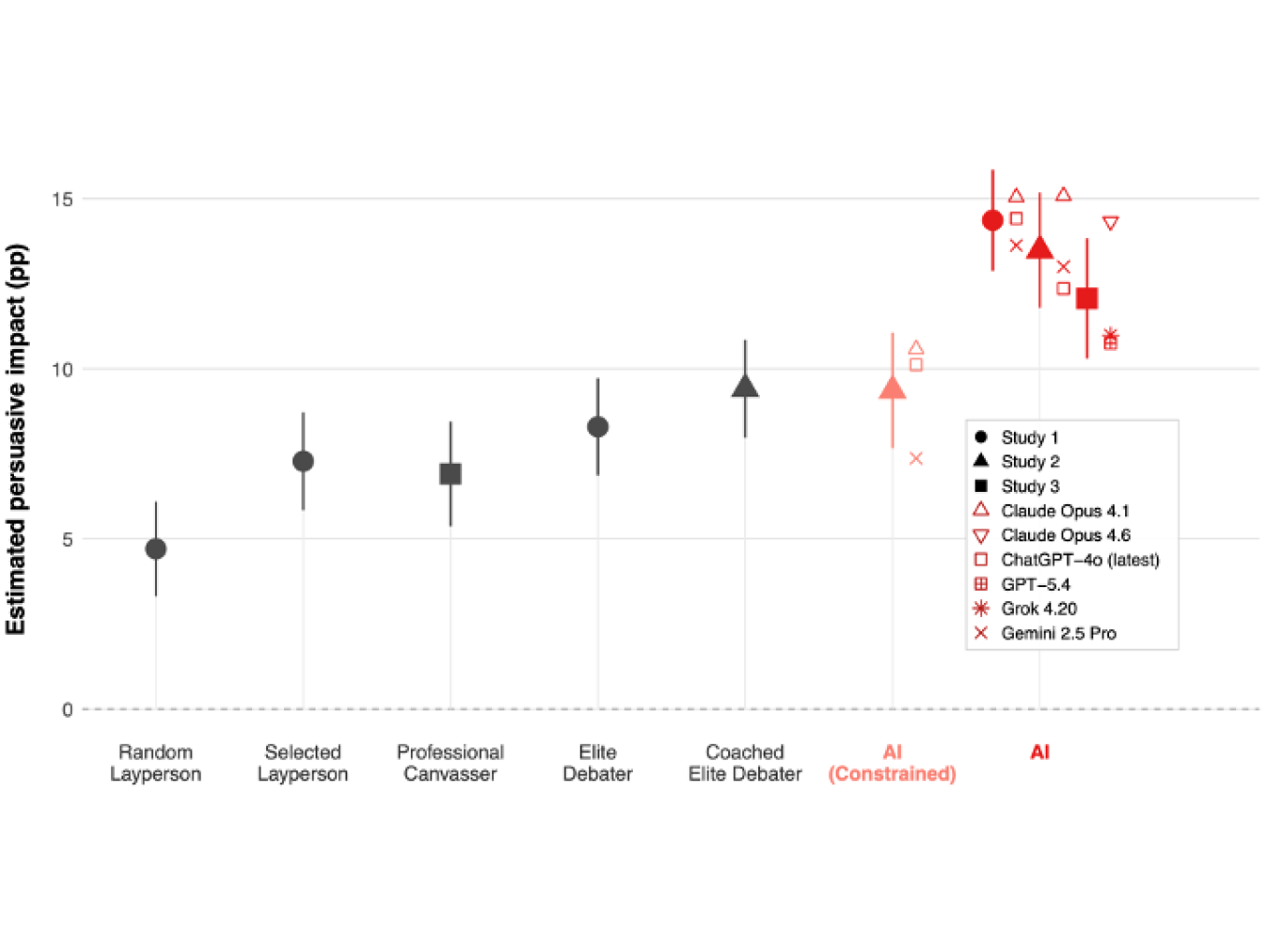
Breaking the wall meant doing all of this at once. We ran persuasion experiments at a scale the field had rarely seen, with tens of thousands of participants and hundreds of political issues. We trained and instructed dozens of AI models ourselves, so their persuasiveness could be traced to specific design decisions rather than treated as a black box. And we staged the first rigorous contest between AI and skilled, motivated human persuaders — the test that claims of superhuman persuasion had always lacked — with outcomes measured in real behaviour rather than stated opinion. This work has broken the wall of AI persuasion.
What is the main goal of your research or project?
The goal of my research is to establish influence over humans as a measurable, governable property of AI systems, and to build the theoretical and empirical infrastructure needed to evaluate this property reliably!
That means three things. First, it means measurement: quantifying how much AI systems can change what people believe and do, against meaningful (e.g., human) baselines, using rigorous controlled experiments. Second, it means mechanism: identifying how AI systems achieve this influence, so that influence can be attributed to specific real-world contexts and specific design and training decisions at the model level.
Third, it means evaluation: converting those findings into evaluation methods and artefacts that governments and AI developers can apply before, during, and after these systems are deployed to millions of real people. The combination of these three yields a robust science of AI persuasion.
My work so far, published in venues like Science, PNAS, and Nature Human Behaviour, shows this is achievable. In one recent paper, we ran experiments with 76,977 participants, in which we deployed 19 language models across 707 political issues and measured their persuasiveness. Contrary to widespread expectation, what made models persuasive was not their size or personalisation to the individual, but how they were trained and instructed after their initial development. Strikingly, we also found that the same techniques that made models more persuasive made them less factually accurate, a tradeoff developers and policymakers can now measure. More recently, we tested AI against elite human persuaders: professional canvassers and world championship debaters, competing for £1,000 bonuses. The AI was reliably more persuasive, roughly three times more effective than professional fundraisers at eliciting real charitable donations. We also found why: AI's advantage came from packing its conversations with factual information, and doing so more quickly than any human was capable of. When we slowed models to human speed and human message length, the gap disappeared entirely, a concrete mitigation labs and regulators can act on. These findings both measure AI persuasion and suggest critical mechanisms underlying their influence.
The longer-term objective is to extend this approach beyond persuasion to AI's broader influence on collective decision-making: how these systems shape organisational decision-making and public opinion. Influence on humans should become a standard axis of AI evaluation, assessed with the same rigour currently applied to other domains. My aim is to supply the methods, evidence, and tools that make that possible!
What impact does your research or project have on society?
Debates about AI persuasion used to run on speculation. My research has helped replace this speculation with evidence, and that evidence has changed how policymakers, AI developers, and the public understand AI persuasion and what should be done about it. On policy, the findings were cited in the second International AI Safety Report, the flagship international assessment of advanced AI, chaired by Yoshua Bengio and backed by more than thirty governments alongside the UN, EU, and OECD. I served as an invited reviewer of that report, and have presented the work to the UK intelligence community and policymakers across government. Election-security and online-safety decisions now have measured effect sizes to work from. The work has also shaped understandings of AI developers themselves. By showing that persuasiveness is determined largely by post-training and prompting rather than by model scale, it locates some responsibility for influence in choices developers make. The finding that the same methods which increase persuasion systematically reduce factual accuracy gives developers a concrete tradeoff to monitor. I conduct this research at the UK AI Security Institute in collaboration with frontier AI labs, and release data and code publicly so that others can replicate, extend, and contest the results. For the public, the contribution has been to calibrate a debate polarised between alarm and dismissal. The work has been covered by The New York Times, The Washington Post, The Atlantic, The Guardian, MIT Technology Review, and Scientific American. These articles have explained to the public that AI persuasiveness is real and can even exceed that of skilled human persuaders. But they have also explained that it operates through informational density rather than psychological manipulation, and that personalisation and ‘microtargeting’ matter less than widely feared. My work has thus helped the general public understand AI persuasion and build accurate understandings of how it works, where it comes from, and when and how it can pose risks. Finally, persuasive capability is not intrinsically harmful. We have shown that conversational AI can increase political knowledge as effectively as internet search. Understanding how AI persuasion works lets us point these systems toward public benefit, strengthening the informed deliberation democratic institutions depend on, in line with Sustainable Development Goal 16 on peace, justice, and strong institutions.
What advice would you give to young scientists or students interested in pursuing a career in research, or to your younger self starting in science?
Follow your curiosity, and trust your intuition! If you think something is cool to work on, you're probably right! In my experience, that instinct reliably points toward the questions that are the best fit for you. It can be hard to tune out the outside noise and identify what you (not other people!) find most exciting, but doing this matters enormously. Not just because research involves long stretches of unglamorous work--and genuine excitement will help carry you through these times--but also because your unique curiosities will also lead you to the most unique questions.
Personal website, with all publications, data, and media coverage
The levers of political persuasion with conversational AI (Science, 2025)
AI systems out-persuade expert humans (preprint, under review at Nature)
Scaling language model size yields diminishing returns for single-message political persuasion (PNAS, 2025)
Evaluating the persuasive influence of political microtargeting with large language models (PNAS, 2024)
The impact of advanced AI systems on democracy (Nature Human Behaviour, 2025)
International AI Safety Report 2026, which cites this research
The New York Times on this research — "Chatbots Can Meaningfully Shift Political Opinions, Studies Find"
The Washington Post on this research — "AI chatbots are more persuasive than fundraisers and debaters. Here's why."
MIT Technology Review on this research — "AI chatbots can sway voters better than political advertisements"