Breaking the Wall of Computation with Fluidics
Breaking the Wall of Computation with Fluidics
Global Call 2026 Finalist Interview: Art & Science
Ioana Vreme Moser is a Romanian sound artist working with hardware electronics, speculative research, and tactile experimentation. Her practice uses intentionally rough electronic & fluidic processes to reveal the materiality of sound through interactions between circuits, her body, organic matter, found objects, and environmental stimuli, exploring the histories of electronic technologies, production chains, wastelands, and their ties to the natural world.
Which wall does your research or project break?
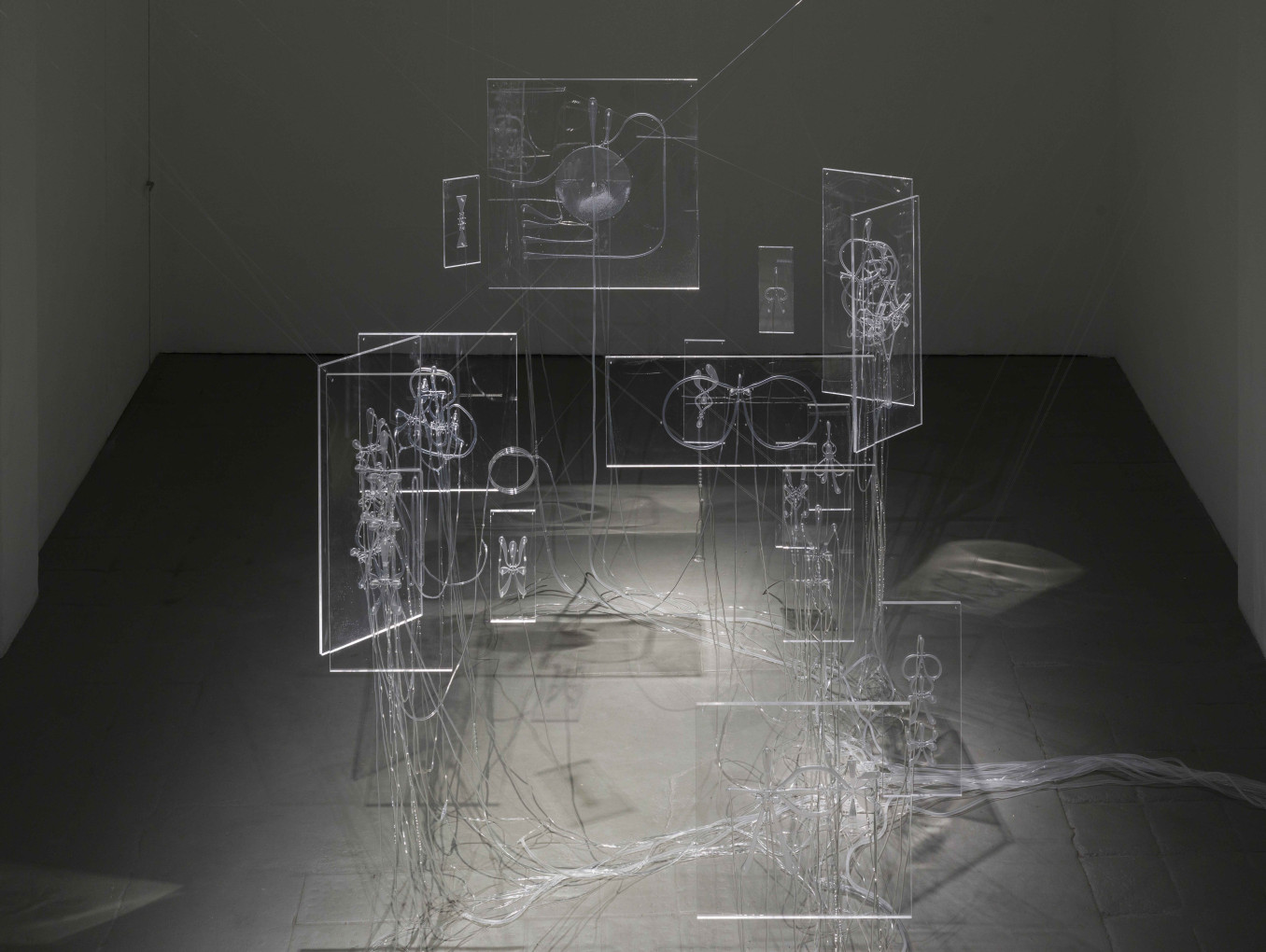
Computing hardware today is mostly sealed in silicon chips, opaque and cryptic, operating at ever-increasing speeds while concealing the material infrastructures that sustain it. Fluid Anatomy revives fluidics, a largely forgotten technology that uses water and air instead of heavy metals to process information. It reimagines an alternative path for the future of computation, one in which computers function in tune with natural rhythms rather than overriding them. Every calculation remains visible as water branches, oscillates, collides, counts, remembers and ultimately feeds back so that everything gets recirculated.
The piece dismantles the assumption that computation must be digital, fast, opaque or electronic. Instead, it showcases seductive, curvaceous cavities through which computation becomes embodied as water jet movements governed by the Coanda effect, making the mechanisms of information perceptible through form, sound, rhythm and flow. The work breaks the wall that separates computation from the natural physical world. The rectangularity of the circuitboards is now drawn into organically looking morphologies through which the fluids find their own path.
Ultimately, the piece questions the obsession with speed, efficiency and miniaturisation that defines contemporary electronics. Fluidic circuits are limited in function by the materiality and physicality of fluids. The project embraces this slowness to speculate on how technologies would develop if they were in tune with the resilient rhythms of water flows. The installation invites audiences to experience computation as a living process rather than an invisible operation, revealing that intelligence can emerge through circulation, physical forces, and environmental interaction. In doing so, it breaks the perceptible wall between machine and organism, proposing a computational paradigm that is transparent and deeply entangled with the natural world.
What is the main goal of your research or project?
Fluid Anatomy does not propose to obliterate electronics in favour of fluidics, but to use fluidic computation as a metaphorical framework for exploring how intelligence, information, and agency can emerge through material processes. The fluidic computer I built is not a machine dominated by function; instead, it shows hydraulic and pneumatic phenomena in its own entropy.
In a world where computational acceleration continues to intensify, leaving growing impacts on both the planet and our collective psyche, Fluid Anatomy reflects on the possibility that the current technological trajectory is not inevitable, but one path among many that history has taken. If we reconsider our relationship with technology through our bodies, environments, and actual needs, other futures can still be imagined.
Throughout history, alternative approaches to computation have filled with valuable insights, methods and ways of thinking that could offer a glimpse into new approaches. Fluidics is such a field which inspired me greatly, not just because of its obvious beauty in form but also because of the way it failed (due to its slowness). By 'de-archiving' these circuits (re-animating them back to function), I reposition them not as obsolete remnants but as speculative instruments of reimagination.
A computer in the form of a cavity that can be filled with anything that flows, always limited by its own material; timelessly resilient and yet so slow that it cannot be capitalised upon. Discovering the possibility of presenting such an idea was something that brought me to dedicate 6 years to research. The installation, as well as the series of works preceding it, present machines with their insides out, computing themselves in feedback, vulnerable and visceral like organoids pulsing and breathing in pursuit of a humanesque form.
What advice would you give to artists at the start of their careers who are interested in working at the intersection of art and science?
Do not feel unworthy of searching these connections because of a lack of previous studies or the place where you come from. As a previous ballerina growing up in Romania, I have managed to teach myself electronics from books and sites and in a slow pursuit. Through multiple tryouts, I arrived at the questions and methodologies through which I could implement my ideas. My grandmother, who was an artist, always used to say: never have a day without drawing a line. And now I do agree with her. Persistence and dedication are key, and in my definition, the real talent.
The hard truth is: 80% of the time, you will be doing logistics. These sorts of artworks are complicated to install, create, and fund. Be prepared to have steel determination and still find love for your work after days of emails and back and forths. There is no real way of going around this; it's part of the process.
Share what you know always. There are no secrets, and an artist should also be an educator (from my perspective). Find connections, make friends, teach as soon as you have something important to give; your work cannot become relevant alone. Teaching and sharing will keep you in touch with your audience and will help you understand what aspects of your pieces work and which don't resonate with others. Almost all of my projects have been developed alongside workshops in which I disclose technological and conceptual aspects of the pieces before I even make them. This has helped me enormously.
And lastly:
Always ask a child what they think of your work at some point; the answers are always very surprising and insightful.
What inspired you to be in the profession you are today?
The attic of the house I grew up in Timisoara. Built by my Hungarian great-grandfather, it contained many old objects under dust, which I would spend hours and hours digging from the piles and trying to understand their history. I started to get obsessed with the idea that objects contain memory through their materialities, and later, when I discovered circuitry, I went down the rabbit hole of the history of technology.
What is one surprising fact about your research or project that people might not know?
Fluidics were imagined to be used in space exploration. Because they are only cavities and run with air, they are resilient to radiation. NASA worked on several fluidic computers to be integrated into rockets.
What’s the most exciting moment you've experienced over the course of your research or project?
After lots of planning and production, I finally had my first fluidic prototype form ready to test. It felt like bringing a ghost from the past back to life. Then I plugged my compressor into the oscillator, and it started to whistle.