Breaking the Wall of Lost Touch and Movement
Breaking the Wall of Lost Touch and Movement
Global Call 2026 Finalist Interview: Life Sciences
Giacomo Valle is Assistant Professor of Bionics at Chalmers University of Technology. His research focuses on implantable neurotechnology, brain-computer interfaces, and sensorimotor neuroprosthetics. He develops computational and experimental methods to restore movement and sensation after neurological injury through interdisciplinary collaborations spanning engineering, neuroscience, and clinical research.
Which wall does your research or project break?
Every year, millions of people lose the ability to move or feel because of spinal cord injury, stroke, limb amputation, or neurological disease. While recent advances in brain-computer interfaces (BCIs) have demonstrated that neural signals can restore voluntary movement, most current systems address only one side of the problem: motor control. The equally critical loss of touch and body awareness remains largely unresolved, limiting dexterity, confidence, and long-term usability.
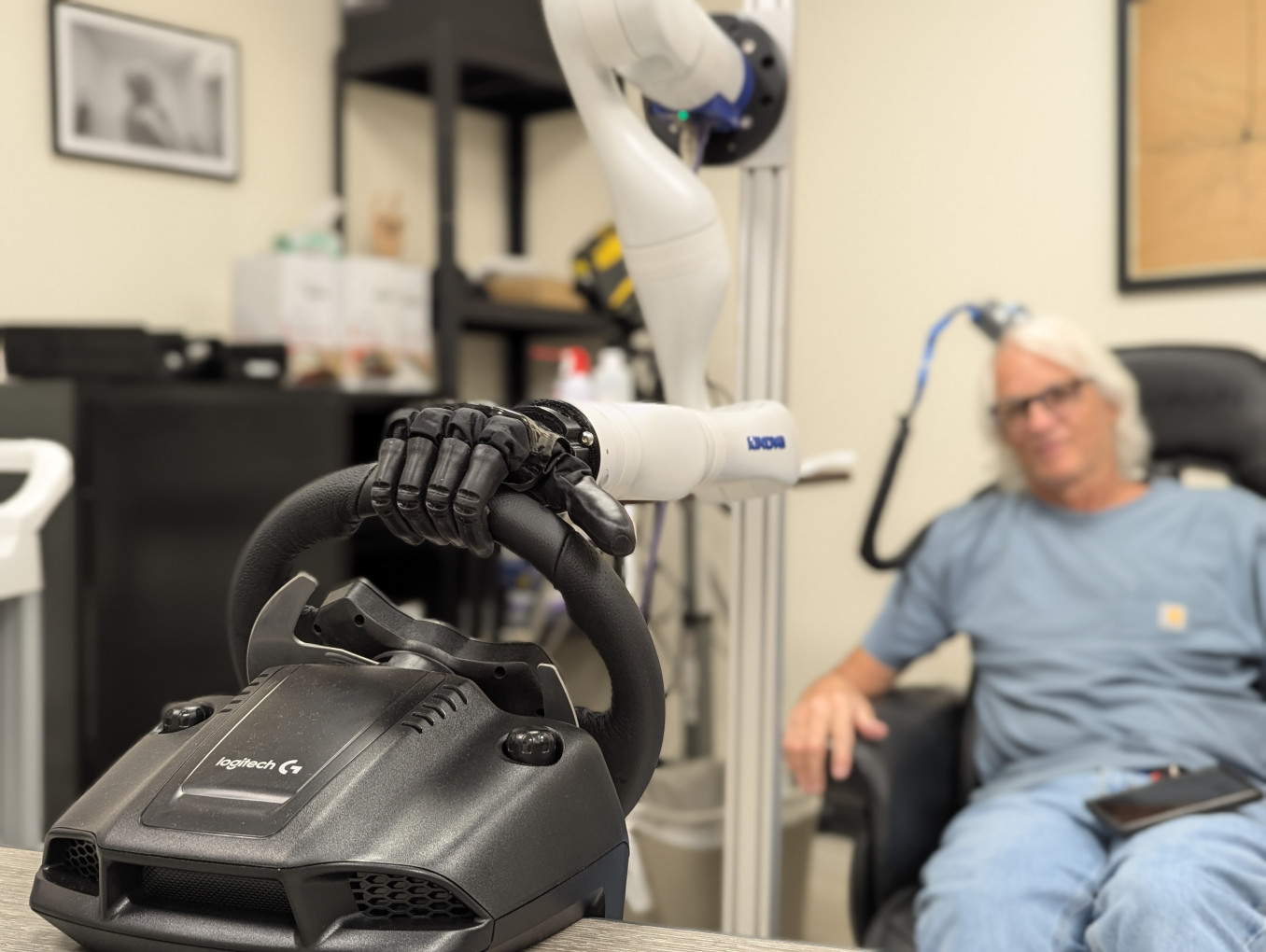
My research aims to break this wall by developing sensorimotor BCIs that restore both movement and sensation through implantable neurotechnology. By creating a bidirectional communication pathway between the brain and external devices, these systems enable users not only to control robotic limbs or assistive technologies through their neural activity, but also to receive meaningful sensory feedback. Restoring touch closes the sensorimotor loop that humans naturally rely on to interact with the world.
Achieving this vision requires overcoming challenges that span neuroscience, biomedical engineering, artificial intelligence, computational modeling, and clinical translation. My group develops computational models of neural stimulation, advanced decoding algorithms, and implantable interfaces that are designed to work safely and effectively in real-world settings. These technologies are developed in close collaboration with clinicians, neuroscientists, and industry partners to accelerate their translation from the laboratory to patients.
Beyond improving individual devices, this work contributes to a broader transformation in neurotechnology: shifting BCIs from systems that simply decode intentions to intelligent interfaces that recreate natural interaction with the environment. Breaking the wall of lost touch and movement means enabling people with paralysis or limb loss to regain not only function, but also independence, confidence, and quality of life.
What is the main goal of your research or project?
The goal of my research is to restore a natural sense of touch to people living with paralysis or limb loss through next-generation sensorimotor BCIs. While current BCIs have demonstrated remarkable success in restoring voluntary movement, artificial touch remains limited, reducing dexterity, object manipulation, and the feeling that a prosthetic limb is truly part of the body.
My research addresses this challenge by developing implantable neurotechnology that recreates the neural language of touch. Building on our understanding of how tactile information is represented in the primary somatosensory cortex, we develop intracortical microstimulation strategies that deliver meaningful sensory information directly to the brain. Our recent work demonstrated that spatially and temporally patterned stimulation can evoke the sensation of object edges, arbitrary tactile shapes, skin indentation, and apparent motion across the skin. These biomimetic sensations substantially enrich the tactile experience of users and improve the control and functionality of brain-controlled bionic hands.
The next step is to transform these advances into clinically viable sensorimotor BCIs that seamlessly integrate movement and sensation. To achieve this, my group combines neuroscience, computational modeling, artificial intelligence, and neuroengineering to design patient-specific stimulation strategies and intelligent decoding algorithms that optimize communication between the brain and implanted devices.
Ultimately, the objective is not simply to enable users to move a prosthetic hand, but to restore natural interaction with the environment. By recreating the closed sensorimotor loop that underlies everyday human behavior, this research aims to make neuroprosthetic devices feel more intuitive, improve functional independence, and establish a new generation of implantable technologies capable of restoring both movement and touch.
What impact does your research or project have on society?
The ability to move and feel is something most people take for granted until it is lost. For millions of people living with paralysis, limb loss, stroke, or other neurological disorders, the loss of touch and movement affects every aspect of daily life, from independence and employment to social relationships and mental well-being. My research aims to help change that. By developing next-generation brain-computer interfaces that restore both movement and sensation, we are working toward technologies that do more than replace lost function—they rebuild the natural communication between the brain, the body, and the environment. Restoring the sense of touch has the potential to make prosthetic limbs and assistive devices more intuitive, more effective, and ultimately more life-changing for the people who rely on them. The impact extends well beyond neuroprosthetics. Understanding how the brain creates the perception of touch provides fundamental insights into one of the most complex questions in neuroscience: how neural activity gives rise to perception and behavior. These discoveries can shape future treatments for neurological disorders and deepen our understanding of the human brain. Our work also drives innovation in engineering and medicine. It combines artificial intelligence, computational modeling, advanced electronics, and implantable medical devices to create technologies that can be translated into future clinical therapies. The methods developed through this research can influence a wide range of fields, from personalized medicine and surgical planning to robotics and human-machine interaction. Ultimately, this research is about redefining what is possible. By bringing together neuroscience, medicine, and engineering, we are helping build a future in which neurological injuries are no longer viewed as permanent limitations, but as conditions that can be treated through intelligent technologies that restore natural function. The knowledge generated will not only improve the lives of patients today but also lay the scientific foundation for the next generation of restorative neurotechnologies.
What advice would you give to young scientists or students interested in pursuing a career in research, or to your younger self starting in science?
My advice to young scientists is to remain curious, take risks, and focus on important questions rather than only on immediate results. Science is a long journey, and many of the most meaningful discoveries come from exploring uncertain paths, challenging existing assumptions, and combining ideas from different fields.
I would encourage students to build a strong foundation in their own discipline while also learning from other areas. The most impactful advances often happen at the intersection of fields—for example, where neuroscience, engineering, medicine, and artificial intelligence come together. Being open to collaboration and learning from people with different perspectives is one of the greatest strengths a researcher can develop.
To my younger self, I would say: do not be afraid of difficult problems. The most ambitious questions are often the ones worth pursuing, even when the path is unclear. Research is not a straight line; failures, unexpected results, and changes in direction are an essential part of discovery. Persistence, creativity, and the ability to adapt are just as important as technical skills.
The most rewarding aspect of research is knowing that your work can contribute to improving lives and expanding our understanding of the world. Stay passionate, surround yourself with inspiring people, and remember that science is a collective effort built across generations. Every researcher contributes a small piece to a much larger picture.