Breaking the Wall of Hidden Whale Vowels
Breaking the Wall of Hidden Whale Vowels
Global Call 2026 Finalist Interview: Social Sciences & Humanities
Gašper Beguš studies how language emerges across human, animal, and artificial intelligence. An Associate Professor of Linguistics at UC Berkeley and Linguistics Lead on Project CETI, he combines philology, interpretable AI, neuroscience, and marine biology to uncover hidden structures in communication. He discovered a previously unknown dimension of sperm-whale communication—vowel-like sound patterns—and is now investigating comparable structure in orcas.
Which wall does your research or project break?
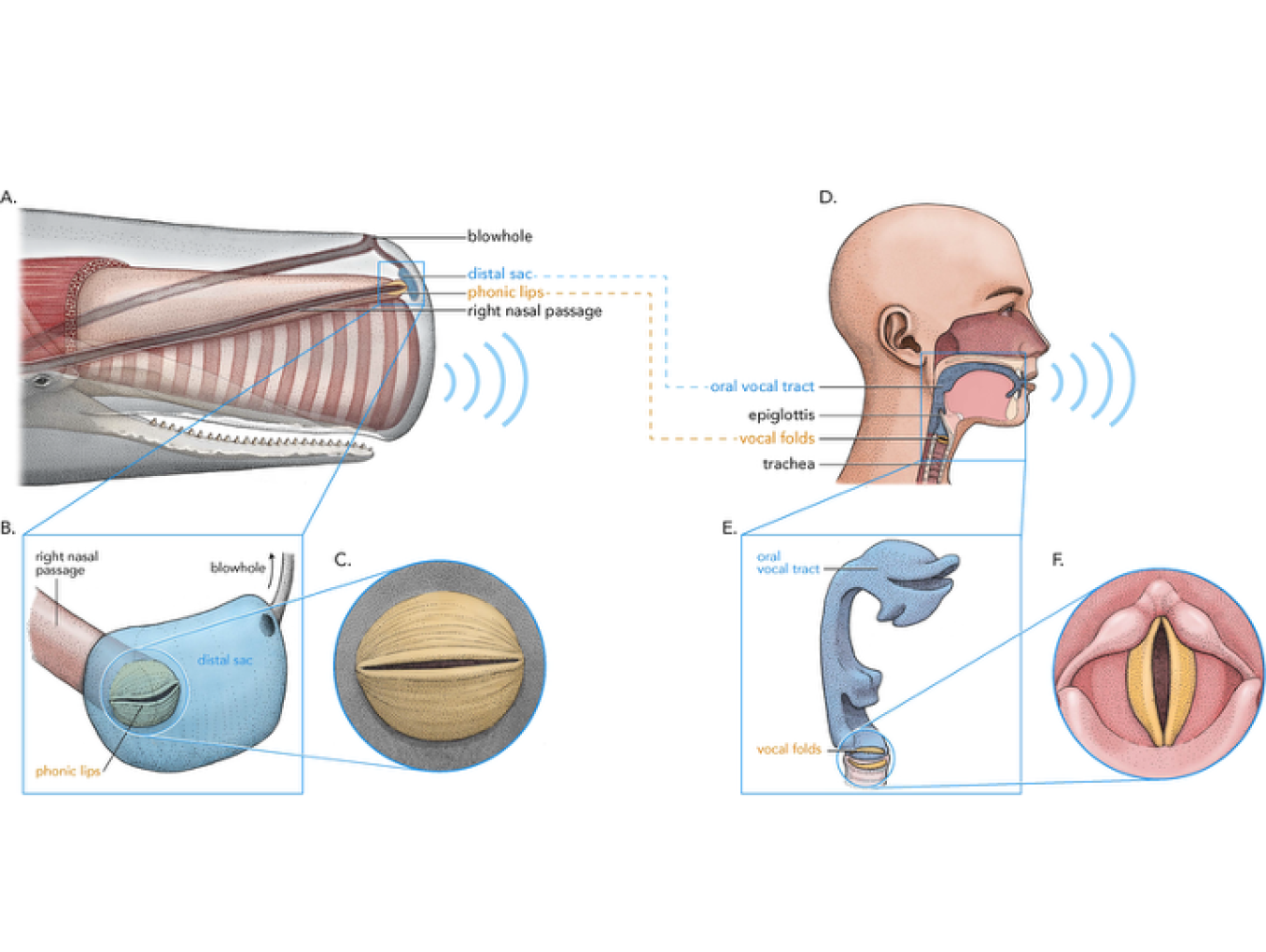
Language is a special and very complex phenomenon, which was long considered a uniquely human trait. In my research, I’m breaking the wall between human and whale language by uncovering so far unobserved properties in whale communication. Sperm whales communicate by exchanging click-like sounds. These clicks were considered an alien, Morse code-like communication that bears little resemblance to human speech.
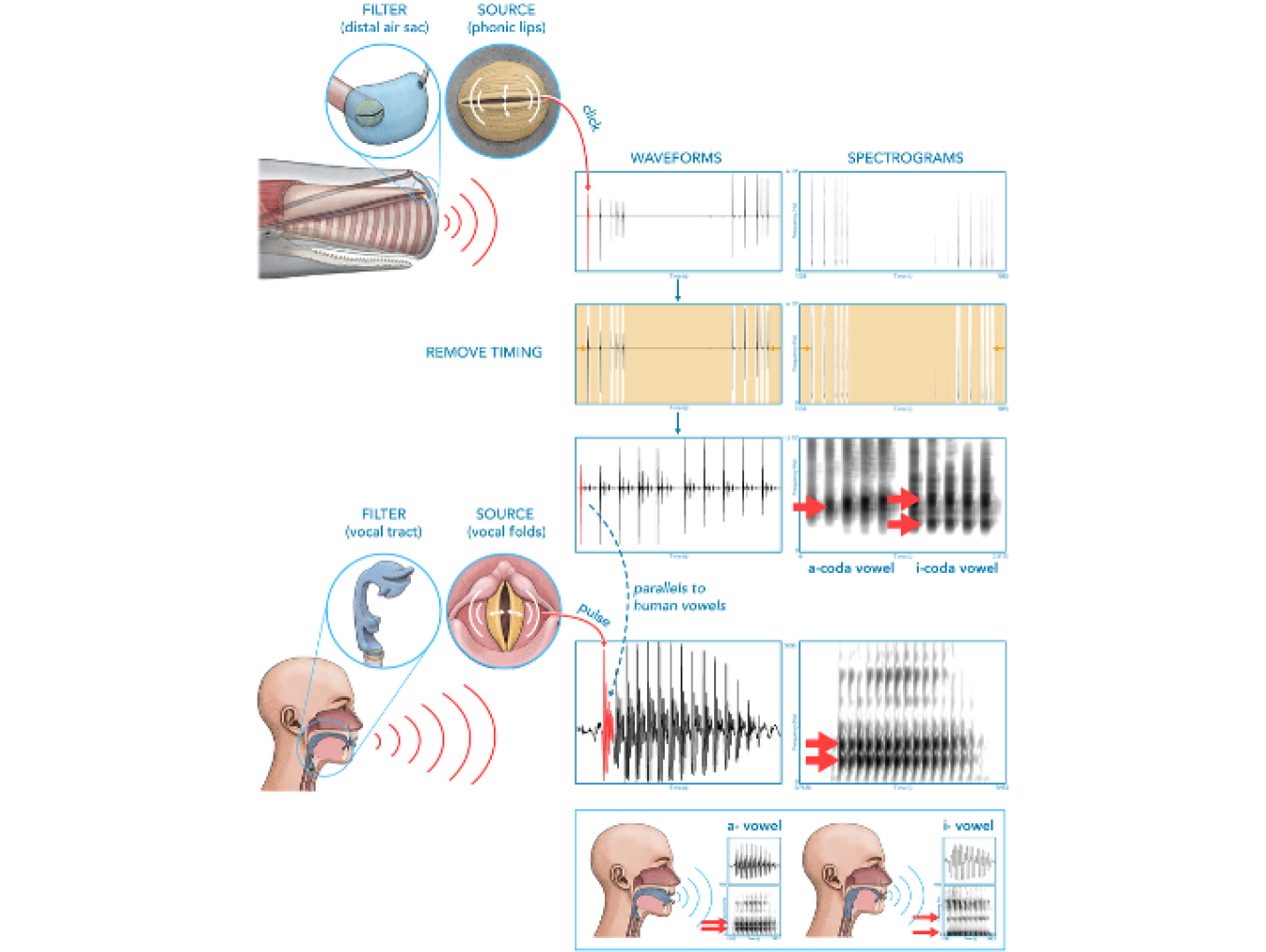
The crucial part in the discovery of whale vowels was the realization that the perception of time might be different in whales and humans. When silences are removed between clicks which effectively speeds up the slow clicks, patterns that are highly parallel to human vowels become obvious to our human eyes and ears. We uncovered a whole new dimension in their communication system that is highly structured, controlled, discrete and independent of movement or depth. The patterns are so clear that you can start transcribing them with human letters. The most important thing in this discovery was thus to move outside our human biases, outside our human-centered perception of timing and accept that timing works differently across species.
We show that these vowels don’t just look like human vowels, but also behave like ones. We identified at least two vowels so far, the a-vowel and the i-vowel, and several diphthongal patterns. We applied traditional linguistics tools to their vocalizations and found several phonological parallels between humans and whales. We found long and short whale vowels, similar to how Latin has long and short vowels. We show that some tonal patterns prefer some whale vowels, similar to how some tones only surface on some vowels in Slovenian. The vowels were also found during a birth event, where ten females came together and coordinated a unique collaborative birth of a baby sperm whale. The same approach is now proving effective in preliminary analyses of orca vocalizations where we found so far overlooked vowel and consonant-like patterns.
Finally, we show that these vowels might carry something meaningful as whales change the types of vowels in the presence of shipping noise.
This research not only uncovers a new dimension in whale communication, but also shows that whales have a vastly more complex system than previously believed and that their communication system is much closer to human speech. Finding the moving pieces in whale communication brings us a step closer to understanding their rich internal lives, their societies, and their place in the world.
What is the main goal of your research or project?
My goal is to replace the binary question “Do animals have language?” with a comparative science that tests which building blocks of language emerge across human, animal, and artificial systems. Whale vowels provide a first powerful case study.
In my lab, we are building AI models of human language that learn more like human babies. Instead of text, they are trained on sound and have to learn by imitation and imagination. We show that several properties of human language emerge in our models that learn from speaking and listening to raw sounds only and that imitation by imagination is a powerful learning strategy that can help us expand our notion of language to other species. The models we are developing in the lab were also instrumental in the whale vowel discovery, as a model trained on whales instead of human language pointed us to the spectral investigations initially.
What language is, how it evolved, how it emerges in the brain, how it makes us special and whether other species have similar communications to our language are questions that have intrigued humans for centuries. Whales show us how speech-like units can emerge in an underwater world and how the speech apparatus can evolve in an independent way but with the same function as our mouth and tongue. Centuries of traditional study of human language provide us with tools to discover new properties in non-human communication systems.
It is an exciting time to be a scientist, because I can use traditional linguistics on non-human animals to understand them better, I can use evidence from animals to understand human language and its evolution better, and I can use AI to help me better simulate both human and non-human communication. I am building a framework that will equally weigh evidence from non-human animal communication, artificial intelligence, and traditional linguistics, the three pillars of linguistics for the decades to come.
The ultimate goal is to rethink what language is and how this pivotal moment can redefine how we think of humans, other intelligences, and our position in the world. This reframing allows us to see language as a window into the minds and lives of another wonderful intelligence—whales
What impact does your research or project have on society?
Since Aristotle, humans were considered to be animals with language and there was a clear barrier that set humanity apart from the rest of the natural world. Uncovering new parallels between human language and animal communication bears consequences beyond linguistics: for philosophy, legal studies, evolutionary theory. With our new framework, we can show that human language is still special and unique, but that other species have their own communication systems that are highly complex and approach our language both in structure and complexity. In a co-authored legal paper, we examine the animal-rights implications of these findings and show that one of the rare barriers for non-human animals to be legally distinguished from humans is far less clear-cut than previously believed. Two sets of evidence are uprooting old barriers suggesting that only humans have language. First, research from my lab and others shows that properties of human language long held to be uniquely human are emerging in artificial models. Second, we are showing that an unprecedented level of structural complexity exists in whale vocalizations. Sperm whales evolved their vocalization independently of how most other animals including humans vocalize. Our speech comes from our vocal cords and mouths. One reason why human speech is so complex is because we both manipulate the frequency of vocal cord vibrations (called the tone) and at the same time change the shapes of our vocal tract (called the resonant frequencies). Sperm whales don’t vocalize through their vocal cords or mouth: they independently evolved their sound apparatus inside their noses. Before our research, we didn’t know that whale sound apparatus can produce sounds as complex as human vowels, especially underwater. The immediate societal implication of whale vowels is conservation. These newly identified spectral categories provide additional acoustic features for monitoring whale communication—we showed that it changes under shipping noise which suggests noise is disturbing them in this additional dimension. More broadly, this research shows whale vocalizations are vastly more complex than previously believed. The complexity of the communication system is suggestive of their complex inner thoughts and lives. The knowledge about vowels can help us protect their lives and habitats better and can reorient how we think of their rights and place in the natural world.
What advice would you give to young scientists or students interested in pursuing a career in research, or to your younger self starting in science?
Study something unusual first. Original pathways, unique perspective, and unusual backgrounds will give young scientists the edge and help them be bold and original.
In my undergraduate years, I studied ancient languages, such as Hittite, Sanskrit, Old Irish, and Old Persian. Ancient languages have seemingly nothing in common with artificial intelligence or whale language. But the study of ancient languages gave me unexpectedly useful skills for all my future work.
This unique background gave me two important guidelines that I use at every step of my research. First is love of data and attention to detail. Studying ancient languages teaches you to spend countless hours with data. Everyone who studied Latin or a similar language knows that it sometimes takes hours to translate even a sentence. The finding of whale vowels was preceded by countless hours of careful listening to their sounds. In ancient languages one also learns attention to detail: the exceptional English plural oxen from ox tells us more about the history of English than the regular plural such as books. In the age of big data and global trends, having a perspective that is fine-tuned on detail gave me an edge.
Studying ancient languages also taught me to be curious to understand distant minds. Reading an old text sometimes feels like time travel. It requires humility to understand what was going on in the mind of a person who wrote Hittite laws 3500 years ago. You realize that in some ways, these people that you spend hours decoding were very similar to us. You identify things that unite us. But on the other hand, their lives were so different too. Their laws were different, their beliefs, fears, and hopes were different from ours.
Studying whales is in a sense a travel through worlds and intelligences, a journey into an underwater umwelt. It requires humility to understand these remarkable intelligences, whose lives are in many ways different from ours. Whales never walk on paths, they are not stuck to the ground, they don’t see a tree. On the other hand they are also so similar to us. They come together to have conversations, grandmothers are very important in their societies, they babysit each other's calves. There’s a lot to relate to if one listens to them deeply and carefully.
Whale vowel paper
Whale phonology paper
Image explaining whale vowels
Video #1: Hear the whale vowels
Video #2: An explanation of parallels between whale and human vowels with sound examples
CBS KPIX on whale vowels
Berkeley News video on the discovery
WIRED coverage of LLM's abilities to do metalinguistics and recursion
The Guardian’s coverage of the whale vowel phonology paper
National Geographic coverage on whale vowels changing in noise
Quanta coverage of Beguš’s AI models
The Economist coverage of whale vowel discovery