Breaking the Wall of Vision Loss by a Retina Implant
Breaking the Wall of Vision Loss by a Retina Implant
Global Call 2026 Finalist Interview: Life Sciences
Frank G. Holz is Professor and Chairman of the Dept. of Ophthalmology, University of Bonn, Germany. His main interests include biomarkers and therapies for retinal diseases. He was a scholar of the German National Academic Foundation (Studienstiftung des Deutschen Volkes), trained at the University of Heidelberg, the University of Chicago School of Medicine, and passed a research fellowhip at Moorfields Eye Hospital, London. He is a member of the German National Academy of Sciences Leopoldina.
Which wall does your research or project break?
Geographic Atrophy is a late stage manifestation of Age-Related Macular Degeneration (AMD) in which cells in the macula, the central part of the retina responsible for sharp, detailed vision, gradually degenerate and die. This leads to well-defined patches (“atrophy”) where retinal tissue is lost, causing progressive loss of central vision. AMD is now the most common cause for legal blindness with increasing incidence and prevalence. The disease has a major impact on the quality of life for patients. They are no longer able to read, recognize faces or drive a car amongst other daily activities.
So far, the only therapy has been the monthly or bimonthly injection of complement inhibitors in the eye achieving only a slowing of the progression of disease.
Our project breaks the wall of AMD-related blindness: for the first time we achieved restauration of central vision with marked improvement of visual function in the affected patients.
The PRIMA system is a novel photovoltaic retinal neurostimulation microchip paired with specialized glasses. The chip which measures 2 x 2 mm, 30 µm thickness. The chip is surgically inserted beneath the central retina to replace the light-sensitive cells that have been lost. The glasses project near-infrared light to the implant which converts it into electrical stimulation signals. A zoom-in feature provides patients with the ability to magnify letters.
In a prospective multi-center clinical trial published by the New England Journal of Medicine we demonstrated efficacy and safety of the PRIMA implant system. There was a significanat mean improvement of 25.5 letters (more than 5 lines) on ETDRS letter chart.
What is the main goal of your research or project?
The main goal of our research project is to restore functional vision in patients affected from late-stage atrophic age-related macular degeneration (AMD). This pioneering work in a prospective clinical study demonstrated for the first time that degenerated/lost light sensitive photoreceptor cells can be replaced by a small neurostimulation chip which is implanted beneath the neurosensory retina in patients with geographic atrophy. On average patients gained signifcant visual improvements.
What impact does your research or project have on society?
The PRIMA retinal implant system introduces a shift from managing blindness to restoring vision. It offers patients with advanced atrophic age-related macular degeneration renewed independence in tasks like reading and navigation. It helps avoiding falls, social isolation and depression. AMD has become the most common cause for legal blindness in the elderly with increasing incidence and prevalence along with demographic developments. Future application may also include other blinding retinal diseases such as retinitis pigmentosa or Stargardt disease.
What advice would you give to young scientists or students interested in pursuing a career in research, or to your younger self starting in science?
I would advice young scientists or students interested in pursuing a career in research to identify unmet needs in an area they are particularly interested anf enthusiastic. They should watch out for internationally reknown research goups with an excellent scientific track record. They should go abroad for research fellowship/PhD programs and built a network with other scientists early on. Interdsciplinary work appears particalarly promising in tackling challenges. They should eventually aim at translation of their work into real world applications to provide better solutions for unsolved problems, e.g. novel efficacious and safe therapies for diseases.
The Photovoltaic Retina Implant Microarray (PRIMA) System
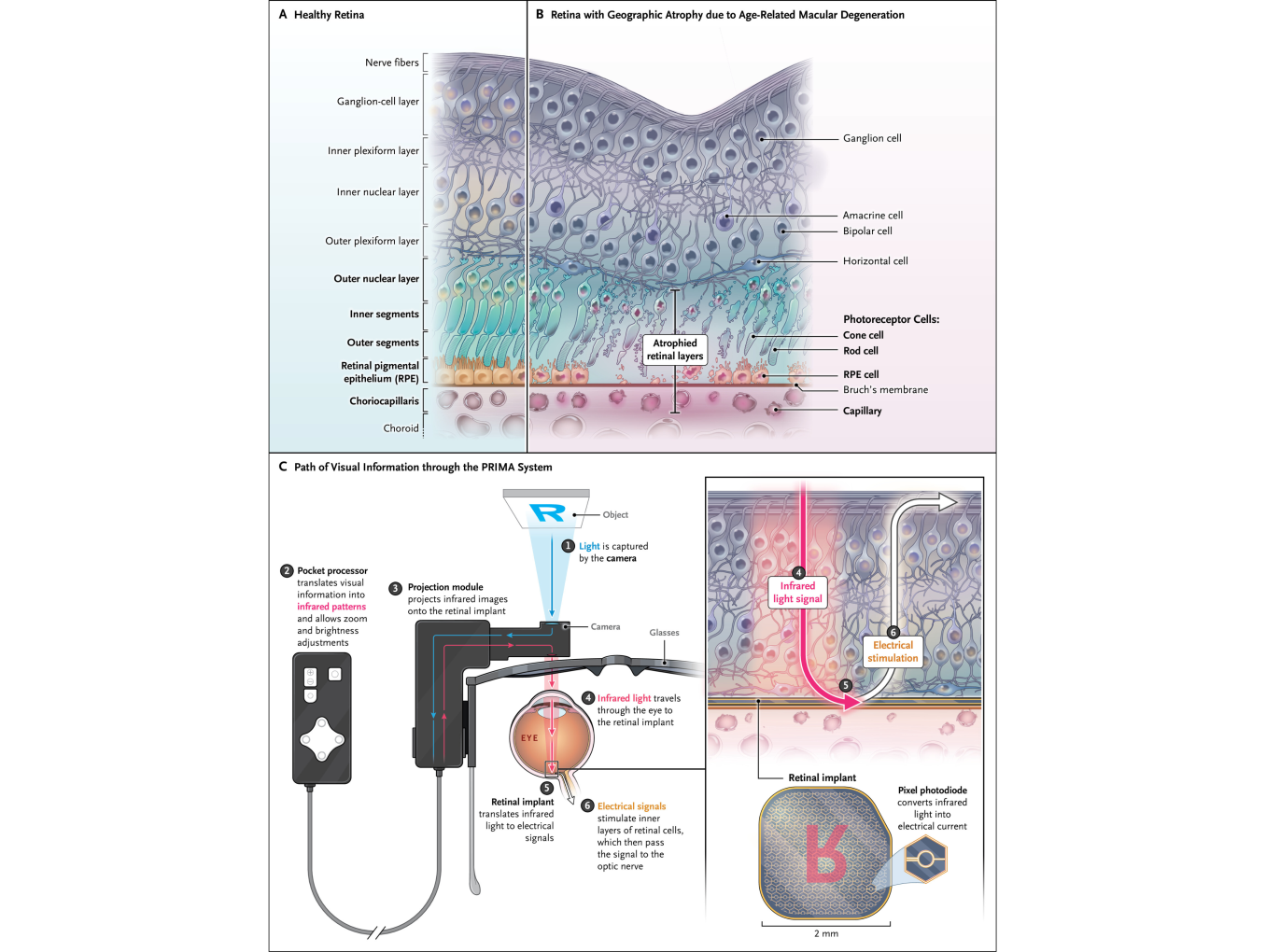
The following figure shows the mechanism of the PRIMA implant, published in the New England Journal of Medicine.
"Shown is the anatomy of a healthy retina (Panel A) and a retina with geographic atrophy due to age-related macular degeneration (Panel B). The PRIMA system (Panel C) combines a subretinal photovoltaic implant, a pocket processor, and glasses that project near-infrared light to the implant to restore sight to areas of central retinal atrophy. The camera captures light reflecting from an image (e.g., a letter R) and sends the visual information to the pocket processor. Processed information is then sent to the glasses and projected onto the implant by means of near-infrared light (wavelength 880 nm); the letter R on the implant is shown in red to indicate that the wavelength of the projected image differs from that of the light reflected by the original letter R. To achieve continuous, uninterrupted central visual perception, the projector operates at a frame rate of 30 Hz, and the processor adjusts perceptual brightness by controlling the pulse duration from 0.7 to 9.8 ms at a peak irradiance of 3.5 mW per square millimeter. The implant has an area of 2 mm by 2 mm and is composed of pixels with a width of 100 μm. Each pixel includes an active electrode in the center, a hexagonal return electrode mesh, and two photodiodes filling the space between the active and the return electrode. The photodiodes convert the near-infrared light into electrical current in order to stimulate the nearby inner retinal neurons, which process the electrical information in the retina. This information is then transferred via the optic nerve to the brain, where it is interpreted as a visual image.”
Holz, F. G., Le Mer, Y., Muqit, M. M., Hattenbach, L. O., Cusumano, A., Grisanti, S., ... & Sahel, J. A. (2026). Subretinal photovoltaic implant to restore vision in geographic atrophy due to AMD. New England Journal of Medicine, 394(3), 232-242.