Breaking the Wall of Quantum with Molecules & Proteins
Breaking the Wall of Quantum with Molecules & Proteins
Global Call 2026 Finalist Interview: Physical Sciences
David Awschalom is the Liew Family Professor, Director of the Chicago Quantum Institute, and Director of the Chicago Quantum Exchange at the University of Chicago. He is the Chief Science Officer of Q-NEXT at Argonne. His research explores the properties of electrons, nuclei, and photons in semiconductors and molecules for quantum processing. He is a member of the American Academy of Arts & Sciences, National Academy of Science, National Academy of Engineering, and European Academy of Sciences.
Which wall does your research or project break?
Our research focuses on breaking the wall of building quantum technology with molecules and proteins. One of the significant challenges of this rapidly moving field is the creation of single-atom devices: how does one develop a toolkit that future “atomic architects” can deploy to probe the fundamental nature of quantum mechanics in matter, as well as design and create technologies with extraordinary precision - precision well beyond our current capabilities? That is, can we make this technology an atomic “Lego set” that will be robust and scalable, capable of addressing significant societal needs? And once we build it, how do we connect it to our world, spanning from the atom to the human scale?
This project aims to break through a wall of invisibility: how do we explore the atomic world in ways that have been nominally invisible to classical technologies? Moreover, how do we organise and craft structures at this scale and communicate with them, bridging many dozens of orders of magnitude in scale? For example, how do we place a quantum sensor that is a few dozen atoms in size within a single cell at a specific location and read its information? How do we store this information, keep it secure, and transmit it to future quantum computers? And are there new ways of attacking these problems that go beyond our current semiconductor electronics technologies?
What is the main goal of your research or project?
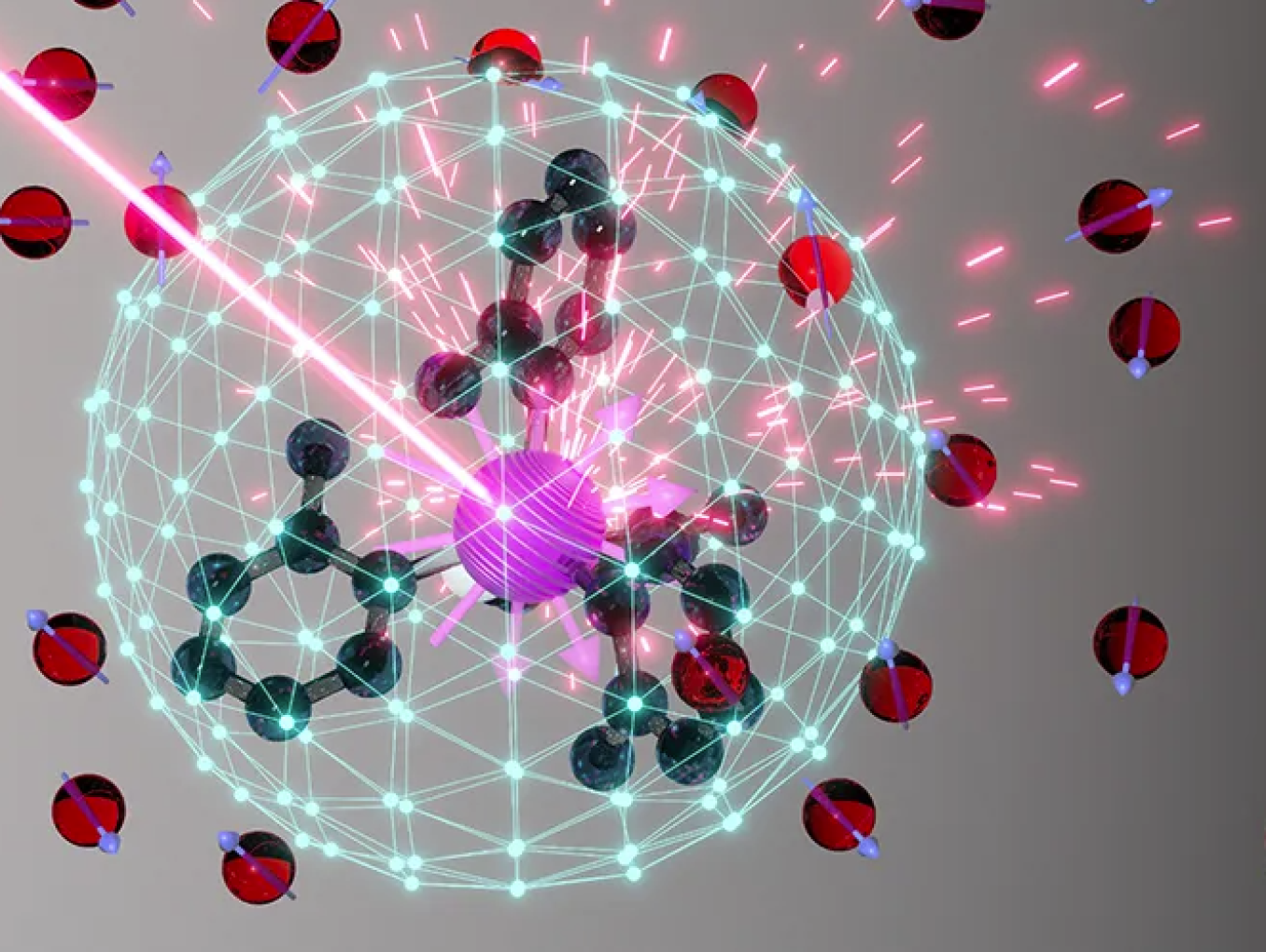
In contrast to today’s “top-down” technologies with advanced cleanrooms, lithography, and advanced etching schemes, our main goal is to use chemical and biological systems to forge unique structures with atomic precision in a “bottom-up” approach, tapping into nature’s capabilities. The goal is to develop a fundamentally different approach to create, control, and deploy atomic-scale qubits for quantum computing, sensing, and communication using the power of molecular assembly: to create organised arrays of quantum bits within length scales that are challenging for today’s inorganic technologies.
Molecular spin systems are attractive building blocks for quantum information science. Through a chemical approach, bottom-up design of qubits enables atomic-level control of their environment, scalability to multi-qubit architectures, and portability between various host materials and devices. With these functionalities, designer qubits could be synthesized for a diverse range of applications from quantum sensing in biosystems to the creation of nodes in a quantum network.
What impact does your research or project have on society?
Developing molecules that can be controlled and read using light would open a new paradigm for quantum technologies with broad impacts on society. For example, metallic organic frameworks may be used as scaffolds to create perfectly ordered arrays of quantum states at the atomic level. Metal-doped molecules may be used as quantum memories for scalable quantum communication systems. And sensors designed with specific targets could be used to monitor the environment, moisture levels for agriculture, vibration levels for early earthquake detection, and open the door to hybrid organic-inorganic circuits to easily swap information between the organic and inorganic worlds.
Quantum bits made from molecules and proteins are likely to have significant impacts in medicine and health care. Qubits made from proteins may be genetically encodable, fully biocompatible, and have a diameter of only four nanometers, meaning that they can be directly attached to cellular structures and target proteins. And these techniques can be applied across existing libraries of hundreds of proteins, organic molecules, and crystallographic defects that have been optimised for desired chemical, biological, and optical properties.
Taken together, these discoveries may offer health diagnostics at the single-cell level, providing levels of detection and preventative care orders of magnitude beyond what is available today.
What advice would you give to young scientists or students interested in pursuing a career in research, or to your younger self starting in science?
My advice would be to fearlessly chart new paths to discovery in the gray areas between traditional disciplines. The spaces where different fields intersect are ripe for exploration, where ideas and techniques can merge, and develop into fundamentally new discoveries in science and technology.
In addition, I would encourage scientists to embrace failure as a means of learning with the confidence that one will ultimately reach success. History has shown that accidental discoveries emerge from forging new directions, from Post-Its to microwave ovens to x-rays, societal impact often appears when and where you least expect it.
Trust yourselves and follow your passion. And when entering new worlds of science, be mindful of the fact that you are truly an explorer and that your intuition may be suspect. You may end up in a far more exciting place than you imagined.