Breaking the Wall of the Photonics Yield Crisis
Breaking the Wall of the Photonics Yield Crisis
Global Call 2026 Finalist Interview: Engineering & Technology
Dr. Mahmoud Jalali Mehrabad is an Associate Research Scientist at the Joint Quantum Institute, University of Maryland, and formerly a Research Scientist at MIT. He holds a PhD from the University of Sheffield. His research spans topological and nonlinear integrated photonics and chiral quantum optics, including the first demonstrations of topological frequency combs and multi-timescale mode locking. His honors include the UK's Rank Prize and a 2025 UM Ventures Outstanding Invention Award.
Which wall does your research or project break?
My project breaks the wall of the photonics yield crisis — the decades-old manufacturing barrier that has kept nonlinear photonic chips from scaling beyond the laboratory.
Chips that convert laser light into new colors are engines of modern technology: they multiply frequencies, generate frequency combs for precision measurement and produce quantum states of light. But all of this relies on a fragile requirement called frequency and phase matching: a device must support several colors of light simultaneously and circulate them at exactly matched speeds. Nanometer-scale fabrication variations — unavoidable even in the world's best foundries — are enough to break these conditions. As a result, most fabricated devices fail to perform as designed. They must be individually engineered, actively corrected with on-chip heaters or discarded altogether, which adds power consumption and complexity and makes wafer-scale production impractical. While electronics achieves near-perfect yield, nonlinear photonics has remained essentially artisanal: spectacular in the lab, but stuck there.
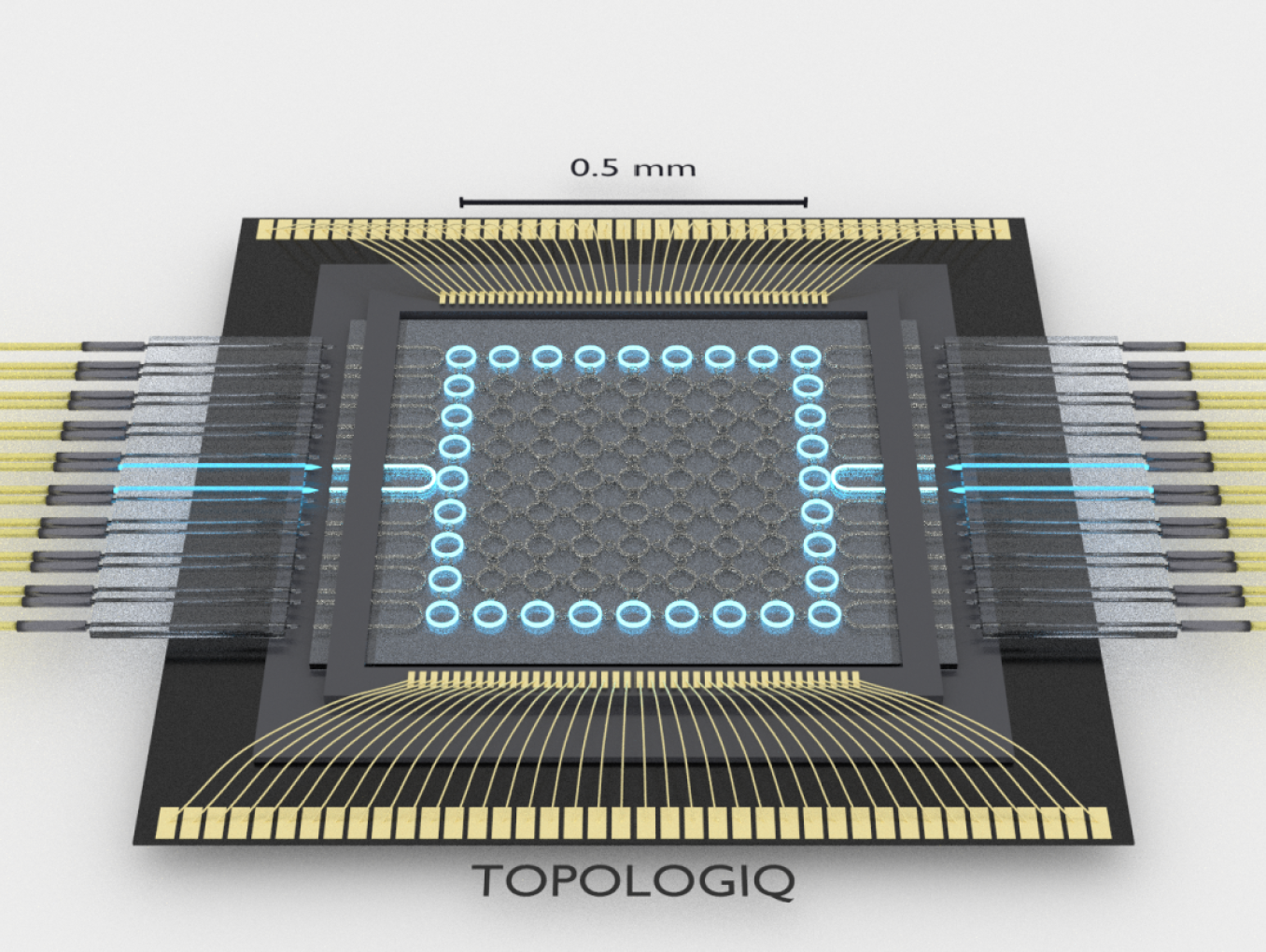
Our work breaks this wall by rethinking the matching condition itself instead of fighting fabrication disorder. We discovered that a lattice of coupled ring resonators naturally hosts light on two timescales: photons circulate rapidly inside each small ring while drifting slowly around the larger super-ring formed by the array. This nested, multi-timescale structure relaxes frequency-phase matching so dramatically that the condition is fulfilled automatically — passively, with no tuning, no heaters and no post-fabrication correction.
Fabricated in a standard commercial silicon nitride process, our chips simultaneously generated second, third and fourth harmonics — turning invisible infrared laser light into red, green and blue — with one hundred percent multi-functional device yield across the wafer. Every single device worked.
The wall that falls here is the assumption that nonlinear optics must be exquisitely precise to function. Once robustness is designed into the physics itself, nonlinear and quantum photonics can finally follow the path of microelectronics: from handcrafted laboratory devices to reliable, mass-produced technology.
What is the main goal of your research or project?
The main goal of my research is to make the generation and control of light — new colors, frequency combs and quantum states — as reliable and manufacturable as electronics, so that photonic technologies can move from specialized laboratories into everyday use.
In the near term, this means establishing nested, multi-timescale frequency-phase matching as a universal, foundry-compatible design principle for nonlinear photonics. Because the framework is fully passive and uses commercially available silicon nitride fabrication, it applies directly to the workhorse processes of the field: harmonic generation, broadband frequency combs and conversion between the infrared light of telecommunications and the visible light needed to address atoms, ions and biological systems.
Building on this foundation, we aim to demonstrate self-referenced combs and compact optical clocks, wafer-scale sources of squeezed and entangled light for quantum sensing and networking, and large synchronized resonator arrays for optical computing. The latter is the vision behind TOPAI, our topological photonics architecture for optical computing and AI, recognized with a UM Ventures Outstanding Invention of 2025 Award.
On a deeper level, my goal is to change how photonics deals with imperfection. I come from topological photonics, a field founded on the idea that robustness should emerge from design rather than from precision. Disorder is usually treated as an enemy to be suppressed with ever-tighter tolerances and active correction; our results show that it can instead be made irrelevant by the architecture itself. I want first-try success to become the norm: a chip designed anywhere, fabricated in any commercial foundry and working on arrival — no heaters, no trimming, no post-selection.
Ultimately, success looks like this: a student, a startup or a hospital orders a nonlinear photonic chip and simply trusts that it will work. That guarantee — mundane as it sounds — is exactly what unlocked the electronics revolution, and it is what photonics needs next.
What impact does your research or project have on society?
Reliable chips that create any color of light on demand touch nearly every corner of modern life, because light is our most precise tool for measuring, sensing, communicating and computing. Frequency conversion and frequency combs sit at the heart of optical atomic clocks that synchronize navigation and financial networks, spectrometers that monitor greenhouse gases and pollutants, emerging systems for early disease detection, and the lasers that control atoms and ions inside quantum computers. Yet most of these instruments remain large, expensive and confined to specialized labs — in good part because the nonlinear photonic components at their core cannot be mass-produced. When most chips off a wafer fail, every instrument stays a hand-built prototype. Breaking the yield wall changes that arithmetic. Passive, wafer-scale nonlinear photonics enables portable optical clocks for resilient timing and navigation when satellite signals are jammed or unavailable; low-cost chip-based sensors for climate monitoring and medical diagnostics that can be deployed in thousands rather than handfuls; compact sources of visible and multi-color light for quantum processors, atomic sensors and biomedical imaging; and greener technology overall, since our devices require no heaters or active electronic correction. Because the chips are made in existing commercial foundries, the distance between scientific result and manufactured product is unusually short. There is also a quieter, more democratic impact. When devices work on the first try, cutting-edge photonics stops being the privilege of institutions with large budgets and cleanrooms. Small research groups, startups, hospitals and universities in less-resourced regions can build directly on state-of-the-art hardware. Reliability is not just an engineering metric — it is what allows a technology to spread through society. Finally, as artificial intelligence drives an unprecedented demand for computation and energy, synchronized photonic lattices like ours offer a route toward light-based computing — a future where society's growing appetite for intelligence does not have to come at a growing energetic cost.
What advice would you give to young scientists or students interested in pursuing a career in research, or to your younger self starting in science?
My first advice: do not run from walls — study them. Every field has problems that everyone agrees are simply facts of life; the yield problem in nonlinear photonics was one of them for decades. Walls like these are often where the most interesting physics hides. Our breakthrough did not come from fighting imperfection with ever more precision; it came from changing the question — from asking how to make devices precise enough to work, to asking how to design devices for which precision does not matter. When a wall refuses to move, stop pushing and walk around it: reframe the problem, simplify it, look at it on a different timescale. That is, quite literally, what worked for us.
Second, move — between fields, groups, countries and communities. I trained in quantum optics in Sheffield, worked on topological photonics in Maryland and on photonics and AI at MIT. Every move was uncomfortable at first, and every one multiplied what I could see. Ideas travel with people, and discoveries tend to wait at the borders between fields.
Third, remember that science is a team sport. Nothing in this project would exist without generous mentors and brilliant colleagues — experimentalists, theorists and students pulling together. Seek out mentors who give you room to fail, be one for others as early as you can, and when success arrives, share the credit loudly.
Fourth — and this is what I would tell my younger self — most experiments fail, and that is not a verdict on you; it is the everyday texture of research. Persistence is not gritting your teeth harder; it is staying curious about why something failed.
Finally, protect your curiosity. Prizes, papers and titles follow the work; they should never lead it. The best reason to do science is still the oldest one: the universe is strange and beautiful, and we get to ask it questions.
What inspired you to be in the profession you are today?
What drew me in was the realization that the most abstract ideas in physics — like topology — can be turned into real devices that create and control light. Once I watched mathematics become a working chip, there was no way back.
Light is humanity's most precise tool, and I was inspired by the generations of scientists who kept finding new ways to tame it. I wanted to spend my life turning beautiful physics into technology anyone can use.
What is one surprising fact about your research or project that people might not know?
Inside each chip, light lives on two clocks at once — sprinting around tiny rings while slowly drifting around the larger super-ring they form, a bit like the second and hour hands of a watch. That hidden rhythm is exactly what makes every device work.
We never removed the fabrication imperfections that plague photonic chips — we designed a lattice in which they simply stop mattering. Every single chip on our wafer worked, in a field where a few working devices is considered a good day.
What’s the most exciting moment you've experienced over the course of your research or project?
Testing chip after chip and watching every single one light up with new colors — red, green and blue from an invisible infrared laser — with no tuning at all. That was the moment we knew the yield wall had fallen: it just worked.
The first time we sent invisible infrared light into an untuned, uncorrected chip and saw brand-new visible colors come out — and then watched it happen again on every device we tested.
Multi-timescale frequency-phase matching for high-yield nonlinear photonics (Science)
With Passive Approach, New Chips Reliably Unlock Color Conversion (Joint Quantum Institute)
Observation of topological frequency combs (Science)
New photonic chips passively convert laser light into multiple colors on demand (Phys.org)
Scientists Create Chip That Generates Brand-New Colors of Light, Cracking a Decades-Old Nonlinear Optics Challenge (SciTechDaily)
Mahmoud Jalali Mehrabad's Google Scholar Profile