Science Breakthroughs Success Stories: Tubulis
Global Call Category Science Start-Ups
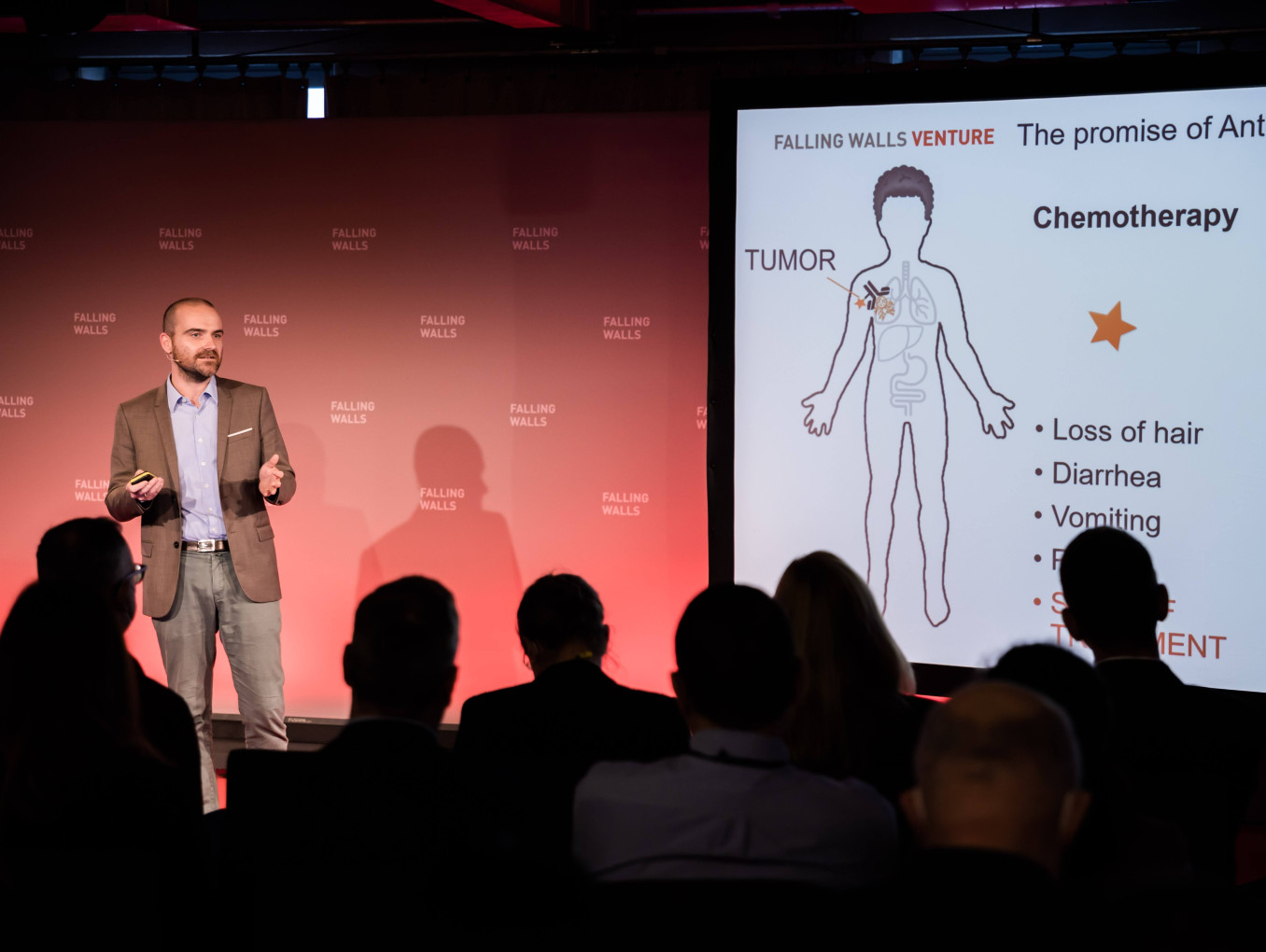
The German biotech company redefining cancer treatment with next-generation ADCs
Cutting-edge German biotechnology company and Falling Walls Venture alumni, Tubulis, creates next-generation Antibody-Drug Conjugates (ADCs) to treat cancer. In 2025, Tubulis closed its Series C with a second and final round, bringing total funding to €344 million. In addition the company published positive results from the first clinical data from Phase I/IIa Trial for their lead ADC-candidate TUB-040 in platinum-resistant ovarian cancer.
We spoke to CEO Dominik Schumacher about the breakthrough science behind the company's success, their experience of being part of the Falling Walls Venture programme and the current challenges facing sciencepreneurs.
What were the key scientific breakthroughs that made this groundbreaking success possible?
Everything started during my PhD in the lab of Prof. Christian Hackenberger (FMP Berlin), where we investigated new ways of linking antibodies to payloads. Here, I also met my co-founder Jonas, who was doing a postdoc in the lab of Prof. Heinrich Leonhardt (LMU, Munich) and collaborated with our group on this topic.
Supported by our supervisors, we had the idea of applying this new chemistry for the generation of ADCs, creating highly stable compounds that can overcome current challenges in their therapeutic application, such as premature payload loss and off-target toxicities. This was the basis of our first technology platform, Tub-tag.
Our second platform technology, P5, is based on the PhD research of Marc-Andrè Kasper, who also worked at Prof. Hackenberger’s lab and is now our VP Chemistry and Early development. This technology is used in our clinical lead candidates TUB-030 and TUB-040, which feature a high drug-to-antibody ratio (DAR8), exceptional stability and high tumor exposure to the payload, resulting in deep and durable anti-tumor-activity.
Finally, we developed the so-called Alco-5 technology, which enables the conjugation of previously inaccessible hydroxy-containing payloads. This includes the development of Degrader-Antibody Conjugates (DACs), an emerging modality to broaden the intracellular target space.
What motivated you to co-found Tubulis as a spin-off from your academic background?
Since I was a child, I'd always wanted to found a company. When the opportunity presented itself, I took it. There were several key factors coming together that made it possible:
- My research topic showed a great translational potential to improve chemical linkers used in a therapeutic modality;
- I met my co-founder Jonas and we immediately “clicked” on this idea;
- We got great guidance, encouragement and support from our supervisors who are also our scientific co-founders.
The vision that we can improve ADC treatments significantly with our technology to provide cancer patients with new options and better outcomes is what motivates us still today.
You pitched on the Falling Walls Venture stage in 2022. How did this program support you in your process with Tubulis?
Pitching on the Falling Walls Venture stage provided valuable visibility beyond our immediate biotech ecosystem and allowed us to position our progress and ambition in front of a highly engaged industry audience.
Receiving feedback from an experienced and thoughtful jury helped us sharpen our strategy and refine how we communicate our long-term vision. I also highly appreciated the exchange with other founders who were navigating similar growth phases, sharing honest peer perspectives and a real sense of momentum beyond our own company.
Do you have a standout memory from the Falling Walls Science Summit in 2022?
One of my strongest memories was the interaction between inventors and innovators from all over the world. Those conversations were a great reminder of how much creativity and ambition exists—including beyond our own field—and how energising it can be to exchange ideas with people who are equally driven to push boundaries and turn science into real-world solutions.
What was the biggest challenge for you as a sciencepreneur, and what did you learn from it?
I would say it's been a sequence of very different challenges that evolved as the company grew, with each phase bringing new scientific and entrepreneurial questions. This required us to continuously develop new skills and perspectives.
What I learned is that building a biotech company goes hand in hand with continuous growth as a leader. As strategies, structures and roles evolve, progress comes from staying open, curious and adaptable; consciously designing systems that remain flexible and fit for the next stage of growth.
Ultimately, building and growing a company is never an individual achievement. It grows through its people, and I am deeply grateful to work with a team I can fully rely on, that shares the same vision and turns ideas into impact.
Unsubscribe any time. You’ll find our data privacy policy here.