Breaking the Wall of Chemical Energy Storage
Breaking the Wall of Chemical Energy Storage
Global Call 2026 Finalist Interview: Physical Sciences
Peter R. Schreiner is a professor of chemistry and Liebig-Chair at Justus Liebig University Giessen and a leading physical organic chemist. His research uncovers how quantum tunneling and London dispersion shape chemical reactivity and has enabled discoveries ranging from organocatalysis to the first nitrogen allotrope beyond N₂, N₆. A member of Leopoldina, he has received the Leibniz Award, Dirac Medal, Schrödinger Medal, and other major international honours.
Which wall does your research or project break?
The wall we break is the long-standing chemical barrier that has confined elemental nitrogen essentially to dinitrogen (N₂), the main constituent of air. For decades, larger neutral nitrogen allotropes (molecules only made of one element) were considered experimentally inaccessible because nitrogen overwhelmingly prefers the exceptionally stable N₂ form because of the very strong N≡N triple bond. Higher nitrogen allotropes were deemed a daunting synthetic task, with the expectation that they would very rapidly decompose back to N₂.
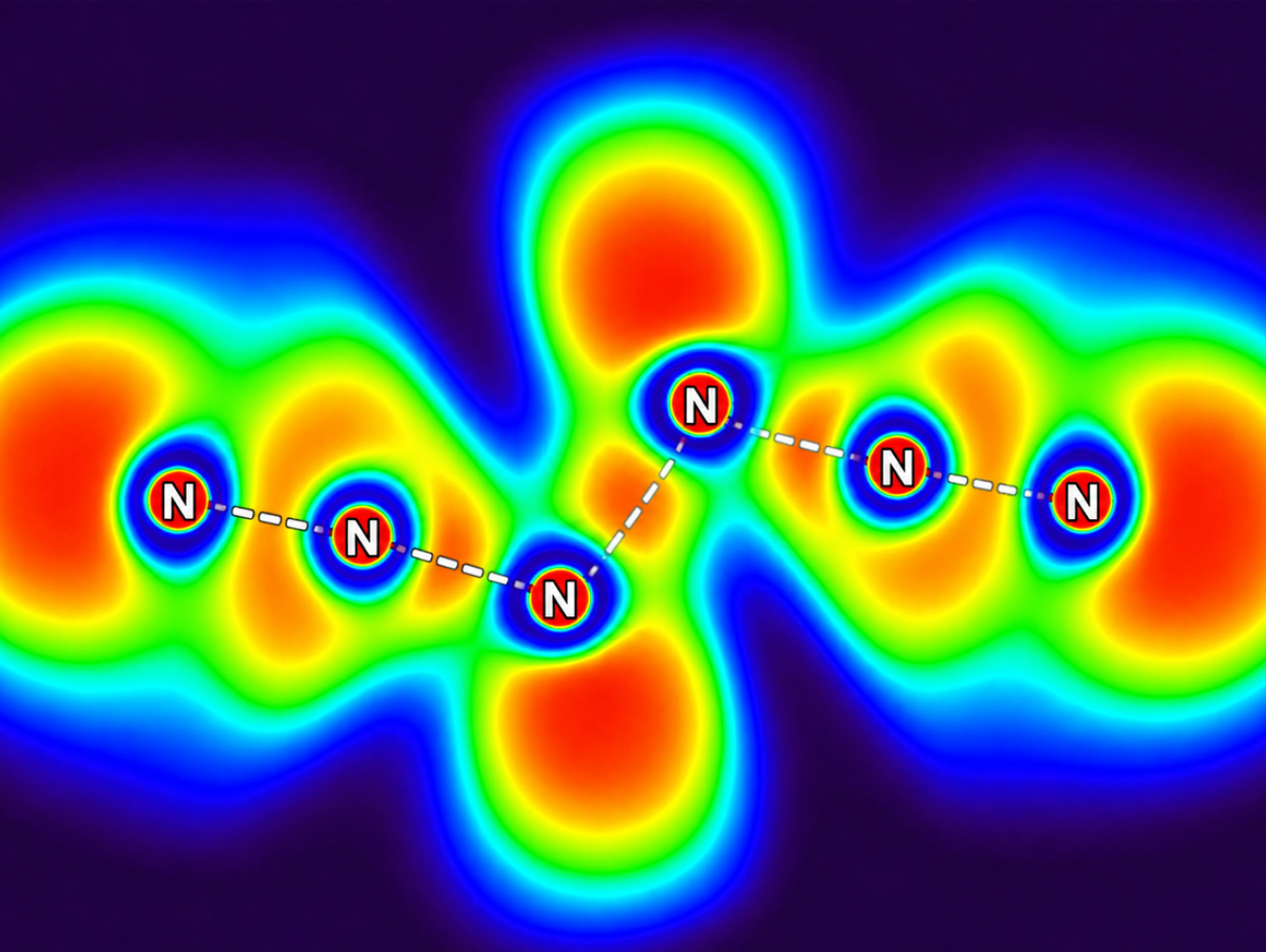
Our work demonstrates that these limits are not absolute. We developed an experimental strategy based on highly controlled reactions that allowed us to synthesise and spectroscopically identify neutral hexanitrogen (N₆), with the assignment supported by isotopic labelling and high-level quantum chemical computations. In doing so, we demonstrated for the first time that a neutral nitrogen allotrope beyond N₂ can exist under experimentally accessible conditions. The challenge is not merely to make such a molecule, but to capture, stabilise, and unambiguously characterise a species that is intrinsically driven to decompose. Overcoming this required the close integration of synthesis, matrix-isolation spectroscopy, isotopic experiments, and theory.
Our strategy in preparing N₆ through nitrogen anion oxidation and radical coupling manifests as a general approach to higher nitrogen allotropes, and we expect that many more such species will become available in the future.
N₆ expands the known limits of chemical bonding and molecular stability, but it also points toward a broader opportunity: chemical energy storage in materials composed only of nitrogen. This has been a dream for many chemists and visionaries, because conversion of high-energy nitrogen allotropes to N₂ releases substantial energy without carbon-containing or otherwise harmful byproducts; such molecules could inspire future carbon-free approaches to energy storage, transfer, and propulsion.
By synthesising a molecule long considered impossible, we have opened a new field of nitrogen chemistry, and thereby demonstrate that one of chemistry’s most persistent “walls” can be broken.
What is the main goal of your research or project?
'Much of today’s (chemical) energy economy relies heavily on carbon-based energy carriers (natural gas, oil, plant-based). Their availability and exceptional utility come with a fundamental disadvantage: utilising their stored chemical energy ultimately produces CO₂, contributing to climate change. Moving toward sustainable energy management therefore requires not only renewable energy generation, but also new ways to store and release energy without carbon in the overall production cycle. Higher nitrogen allotropes may provide an entirely new molecular concept for such carbon-free energy management.
The main goal of our research project therefore is to unlock the chemistry of elemental nitrogen beyond N₂ and establish higher neutral nitrogen allotropes as experimentally accessible high-density energy carriers. The synthesis and identification of hexanitrogen (N₆) represents a first but decisive step toward this goal.
Nitrogen offers a remarkable combination of properties. While N₂ is exceptionally stable because of its strong triple bond, molecules composed exclusively of nitrogen atoms connected through weaker bonds can store very large amounts of chemical energy. When they decompose to N₂, this energy can in principle be released without producing CO₂ or other carbon-containing waste products.
Our immediate objective is fundamental: to understand how such higher nitrogen-only molecules can be formed, stabilised, characterised, and ultimately controlled. N₆ provides a new platform for exploring the limits of chemical bonding and molecular stability. In the longer term, we aim to move from the discovery of a single extraordinary molecule toward a broader chemistry of polynitrogen species. Moving from N₆ toward N₁₀ and potentially even larger nitrogen architectures would establish polynitrogen molecules as a genuine molecular family rather than an exceptional case. We will identify new structures, understand their stabilities and decomposition pathways, and determine how their stored energy can be harnessed safely and controllably.
Our overarching goal is therefore to transform an “impossible molecule” into the starting point of a new field, connecting fundamental chemical discovery with the long-term vision of high-energy-density, carbon-free energy storage, transfer, and propulsion.
What impact does your research or project have on society?
The societal impact of our research lies in opening a fundamentally new route toward carbon-free energy management while advancing our understanding of the limits of chemical matter. Modern society still depends heavily on carbon-based fuels and energy carriers. Although they provide high energy densities and have enabled enormous technological progress, releasing their stored chemical energy typically produces very large amounts of environmentally critical CO₂. A sustainable future therefore requires not only renewable sources of energy, but also new ways to store, transport, and release energy without relying on carbon-based molecules and materials.
Higher nitrogen allotropes offer an intriguing long-term possibility. Molecules such as hexanitrogen (N₆) contain large amounts of stored chemical energy because their nitrogen atoms are connected by bonds that are much less stable than the extraordinarily strong triple bond in N₂. Their conversion into N₂ therefore releases very substantial amounts of energy while producing molecular nitrogen rather than CO₂ or carbon-containing waste.
Our discovery does not yet constitute an energy-storage technology; much more research and technological developments are needed. Its immediate societal impact is more fundamental: by demonstrating that a neutral nitrogen allotrope beyond N₂ can actually be synthesised and characterised, we have opened an experimental field that was previously considered virtually inaccessible. This provides the scientific foundation for exploring larger nitrogen architectures, understanding their formation and decomposition, and ultimately learning whether their energy can be stored and released safely and controllably. If that challenge can be overcome, polynitrogen materials could contribute to new concepts for high-energy, high-density storage, energy transfer, and propulsion with a massively reduced carbon footprint.
More broadly, our work illustrates how fundamental research can challenge what chemistry considers possible. Breaking the molecular boundary beyond N₂ may ultimately provide both new scientific understanding and an entirely new toolbox for sustainable energy technologies.
What advice would you give to young scientists or students interested in pursuing a career in research, or to your younger self starting in science?
My advice would be: remain curious, question what is considered established, and do not be afraid to work on problems whose outcome is uncertain. Science becomes most exciting when we do not already know the answer. Otherwise, it is just a mere extension of existing thoughts and technologies. At the same time, I would emphasise studying hard, engaging in scientific discussions with peers and mentors, and never assume you know it all!
If I could speak to my younger self, I would say: “Do not plan your career too carefully because scientific results cannot be planned.” Some of the most interesting discoveries emerge when we follow an unexpected observation rather than a predefined path. Choose questions because they fascinate and excite you, not simply because they are fashionable or promise quick results. If anything is in fashion, it is almost outdated already, and you’ll just be running behind the group that is ahead of you. Never follow.
Meaningful research requires persistence, and ideas that initially appear unlikely or even impossible may ultimately be the most rewarding ones to pursue. They may not be the most glamorous or will not offer immediate recognition and rewards, but they are likely to be noticed in the long run. If anything, they define who you are.
Failure is an essential part of science; as a matter of fact, most of my experiments do not work in my hands or in the hands of my co-workers. Experiments fail, calculations contradict expectations, papers are rejected, and promising ideas often lead nowhere. What matters is learning from these experiences and retaining the willingness to try again, perhaps from a completely different direction. Our work on many unusual reactive intermediates and, ultimately, N₆ are good real-life examples: molecules that appear impossible can become accessible when one asks the question differently and combines the right experimental and theoretical tools.
Finally, surround yourself with people who challenge and inspire you. I have been lucky in choosing co-workers and collaborators smarter than me. Gladly, they have given me a hard time challenging my ideas and conclusions. I had to learn to embrace and appreciate this. Modern science is a collaborative effort, and many breakthroughs arise when different perspectives, methods, and personalities meet.
Above all, preserve the sense of wonder that brought you into science in the first place. Curiosity is a remarkably powerful compass. A good share of naiveté is useful, too. Do not merely ask what can be done with the tools available today. Ask what should be possible, and then invent the tools needed to get there.
And don’t forget to laugh about yourself.
What inspired you to be in the profession you are today?
The most inspiring aspect of being a researcher is that you never fully have to grow up. You can keep the beautiful aspects of curiosity, naiveté, and playfulness of a child alive. Working with young people and sharp minds generates a most stimulating environment, and seeing them grow scientifically and personally is a very special reward.
Further reading
https://www.uni-giessen.de/de/fbz/fb08/Inst/organische-chemie/schreiner/research
https://pubmed.ncbi.nlm.nih.gov/?term=schreiner+pr%5BAuthor%5D&sort=date