Breaking the Wall of Quantum Materials Design
Breaking the Wall of Quantum Materials Design
Global Call 2026 Finalist Interview: Physical Sciences
Xiangfeng Duan is the Raymond A. and Dorothy A. Wilson Endowed Chair and Distinguished Professor of Chemistry and Biochemistry at the University of California, Los Angeles (UCLA). He is a leading nanomaterials scientist whose research spans two-dimensional materials, van der Waals heterostructures, and molecularly programmable quantum materials. His work pioneers new design principles that bridge molecular chemistry and quantum materials, transforming how functional solids are created.
Which wall does your research or project break?
Traditional solids and heterostructures are typically synthesized through high-temperature crystal growth or epitaxy, where their structures and properties are largely dictated by thermodynamics and stringent lattice-matching requirements. While this approach has produced many remarkable materials, it leaves only limited freedom to rationally design and tailor their electronic and quantum properties. As a result, materials discovery has relied largely on empirical exploration rather than predictive design, making it difficult to engineer entirely new functionalities.
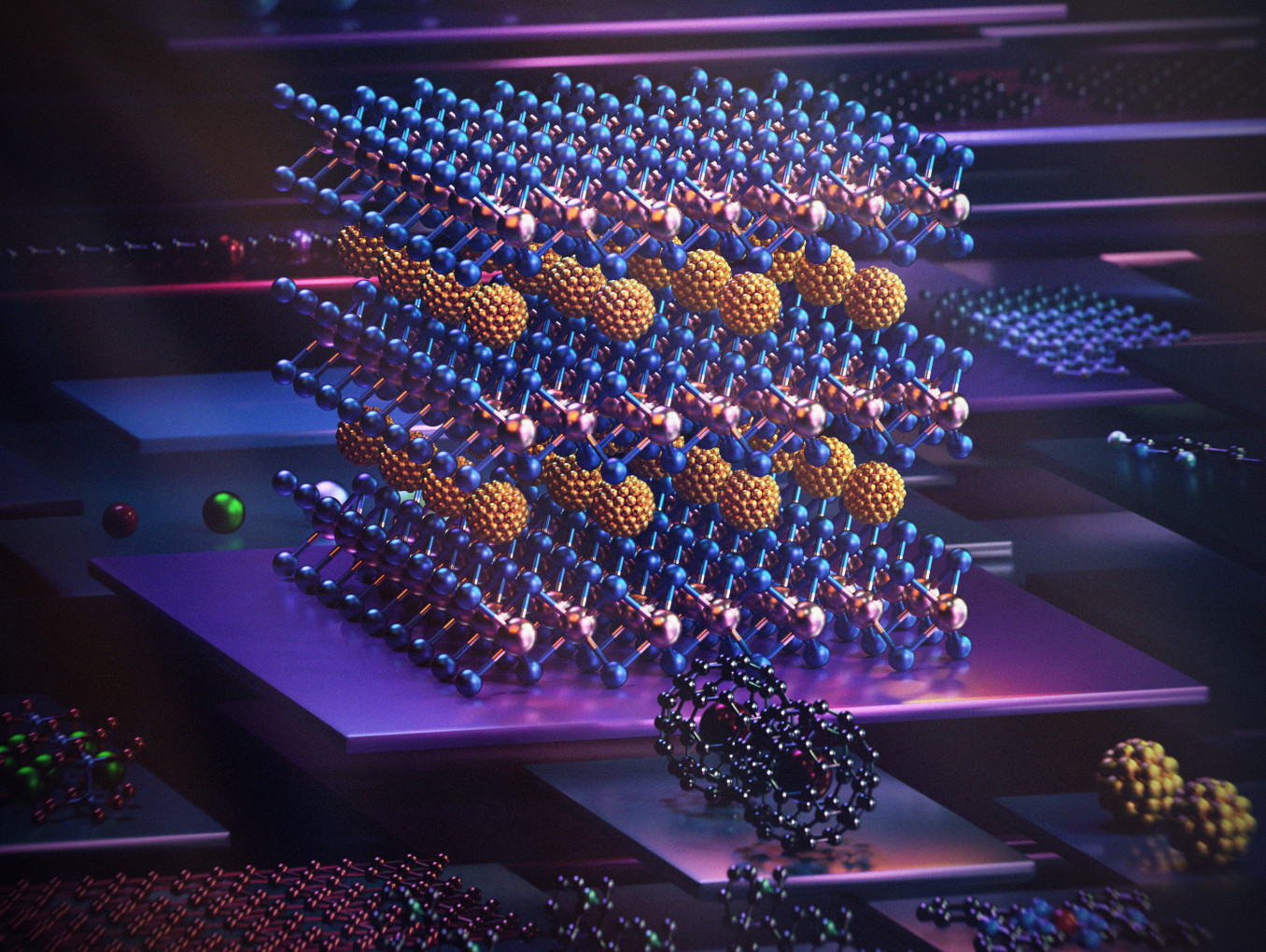
Our work breaks this longstanding barrier by introducing layered hybrid superlattices (LHSLs), a platform for molecularly programmable electronic and quantum materials. Rather than relying solely on atomic composition and crystal structure, we integrate atomically thin crystals with customizable molecular interlayers through non-covalent interactions. These molecular building blocks are deliberately designed to encode structure, symmetry, and functionality into crystalline solids, transforming molecules from passive constituents into programmable elements of electronic and quantum materials. This modular strategy creates artificial periodic potentials and programmable energy landscapes, enabling deterministic control over electronic, optical, magnetic, and quantum properties.
Unlike conventional materials, whose properties are largely inherited from their constituent crystals, molecularly programmable materials can be engineered by design. The platform has already enabled scalable “bulk monolayer” materials that preserve the properties of atomically thin crystals at macroscopic dimensions, as well as the discovery of new phenomena, including spin-selective transport, symmetry-breaking superconductivity, and vastly enhanced nonlinear optical responses.
More broadly, this work establishes molecular programmability as a general design principle for electronic and quantum materials, bridging molecular chemistry with condensed matter physics. By transforming materials research from discovering materials to designing them, it provides a universal framework for engineering functional solids and opens new opportunities in quantum information, electronics, photonics, sensing, and sustainable energy technologies.
What is the main goal of your research or project?
The long-term goal of our research is to transform electronic and quantum materials from systems discovered through empirical exploration into materials that can be rationally designed with desired properties. We seek to establish molecular programmability as a general design principle for engineering electronic and quantum materials, enabling molecular building blocks to encode structure, symmetry, and functionality directly into crystalline solids.
To achieve this vision, we developed layered hybrid superlattices (LHSLs), a modular platform that integrates atomically thin crystals with programmable molecular building blocks. Unlike conventional heterostructures, whose composition, structure, and properties are largely constrained by thermodynamics and lattice-matching requirements, LHSLs use molecular design to create artificial periodic potentials and programmable energy landscapes with atomic precision. This enables deterministic engineering of electronic, optical, magnetic, and quantum properties through modular chemical design rather than fixed material composition.
Beyond creating a new class of molecularly programmable quantum materials, our broader objective is to establish a universal framework for materials design that bridges molecular chemistry, materials science, and condensed matter physics. We envision a future in which electronic and quantum materials can be designed on demand for targeted applications, accelerating advances in quantum information, electronics, photonics, sensing, and sustainable energy technologies. Ultimately, our goal is to transform materials research from discovering materials to designing them, providing the scientific foundation for a new generation of programmable solids whose structure and functionality are encoded through molecular architecture.
What impact does your research or project have on society?
Our research establishes a new foundation for designing electronic and quantum materials that can address some of society's most pressing technological challenges. Rather than relying on the slow discovery of naturally occurring materials, molecular programmability enables materials to be engineered with properties tailored for specific applications. This approach has the potential to dramatically accelerate innovation in materials science.
The layered hybrid superlattice platform enables scalable materials architectures with precisely controlled electronic, optical, magnetic, and quantum properties. These capabilities provide a pathway toward more energy-efficient computing, advanced photonic technologies, quantum information systems, and next-generation sensors, while also supporting the development of functional materials for sustainable energy conversion and storage.
Beyond individual applications, the broader societal impact lies in transforming how materials are created. The modular nature of this platform creates a vast and programmable materials design space that is ideally suited for AI-assisted materials discovery and optimization. Instead of searching empirically through naturally occurring materials, researchers will be able to systematically explore and optimize molecular building blocks and superlattice architectures to rapidly develop materials with targeted properties. This shift from empirical discovery to programmable design has the potential to shorten development cycles, reduce the cost of innovation, and accelerate the translation of scientific discoveries into practical technologies.
By establishing molecular programmability as a universal design principle that bridges chemistry, materials science, and condensed matter physics, our work provides a foundation for a new generation of programmable materials. We believe this paradigm will reshape how materials are discovered and engineered, enabling transformative advances across electronics, photonics, quantum technologies, energy, and other emerging fields.
What advice would you give to young scientists or students interested in pursuing a career in research, or to your younger self starting in science?
Scientific breakthroughs rarely come from following established paths—they come from asking questions that others have overlooked. If there is one lesson I have learned, it is to pursue important problems rather than fashionable topics. The most exciting discoveries often emerge at the boundaries between disciplines. My own research has been driven by bringing together chemistry, materials science, physics, and engineering to tackle challenges that no single field could solve alone.
I would encourage young scientists to be patient and persistent. Transformative ideas often require years of effort before they are fully appreciated. Failures are an inevitable part of scientific discovery and should be viewed not as setbacks, but as opportunities to learn, refine ideas, and sometimes uncover even more important questions. Equally important is maintaining curiosity and remaining open to unexpected observations—they often lead to the most meaningful discoveries.
Above all, I believe scientists should strive to create new ways of thinking rather than simply improving existing technologies. The greatest impact comes not from incremental advances, but from developing new concepts and frameworks that enable others to explore questions that were previously unimaginable. Ultimately, science advances by challenging conventional assumptions and creating entirely new possibilities for future generations.
What inspired you to be in the profession you are today?
I have always been inspired by the opportunity to create new materials by design that have the potential to transform future technologies and improve people's lives. The possibility of developing entirely new design principles that enable discoveries beyond what nature provides continues to motivate my research.
What is one surprising fact about your research or project that people might not know?
One surprising aspect of our research is that weak, non-bonding interactions between molecules and crystalline solids can profoundly reshape a material's electronic structure and give rise to entirely new quantum properties. This shows that molecules can act as programmable building blocks for engineering materials with functionalities that do not exist in nature.
What’s the most exciting moment you've experienced over the course of your research or project?
The most exciting moment was discovering that molecules could do far more than simply separate crystal layers—they could be deliberately programmed to control the quantum behavior of solids, including spin selectivity and superconducting pairing symmetry. It was the moment we realized we were not just creating a new materials platform, but opening the door to a new paradigm for designing quantum materials.
Layered Hybrid Superlattices: A Breakthrough in Designable Quantum Materials (UCLA News)
Layered Hybrid Superlattices as Designable Quantum Solids (Nature, 2024)
UCLA Researchers Develop a New Class of Two-Dimensional Materials (UCLA News)
Monolayer Atomic Crystal Molecular Superlattices (Nature, 2018)
Superlattice Material Filters Electrons with High Selectivity (UCLA News)
Chiral Molecular Intercalation Superlattices (Nature, 2022)
Layered Superconductor Coaxed to Show Novel Properties with Potential for Quantum Computing (UCLA News)
Unconventional Superconductivity in Chiral Molecule–TaS₂ Hybrid Superlattices (Nature, 2024)