Breaking the Wall of Lithium Recovery with Bacteria
Breaking the Wall of Lithium Recovery with Bacteria
Global Call 2026 Finalist Interview: Art & Science
Isidora Correa is a Chilean interdisciplinary artist and researcher based in Porto. A PhD candidate and researcher at CITAR, Universidade Católica Portuguesa, she develops artistic research across installation, sculpture, moving image, sound, and bioart. Through fieldwork and scientific collaboration, she investigates extractivism, microbial ecologies, and material transformation to imagine new forms of ecological responsibility and more-than-human coexistence.
Which wall does your research or project break?
The project breaks the wall between lithium extraction and lithium recovery through extremophile bacteria. Today, lithium has become a critical mineral within the energy transition, bringing the promise of cleaner energy through decarbonization. However, the material systems behind this transition depends on extractive practices with deep environmental and social impacts, affecting fragile ecosystems and local communities, while vast amounts of lithium contained in discarded batteries accumulate as toxic waste.
The project addresses this contradiction by focusing on the Salar de Atacama in northern Chile, one of the world’s largest lithium brine extraction sites. Brine extraction places pressure on hydrological systems in one of the oldest and driest deserts on Earth, a territory that contains contemporary descendants of some of the planet’s earliest life forms: microbial communities that sustain unique ecosystems. Large-scale mining in these territories disrupts fragile ecological relations, generating biodiversity loss and threatening the traditional livelihoods of Indigenous Likanantay communities, many of whom depend on agriculture and delicate relations with water, soil, and lagoon systems.
At the same time, the project breaks a perceptual wall. The Atacama Desert is often seen as a mineral resource zone, while the invisible life forms that inhabit these landscapes are rarely considered in environmental debates or assessment frameworks. The research expands the debate beyond human and macroscopic environmental impacts, showing that lithium extraction also threatens extremophile microorganisms that sustain planetary cycles and ecological memory embedded in deep-time processes. By working with a bacterial strain from the Atacama Desert, the project explores how microbial metabolism can help recover lithium and other critical minerals from discarded lithium-ion batteries through bioleaching, demonstrating how biological processes can contribute to more circular material cycles and planetary health.
What is the main goal of your research or project?
The main goal of the project is to explore how microorganisms can become collaborators in regenerative material cycles, while developing new ways of perceiving ecological processes that normally remain invisible. The work brings together microbiology, bioleaching, field research, sound and moving image through an immersive installation to ask how biological processes might help us rethink the future of critical minerals beyond extraction.
Scientifically, the project investigates the potential of extremophile bacteria, particularly Acidithiobacillus ferrivorans ACH, to participate in bioleaching processes capable of recovering lithium from discarded lithium-ion batteries. Instead of approaching waste as the endpoint of consumption, the project treats it as part of a continuous material cycle. Through microbial metabolism, toxic residues and spent battery materials can be reimagined as sites of transformation, detoxification, and recovery.
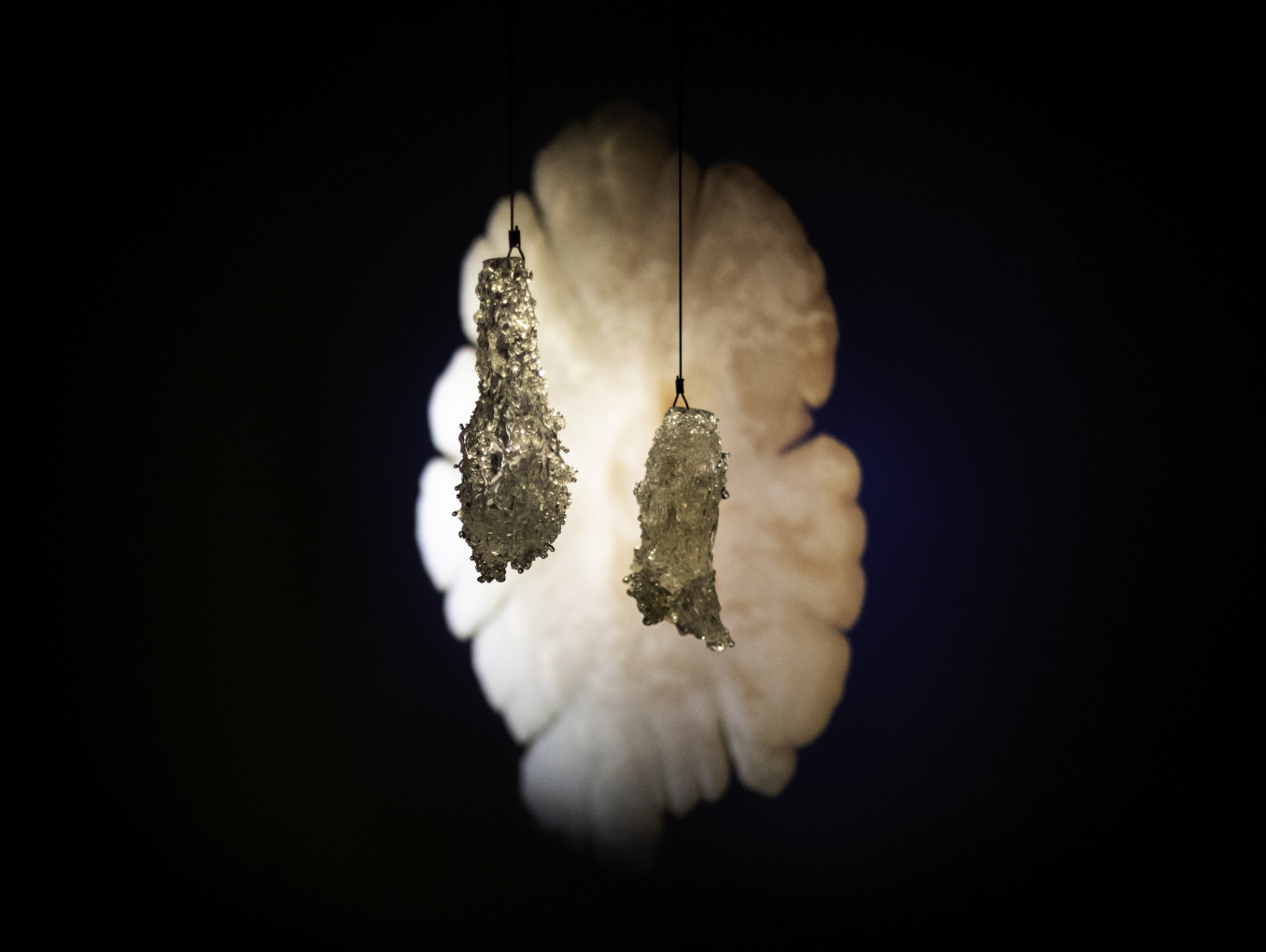
Artistically, the project seeks to make these microscopic processes perceptible. Microbial activity often takes place at scales and temporalities that exceed ordinary human attention. Through an immersive installation combining glass vessels inspired by salt formations from the Atacama salt flat containing bioleaching processes, time-lapse imaging, color tracking, and generative sound, the work transforms imperceptible microbial processes into sensory experiences. Changes in color, movement, and bacterial growth become visual and sonic indicators of biological activity, feeding a generative sound system that allows audiences to experience the process as it unfolds.
The broader goal is to shift perception. The project invites audiences to understand microorganisms as active participants in planetary systems and possible allies in more circular forms of production, creating a space where scientific research, ecological thinking, and artistic experience can meet.
In doing so, the work proposes recirculation as a direct alternative to extractive models of resource use. By connecting scientific research with contemporary art, the project reimagines waste as a resource and extraction as recirculation, proposing new cultural imaginaries that recognize our interdependence with microbial life and the ecosystems upon which planetary habitability depends. At its core, the project asks how the energy transition might move beyond extracting from vulnerable territories and toward forms of recovery, regeneration, and collaboration with the living systems that make planetary futures possible.
What impact does your research or project have on society?
The project contributes to society by making the hidden environmental and social costs of critical mineral extraction more visible, while proposing regenerative alternatives grounded in microbial processes. As demand for lithium grows through electric mobility, digital technologies, and renewable energy storage, the material foundations of the energy transition urgently need broader public discussion.
The project creates an accessible space for that conversation by connecting scientific research with immersive artistic experience. Its impact is ecological, cultural, and educational. Ecologically, the work points toward the potential of bioleaching as a way to recover lithium and other critical minerals from discarded lithium-ion batteries. This does not replace the need for structural change in mining, production, and consumption, but it demonstrates that electronic waste can be reconsidered as part of more circular material systems. By working with microbial metabolism, the project highlights forms of regeneration that are often overlooked in dominant technological narratives.
Culturally, the project brings microbial life into public attention helping audiences recognize its value as living systems that sustain ecological resilience. Microbial communities are essential to biodiversity, planetary cycles, and the persistence of life in extreme environments, yet they are rarely considered in public debates about sustainability. By making microorganisms visible and audible through sound, moving image, and sculptural installation, the project allows audiences to encounter them as active agents of living processes unfolding in time.
The work also contributes to environmental justice by situating lithium extraction within the specific context of the Salar de Atacama, where hydrological pressure, ecological fragility, and Indigenous Likanantay livelihoods are deeply interconnected. It encourages audiences to question whether decarbonisation can be considered truly sustainable if it reproduces extractive damage in vulnerable territories.
Taken together, the project’s social impact lies in creating new forms of understanding. It brings together art, science, sustainability, and ecological ethics to imagine an energy transition based not only on innovation, but also on responsibility, recirculation, and interdependence with more-than-human life.
What advice would you give to artists at the start of their careers who are interested in working at the intersection of art and science?
Stay curious and don't be discouraged if answers or collaborators don't appear immediately. Interdisciplinary work takes time and grows through perseverance. Many of the most rewarding collaborations begin with uncertainty. Be open to learn new languages, and methods, accepting that you will often become a beginner again when entering an unfamiliar field.
Do not be afraid to question what you have been taught or to move beyond established disciplinary boundaries. New paths are created by going beyond existing ones. Some of the most meaningful ideas emerge where different forms of knowledge meet, challenging assumptions that each discipline takes for granted. Approaching science as an artist, and art with scientific curiosity, opens possibilities that neither field could achieve alone.
Seek collaborators who share curiosity, generosity, and commitment rather than a simply specific expertise, because interdisciplinary work depends also on the quality of relationships as much as on knowledge itself. Artists are often accustomed to developing their work through their own creative vision, but collaboration requires a more open and shared understanding of authorship, in which projects are built on mutual respect, trust, and a willingness to learn from one another. Listen carefully, ask questions without fear, and recognize that genuine collaboration means allowing your own ideas to evolve through dialogue. The final work is not yours alone, it emerges from the contributions, methods, and perspectives from everyone involved.
Finally, choose a subject that truly matters to you. Interdisciplinary research can be demanding and slow, sometimes developing without clear or immediate progress. Personal engagement will sustain your motivation through uncertainty and obstacles. Creativity and passion can bring intuition and sensitivity into scientific inquiry, generating new forms of attention. When combined with openness to collaboration, they make it possible to challenge established ways of thinking that expand the boundaries of knowledge and imagine futures that have not yet been conceived.
What inspired you to be in the profession you are today?
I was inspired by the need to move from witnessing and representing ecological damage to creating ways of imagining regeneration. Working as an artist in Chile, a country deeply shaped by mining extraction and intensive agriculture with deep environmental and social injustices, made me understand that materials are never neutral: they carry histories of extraction, depletion, labor, and environmental transformation. What inspires me today is the possibility of making art that does not only show what is being lost, but helps us sense what can still be recovered, transformed, and reimagined, contributing to more responsible ways of inhabiting the planet.
A decisive moment came during an art residency in the Salar de Atacama, connected to my current research. There, I encountered microbial mats: colourful, layered communities of bacteria that organise themselves through mutualistic relations rather than depletion, helping them survive collectively in extreme conditions. The waste of one group can become an energy source for another, creating shared metabolic spaces and offering a powerful model for rethinking material culture. This encounter led me to leave Chile and move to Portugal to pursue a PhD in Science and Technology of the Arts, where I could bring artistic sensitivity into dialogue with microbial life and regenerative approaches through a project involving two research centers: CITAR at UCP in Portugal and Centro Lithium I+D+i at UCN in Chile.
What is one surprising fact about your research or project that people might not know?
One surprising fact is that many bacteria appear nearly transparent under conventional microscopy when observed as individual cells, yet when they grow collectively as colonies, biofilms, or microbial mats, their pigments and metabolic activity can produce visible colour. In extremophile bacteria, colour can become a form of adaptation and resistance: a living signal of how microbial communities protect themselves, organise, and persist under extreme conditions. Some salt formations in Atacama are naturally tinted by bacterial activity, becoming macroscopic traces of these living systems.
What’s the most exciting moment you've experienced over the course of your research or project?
One of the most exciting moments was discovering that small pieces of salt collected in the Atacama Desert contained more than 40 different species of extremophile bacteria, which I was able to culture and continue working with today. This finding directly contradicted the idea of the desert as an inert, mineral-rich space for extraction, revealing it instead as a living landscape of microbial biodiversity whose fragile ecologies are threatened by large-scale mining.