Breaking the Wall of Quantum Music
Breaking the Wall of Quantum Music
Global Call 2026 Finalist Interview: Art & Science
Clemens Wenger is a Viennese composer and Professor of Composition at Anton Bruckner Private University Linz. A pioneer of Quantum Music, he staged BruQner – The Sound of Entanglement, the first concert with entangled photons, before 3,100 people at Linz Cathedral. Invitations followed from Johns Hopkins University, the European Forum Alpbach, and EXPO2025 Osaka. He founded JazzWerkstatt Wien and leads the soul band 5/8erl in Ehr'n, moving fluidly between the popular and the avant-garde.
Which wall does your research or project break?
Quantum mechanics remains one of the most consequential yet least accessible fields of human knowledge. Entanglement, the phenomenon Einstein called "spooky action at a distance," underlies the coming generation of quantum computers, secure communication, and precision sensing, yet it cannot be pictured. Its logic is probabilistic, non-local, and invisible to the senses. This creates a wall between the physics community, which works with entanglement in the abstract language of mathematics, and the public, for whom the term remains a metaphor without meaning.
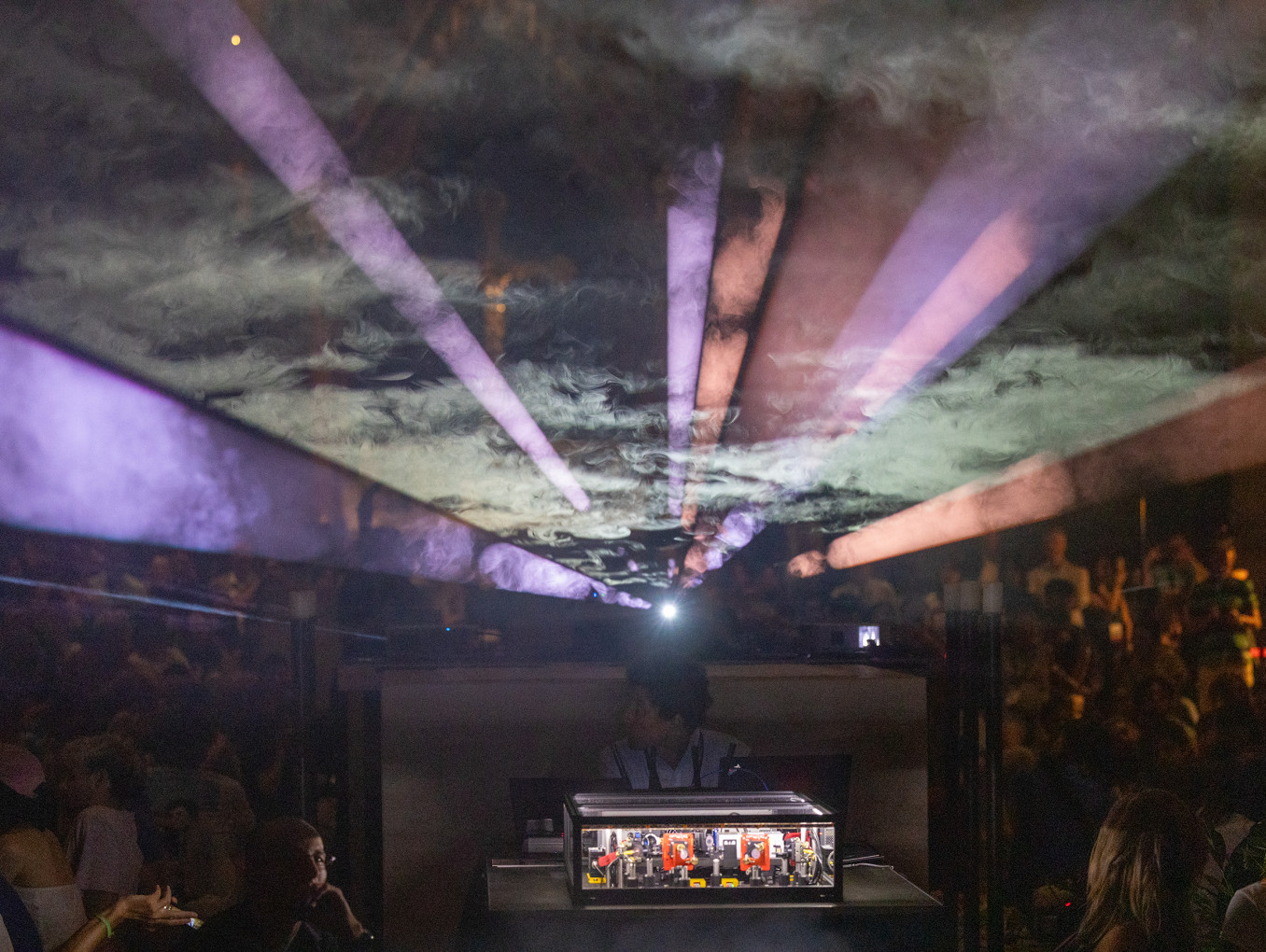
BruQner – The Sound of Entanglement breaks that wall by making entanglement audible. In September 2024, together with physicists from TU Wien, JKU Linz, and the University of Innsbruck, I built the first musical work driven live by entangled photons: the real-time measurement outcomes of an entanglement experiment were translated into a compositional structure and performed for 3,100 people in Linz Cathedral. No simulation, no metaphor — the sound the audience heard was generated by quantum randomness as it happened.
The project addresses three overlapping challenges. First, a communication challenge: how to convey a phenomenon with no everyday analogue, without oversimplifying the physics. Second, a cultural challenge: how to bring frontier quantum research out of the laboratory and into a shared public space, at a scale usually reserved for entertainment rather than physics. Third, an artistic challenge: how to let genuine scientific data, not an illustration of it, determine the structure of a musical work, so the composition itself becomes an experiment in perception.
BruQner treats music not as a metaphor for quantum physics but as its direct medium, closing the distance between two disciplines that rarely share a stage, let alone a language.
What is the main goal of your research or project?
The main goal of BruQner – The Sound of Entanglement was never a single concert — it was to test whether quantum entanglement could become a lasting compositional method, not a one-off spectacle.
Quantum physics will define much of the coming decades, yet it stays locked inside specialist language most people never enter. My aim was to build a genuine two-way collaboration between composition and physics, in which real experimental data determines the music, and the demands of live performance push the physics into new territory — so an audience could encounter entanglement not as an abstract concept but as an audible event unfolding in the room with them.
That aim has held up beyond the premiere. Since Linz, the project has grown into an ongoing line of work rather than a single achievement: invitations followed from Johns Hopkins University, the Science Ball at Vienna City Hall, the European Forum Alpbach, and the Austrian pavilion at EXPO2025 in Osaka. I have since built The Uncertain Question, a dedicated ensemble developing further compositions from quantum data, and Sound of Entanglement has become a repeatable lecture-performance format, adapted to new venues and new physics. A formal research project is now in preparation to put this method on a systematic footing — developing sonic mappings for other quantum phenomena and formalizing the collaboration between composers and physicists as a discipline in its own right.
The underlying goal stays constant: show that rigorous science and ambitious art can share a stage without either being simplified for the other, and open a durable channel between contemporary composition and quantum research that outlasts any single concert.
What impact does your research or project have on society?
BruQner's impact lies less in the physics itself than in who got to encounter it, and how. Quantum technologies — computing, cryptography, sensing — will shape daily life within a generation, yet public understanding of quantum mechanics remains thin, and public trust in complex science is under strain. Most people meet quantum physics only through metaphor or headline, never through direct experience.
By staging entanglement inside Linz Cathedral rather than a lecture hall or laboratory, the project reached 3,100 people who would not have attended a physics talk, many encountering a live quantum experiment for the first time in a setting built for collective, unmediated experience rather than instruction. That shift, from being told about a phenomenon to hearing it happen, is itself a small but real contribution to public science literacy.
The project also offers a working model for how science and art can collaborate without either side deferring to the other. Physicists gained a new, high-visibility way to communicate the significance of entanglement research beyond specialist audiences; composers and performers gained access to a genuinely new sonic material grounded in physical law rather than invention.
As a professor of composition, I bring this method directly into teaching, giving students a concrete example of interdisciplinary practice that treats scientific rigor as a compositional constraint rather than a decorative theme.
Over time, I expect this to influence how a new generation of composers and physicists think about working together: not science illustrated by art, or art borrowing scientific vocabulary, but a shared, mutually accountable practice, capable of reaching audiences that neither discipline could reach alone.
What advice would you give to artists at the start of their careers who are interested in working at the intersection of art and science?
Trust intuition at least as much as knowledge and technique.
Working between art and science tempts you to over-prepare — to think you need a physics degree, a research partner, or a fully worked-out theory before you're allowed to start. It's the opposite, at least for me. The best scientists and the best artists I've met tend to share one thing: a trained gut instinct, and the nerve to act on it before all the facts are in.
That instinct isn't a shortcut around knowledge — you build it the same way you build technique, through doing the work, getting it wrong, paying attention to what happens. But once it's there, it's what you actually navigate by. Use it to find your own path instead of copying a template that answers someone else's questions. Use it to notice which fields are worth poking around in, even before you can explain why. Use it to know when to grind and when to just leave something alone for a while. Use it to tell when a project has quietly stopped working and needs to go somewhere else.
Rigour still matters — in physics and in composition, you can't fake your way through sloppy work forever. But rigor checks an idea once you've had it. Intuition is what gets you the idea in the first place. Train it, trust it early, and let it steer.
What inspired you to be in the profession you are today?
Music was the first language I trusted completely — composing let me keep asking "what if" without ever having to stop.
What is one surprising fact about your research or project that people might not know?
The sounds the audience heard weren't pre-programmed or simulated — they came from real photons hitting real detectors in that exact moment, so the piece was genuinely different, and unrepeatable, every time it played.
What’s the most exciting moment you've experienced over the course of your research or project?
After a year of building the experimental setup, writing the actual software, and countless failed tests — the moment our setup beat the classical bound, just as John Bell predicted, and The Sound of Entanglement worked for the first time.