Breaking the Wall of Computation Compost
Breaking the Wall of Computation Compost
Global Call 2026 Finalist Interview: Art & Science
Marina Otero Verzier is an architect, researcher, and Lecturer in Architecture at Harvard GSD. She also leads the Data Mourning clinic at Columbia GSAPP, examining digital infrastructures and climate catastrophe. Winner of Harvard’s Wheelwright Prize (2022). She collaborated with the DIPC Supercomputing Center on alternative models for storing data, including Computational Compost, awarded by S+T+ARTS Ars Electronica 2025. In Chile, she contributed to the first National Data Centers Plan.
Which wall does your research or project break?
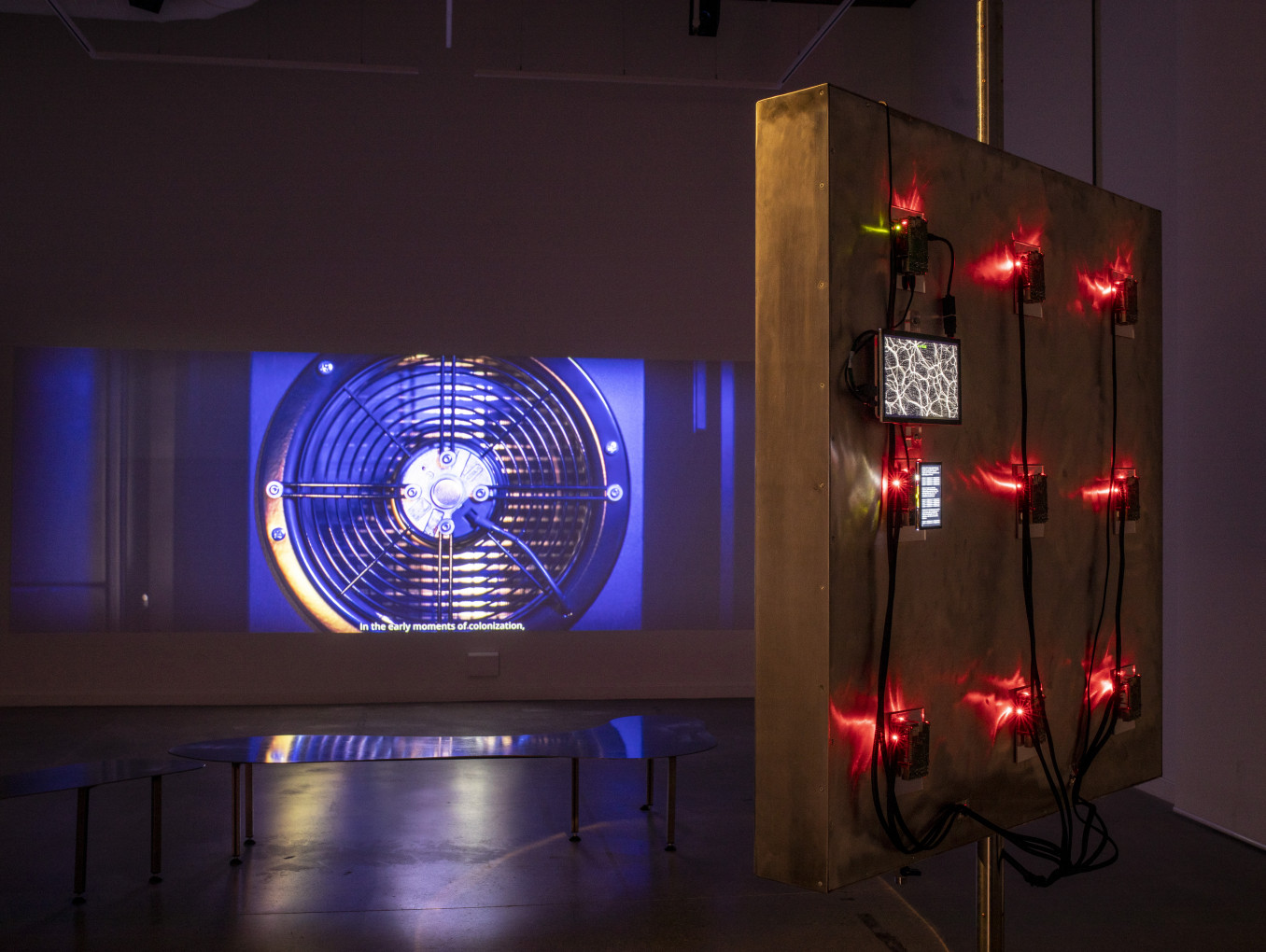
Although the familiar metaphor of the cloud makes us believe that digital information is ethereal, it is supported by gigantic architectures that demand increasingly more energy, water, and raw materials, and inevitably emit heat and carbon dioxide. Computational Compost addresses the environmental impact of data storage and proposes a synergy between technology and ecology. It consists of a prototype using the heat emitted by computers running simulations of the universe’s origin to power a vermicomposting machine with live worms and microorganisms that thrive on this energy to create fertile soil that sustains life in its most primal form. Celestial and biological bodies are linked by processes of metabolism and fermentation, decomposition and regeneration, the metamorphosis that runs through all cycles of matter.
The Computational Compost prototype, first commissioned by Tabakalera Center for Contemporary Culture, is presented as an application for the Donostia International Physics Center (DIPC). DIPC currently redirects the heat generated by its supercomputers into its immediate environment. This process has caused, for example, a nearby loquat tree to bloom prematurely. Understood on a planetary scale, this particular case reveals deeper dimensions, highlighting the significant impact that digital infrastructures can have on processes related to climate change.
The work also includes a film directed by Locument and Otero Verzier, starring the quipu MCHAP 0780, currently exhibited at the Chilean Museum of Pre-Columbian Art in Santiago. Quipus are pre-Columbian recording devices used by the Inka that we can no longer decipher, yet offer some clues for imagining another digital future. Today, humans and artificial intelligence produce so much data that soon there will be no capacity to store it; we are accumulating infinite information with finite resources.
What is the main goal of your research or project?
Computational Compost reimagines digital infrastructure as a life-generating system, transforming the waste heat of high-performance computing into energy for vermicomposting. Developed in collaboration with artists, architects, and scientific institutions, the project responds to Europe's need for sustainable, sovereign, and ecologically grounded technologies.
By bringing together advanced physics and regenerative design, it challenges the extractive logic of contemporary digital infrastructures and proposes an alternative: computation that is materially aware, ecologically integrated, and democratically governed.
The project demonstrates that climate action, democratic data governance, and technological innovation are not competing agendas but mutually reinforcing ones. Drawing on Indigenous knowledge systems such as the quipu and envisioning post-extractivist architectures for computation, Computational Compost offers both a practical prototype and a compelling vision for a digital future rooted in planetary care.
What impact does your research or project have on society?
Computational Compost demonstrates that digital infrastructure can be designed differently. It challenges the dominant extractive model of digital technology and proposes one in which computation becomes part of ecological cycles rather than operating against them.
Beyond the prototype itself, the project contributes to broader public debates about AI, digital sovereignty, and climate change. It encourages citizens, policymakers, researchers, and industry to imagine infrastructures that are more just, transparent, and ecologically embedded.
At a moment when the world is investing heavily in digital technologies, Computational Compost argues that the future of computation should be measured not only by processing power, but also by its capacity to regenerate the environments and communities on which it depends.
What advice would you give to artists at the start of their careers who are interested in working at the intersection of art and science?
Be relentlessly curious and allow yourself to be surprised by others and by the world. Don't try to be the smartest person in the room—that only prevents you from listening carefully and learning from those around you. Seek out collaborators who challenge your assumptions and expand your thinking, and build projects that are as generous as they are ambitious.
Most importantly, use art to imagine alternatives that may not yet seem possible, and to help make the world a more just, caring, and hopeful place. And don't forget to rest and to have fun, and to create moments to celebrate together. The best work is rarely made alone, and sustaining a creative practice also means caring for the friendships that make it possible.
What inspired you to be in the profession you are today?
Curiosity has always been my main driving force. I've always been drawn to architecture because it gave me a way to connect seemingly distant worlds: from science and politics to ecology and culture. And, more importantly, because it opened ways of understanding complex systems and collaborating with others to imagine better futures.
What is one surprising fact about your research or project that people might not know?
The worms that thrive on the excess heat of computation are eventually released into a nearby garden, where a steward continues to care for them. In this way, the project extends beyond the installation itself, becoming part of an ongoing cycle of regeneration.
What’s the most exciting moment you've experienced over the course of your research or project?
During the project, new species unexpectedly took hold in the vermicomposting machine and eventually escaped the prototype. This became an important lesson: rather than striving for closed, perfectly controlled systems, we should design permeable infrastructures that acknowledge uncertainty and create the conditions for unforeseen forms of life to emerge.