Breaking the Wall of Viral Infection and Defense
Breaking the Wall of Viral Infection and Defense
Global Call 2026 Finalist Interview: Life Sciences
Dr. Lou is a professor of molecular virology at Tsinghua University. His research has revealed fundamental mechanistic insights into the replication-transcription complexes of coronaviruses and other highly pathogenic viruses, leading to in-depth understanding of the viral life cycle and the discovery of novel therapeutic targets and inhibitors. To date, he has published more than 160 peer-reviewed research papers, with H-index of 61. He is awarded with several prestigious national and international awards for his notable contributions.
Which wall does your research or project break?
Coronaviruses contain many highly pathogenic pathogens to cause severe human infection diseases, including SARS, MERS and COVID-19. The recent pandemic of COVID-19 caused by SARS-CoV-2 has resulted in millions of infections and deaths worldwide. Upon the evolving of SARS-CoV-2, variants have rapidly emerged and challenged the currently available vaccines, antibodies and drugs. The genome of coronavirus is the largest one among all RNA viruses and encodes 16 nonstructural proteins (nsps). During the viral life cycle, these non-structural proteins must assemble into a set of highly dynamic and complicated Replication-Transcription Complexes (RTCs) for replicating and transcribing viral RNAs. In particular, these non-structural proteins are the most conserved among all reported variants, resulting them as the most essential targets to develop wide-spectrum anti-CoV drugs. However, key questions remain: (1) what are the key steps in the coronavirus replication cycle, (2) how do non-structural proteins assemble the appropriate RTC at each step, (3) how to find promising targets to develop new and potent antiviral drugs? Addressing these challenges requires further insight into the replication and transcription mechanisms of coronavirus.
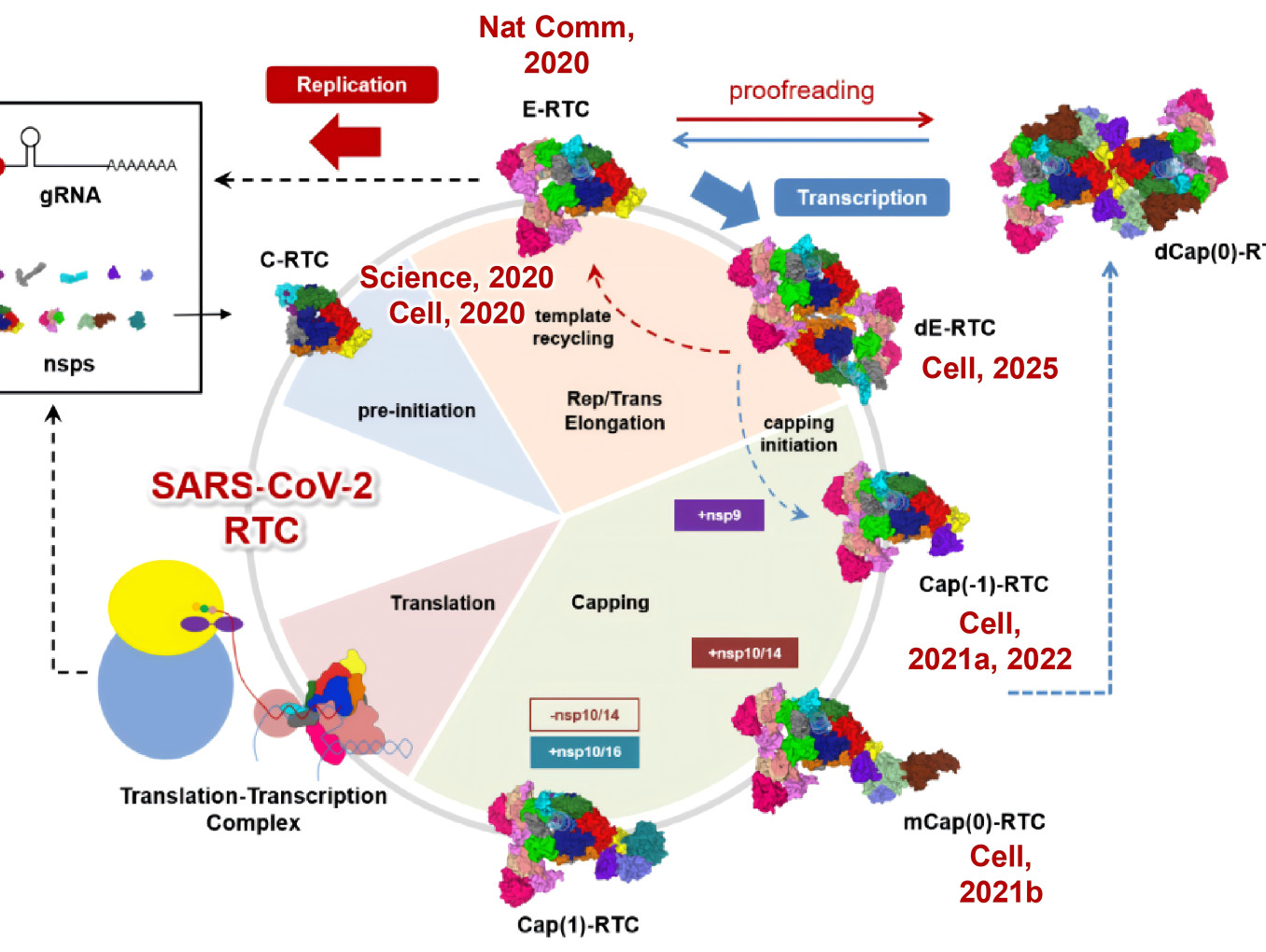
During the early phase of the COVID-19 outbreak, we systematically investigated the transcription and replication cycle of SARS-CoV-2, defining key steps in its replication cycle. We successfully determined the structure of the central RTC composed of the viral polymerase and its cofactors (Science, 2020), providing the first visualization of this crucial antiviral target. We elucidated how the central RTC catalyzes RNA synthesis and how remdesivir inhibits this process (Cell, 2020). Subsequently, we revealed how the viral helicase drives RNA elongation, and the concurrence of template recycling and RNA capping (Nature Communications, 2020; Cell, 2025). After that, we demonstrated the polymerase NiRAN domain serves as the key enzyme catalyzing viral mRNA capping and uncovered a previously unknown capping pathway mediated by RNAylation (Cell, 2021a; Cell, 2022). These findings established NiRAN as a novel and promising target for antiviral development. In the following, we assembled the co-transcriptional capping RTC, illustrating how the co-transcriptional capping and an in trans backtracking mechanism for proofreading concert (Cell, 2021b; JACS, 2025). Together, these works not only provide a structural biology framework for understanding coronavirus proliferates, but also illuminate pathways for antiviral development against rapidly emerging coronaviruses.
What is the main goal of your research or project?
The main goal of our research is (1) presenting the clearest picture of coronavirus replication and transcription from a structural biology view, (2) revealing the key mechanisms underlying viral proliferation, and (3) developing potent antiviral inhibitors targeting proteins that play essential roles in the viral replication and transcription processes.
Since the first structure of a coronaviral protein was determined over two decades ago, in the structural study of coronavirus replication and transcription has progressed through three distinct phases. In the first phase, scientists focused on resolving the structures of individual non-structural proteins. Subsequently, advancing into the second phase, the advent of cryo-EM technologies has empowered us to reconstruct the complicated and dynamic RTCs in vitro and to study its high-ordered architecture. In the future, we aim to investigate how RTCs are assembled within infected cells and to determine their in situ structures.
Understanding of assembly and function of coronavirus RTC provides crucial information for identifying new target for antiviral development and for discovering novel inhibitors. In our previous work, we were the first to elucidate the structure of the polymerase NiRAN domain, revealing a novel RNAylation-mediated capping pathway facilitated by NiRAN. This discovery established NiRAN as a promising target for antiviral development. We are now actively designing and synthesizing compounds that potently inhibit NiRAN-mediate RNA capping in vitro and block coronavirus proliferation. Given that NiRAN is highly conserved across all coronaviruses, inhibitors targeting this domain may provide candidates for broad-spectrum therapies against future emerging coronaviruses.
What impact does your research or project have on society?
COVID-19 is one of the most severe infectious diseases to challenge human society in this century. Since its outbreak, it has caused millions of infections and deaths worldwide, raising significant concerns for global public health. By studying the replication and transcription mechanisms of coronaviruses, we can clearly see how the virus proliferates within host cells. This knowledge has been instrumental in helping scientists develop antiviral treatments and diagnostic tools that have saved countless lives. In particular, while variants of SARS-CoV-2 emerge rapidly and more coronaviruses in wild animals have been found that have possibility to infect human, the replicase proteins remain the most conserved among all these coronaviruses and variants. The results achieved from SARS-CoV-2 replication-transcription complex and antiviral development may help us in combating coronavirus-related infection diseases in the future. The economic impact of coronavirus research is substantial. Although the pandemic triggered widespread economic disruption, advances in vaccines and treatments have helped restore economic stability and promote unprecedented growth in pharmaceutical and biotechnologies. The discovery of novel broad-spectrum anti-coronavirus drugs, targeting mechanisms explored in our works, will provide fresh perspectives for pharmaceuticals innovation. Lessons learned from both basic and translational researches of coronavirus will undoubtedly shape how societies respond to emerging health threats in the years ahead.
What advice would you give to young scientists or students interested in pursuing a career in research, or to your younger self starting in science?
Each individual has varying personal and professional backgrounds, and their choices in a research career differ. There is still common idea in pursuing a career in research. According to my personal experience, finding a scientific area with great impact and novelty on the understanding of our natures and improving the quality of human living may be a first step when a junior scientist steps into scientific research. Understanding the connection of our research to real world problems and the novelty to advance the whole biology field definitely can enhance motivation and provide great idea. Second, keeping curiosity. It is always important for all of us that pursuing questions that genuinely intrigue you, rather than following trends. This intrinsic motivation will encourage us moving forward when we face challenges. Moreover, a well-established collaboration and communication network is also very important for the research. The scientific research in current state demands multidisciplinary approaches and ideas. Collaboration, in particular from different filed, can enhance our ideas and provide invaluable support. There are still many other factors may impact our research career, but these principles help me to face the challenges of my research career with confidence, and my personal growth.