Breaking the Wall of Deadly Bacterial Infections
Breaking the Wall of Deadly Bacterial Infections
Global Call 2026 Finalist Interview: Life Sciences
Mark Brönstrup is a chemist by training. He worked for Sanofi, a large pharma company in Frankfurt, in different R&D positions for 14 years, inter alia on natural product antiinfectives or metabolic biomarkers. He decided to return to translational academic research in 2013 as head of the Chemical Biology Department at the Helmholtz Centre for Infection Research. He holds a Professorship (W3) of the German Center for Infection Research (DZIF) located at the Leibniz University of Hannover.
Which wall does your research or project break?
Our project breaks the wall of deadly bacterial infections. We challenge the long-standing “antibiotic-only” paradigm for treating infections and develop a small molecule drug that does not target the bacterium itself, but its major weapon that enables the spread of the infection in our body.
Let us start with a broader perspective: Infections with bacterial pathogens that are resistant to antibiotics represent a major problem for global health. The underlying antimicrobial resistance (AMR) is responsible for more than 1 million deaths annually and projected to cause GDP losses exceeding 1 trillion USD per year after 2030.
In a ‘ranking’ of pathogens responsible for the largest number of deaths, Staphylococcus aureus assumes the second inglorious position according to a recent landmark paper (Murray, Lancet 2022).
S. aureus, including its resistant variant MRSA, is among the leading causes of severe lung, bloodstream, skin, and soft tissue infections in both community and hospital settings. The infections are associated with markedly prolonged hospital stays, excess mortality, and substantially increased healthcare costs.
There is a conundrum: In most cases, antibiotics should work, because standard lab tests (MIC assays) predict that even MRSA is almost never completely resistant, but sensitive to some antibiotic drugs in the arsenal. In spite of that, clinical outcomes in severe S. aureus infections, in particular of the lung, often remain poor. This implies that the current microbiological definition of ‘resistance’ based on lab tests is insufficient to predict treatment failure or cure in humans. It also suggests that pathogen eradication by antibiotics alone is insufficient, and that novel, complementary approaches are needed.
Our project is based on the observation that S. aureus secretes a major toxin, called the alpha-toxin, that destroys surrounding human tissue to facilitate bacterial dissemination. As part of a truly ‘smart’ defense strategy, alpha-toxin also kills the human immune cells that are responsible for clearing the pathogen. We therefore aimed to find a drug that complements or even replaces antibiotics by restoring immune cell function and tissue integrity.
Because such a virulence blocking drug does not exert selection pressure on bacteria, it is assumed to avoid or delay antimicrobial resistance development. The drug, also enabling more efficacious therapies and reducing healthcare costs, could therefore introduce a paradigm shift for tackling deadly bacterial infections.
What is the main goal of your research or project?
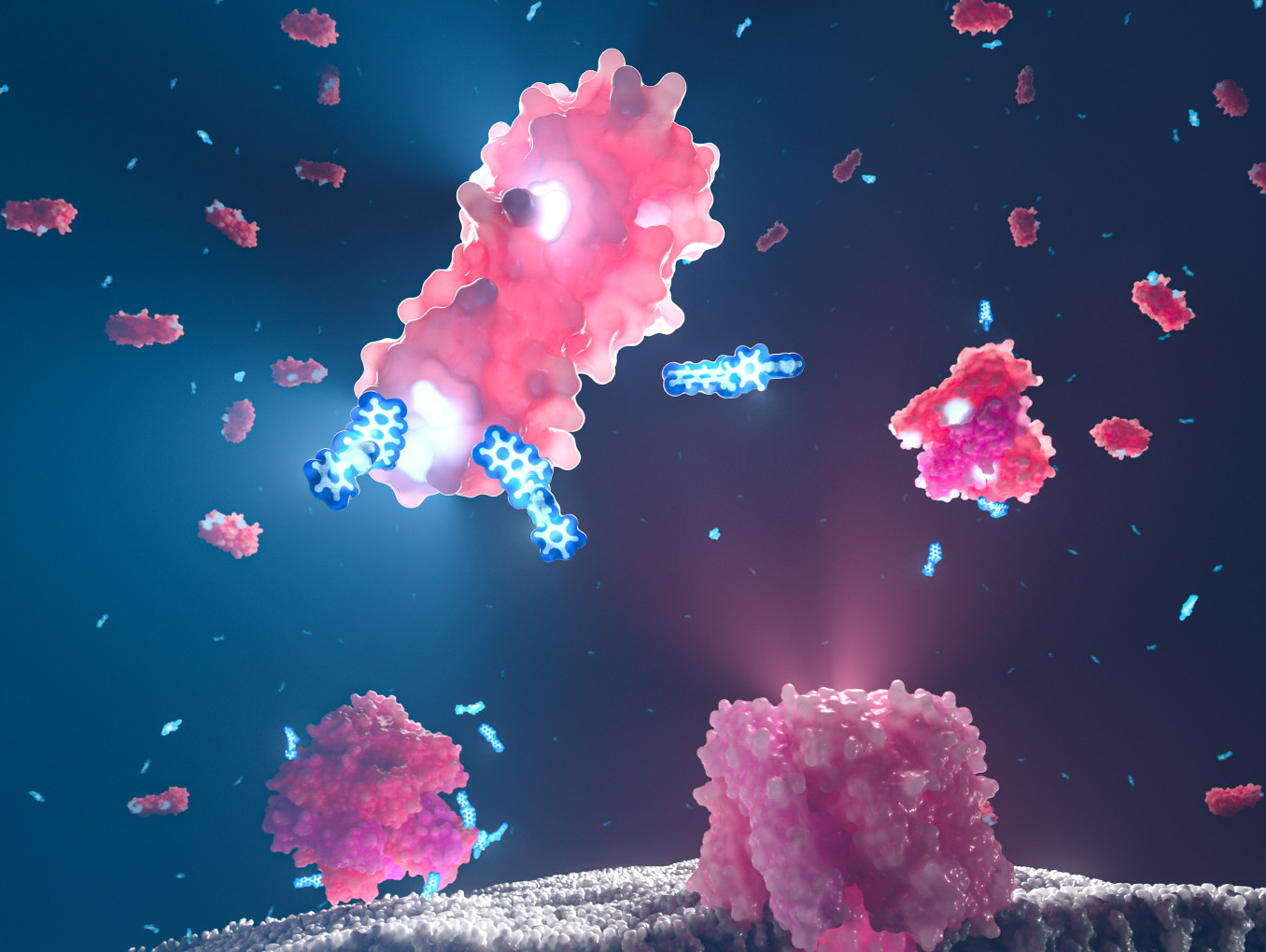
Our project aims to develop a novel therapeutic approach targeting the virulence factor alpha-toxin (α-hemolysin, Hla) of S. aureus. Alpha-toxin is a key pathogenic factor that forms heptameric pores in host cells, leading to cell death. By indiscriminately destroying various cell types, including immune, endothelial, and epithelial cells, it facilitates bacterial dissemination into deeper tissues and the progression to systemic infections.
We are developing a drug candidate that acts differently from antibiotics and complements or even replaces them.
Alpha-toxin neutralization has been achieved with monoclonal antibodies before, but these are expensive, and they slowly reach the lung due to their size - suboptimal in medical conditions where every hour counts. We therefore searched for small molecule inhibitors in collaboration with the Lead Discovery Center in Dortmund. We identified the first-in-class quinoxalinedione drug dubbed "H052" that enables a fast onset of action. By interacting with the phospholipid binding site of the toxin monomers, quinoxalinediones drive the toxin into a futile oligomerization and thereby prevent functional pore formation and protect host cells from damage. We optimized this compound class to a preclinical development candidate, demonstrated efficacy against more than 100 globally collected S. aureus clinical isolates, elucidated its mode of action, and confirmed activity in mouse infection models. Moreover, due to a short and efficient synthetic access to the compound, production costs are low.
We have initiated preclinical development for two clinical indications where antibiotic use is limited or not appropriate: treatment and prevention of S. aureus ventilator-associated pneumonia (VAP) and treatment of atopic dermatitis (AD). VAP, a subset of hospital-acquired pneumonia, is a life-threatening lung infection that occurs in patients on mechanical ventilation. It is among the most common hospital-acquired infections in intensive care units (ICUs), and S. aureus is one of the leading microbial pathogens, causing 15–25% of all cases. AD is a chronic, relapsing inflammatory skin disease characterized by intense itch, eczematous lesions, and substantial impact on quality of life. It affects approximately 129 million people worldwide, making it one of the most common skin disorders globally. AD skin lesions are often colonized by S. aureus, promoting acute exacerbations as well as superinfections and systemic infections.
Our first priority is to show a clinical proof-of-concept in these two initial indications. After that, an extension to other severe infections of S. aureus is planned.
What impact does your research or project have on society?
The question implies that you search for impact on society today? The honest answer is: None. We have just consumed taxpayer’s money so far, and the development of the drug requires years and further investments until benefit for patient will materialize. But what might its future impact be? Our α-toxin inhibitor offers a novel approach to the treatment of difficult-to-treat S. aureus infections and thereby ameliorates morbidity and mortality of disease. Because the treatment costs for invasive infections in ICU’s add to tens of thousands of dollars per case and billions in annual expenditure in some healthcare systems, reducing infection rates, severity of pneumonia, and the length of hospital stays also lowers societal costs associated with disease. Moreover, current broad-spectrum antibiotic use indiscriminately disrupts the gut, lung and skin microbiome, leading to dysbiosis and collateral health effects that extend beyond the acute infection. Widespread antibiotic use in agriculture and livestock production further accelerates the emergence and spread of resistant bacteria, creating environmental reservoirs of resistance that feed back into human and animal health. Our inhibitor does not target the pathogen and therefore does not exert selective pressure, limiting the development of AMR, and preserving the host microbiome. Our preclinical data suggest the compound can be used prophylactically to prevent infections even as a standalone therapy. It therefore could enable a reduction of antibiotic consumption in some indications. The straightforward and cost-effective manufacturing of the small molecule drug enables a therapy that is accessible and affordable in low- and middle-income counties (LMIC). Although AMR affects countries in all regions and at all income levels, its consequences are exacerbated by poverty and inequality, with LMICs being most affected. The limited availability of effective therapeutic alternatives further exacerbates disparities in healthcare access for these populations. In this context, by contributing towards the fight against AMR, our project may also help alleviating health inequalities in high- versus low- and middle-income countries. On a longer perspective, demonstrating the benefit of our inhibitors in prominent S. aureus infections may trigger further virulence blockage developments against other WHO priority pathogens and help to establish this approach as a novel treatment paradigm against bacterial infections.
What advice would you give to young scientists or students interested in pursuing a career in research, or to your younger self starting in science?
I have spent about half of my life post-Ph.D. in industry (14 years), and half of it in academic research (13 years). Because worklife consumes a major portion of your daytime, my first, serious advice is to strive for an inspiring and rewarding activity, rather than just to ‘get a job’. There are multiple ways to find it, but if you enjoy intellectual work, exploring unknown paths and interacting with people, I strongly encourage you to become a scientist. It is an exciting time to join the field, fueled by breathtaking recent advances. Disclosing something new is intriguing and deeply satisfying, and a cultural value in itself. Even if it is on a seemingly ‘useless’ topic, as my Ph.D. Thesis work on ion chemistry in the gas phase. At the same time, excellent research has regularly turned to innovation and products, at all times, at all places. There is consensus that scientific progress is an essential component for mastering the Grand Challenges we face around the globe. Thus, scientists will be needed more than ever. However, the transition from knowledge to utility and impact remains unpredictable. This makes it hard for politicians to allocate research budgets ‘efficiently’, and difficult for students to find their ‘right’ direction. My second advice is therefore to be guided by your genuine interest for a field, your skills, and by excellent people you like to work with, rather than by trends or advisors (who currently tell you that a GMP course is beneficial).
Among graduates looking for their first position post-Ph.D., I sense a preference for 1) staying in Germany rather than going abroad (because of the working conditions, Trump, etc) and 2) for an immediately permanent job, which is still rare in academia. This is exactly what I did after my Ph.D. – and I was wrong. Take the chance to experience a different culture, even if you want to settle elsewhere. Grasp science from different angles, even if a career in a company, in or outside R&D, is the better choice for you in the end. I like both industrial and academic worlds, it was best for me to explore both, and to return to academia in the end. My third advice is therefore to take risks, and understand life as a game. To quote Hans Blumenberg: “The harbour is no alternative to shipwreck; it is the place where one misses out on life’s happiness”.