Breaking the Wall of Invisible Lipid Transport in Cells
Breaking the Wall of Invisible Lipid Transport in Cells
Global Call 2026 Finalist Interview: Life Sciences
Juan Iglesias Artola developed the first quantitative methodology for measuring lipid transport in mammalian cells, as a postdoc in the Nadler lab at the Max Planck Institute of Molecular Cell Biology and Genetics, Dresden. Combining photoactivatable and clickable lipid probes, quantitative imaging and mathematical modelling, he showed with his collaborators that cells sort lipids through protein-mediated, non-vesicular transport rather than vesicle traffic. He is now CEO of Blue Ice Labs GmbH.
Which wall does your research or project break?
With my research, we break the wall of invisible lipid transport in cells. Tracking how lipids move inside cells has always been challenging, yet lipid transport is fundamental to how cells work, from building membranes to storing energy to transmitting signals. The difficulty comes from the lipids themselves. They are extraordinarily diverse and they are small.
A cell makes more than a thousand chemically distinct lipids, many differing by a single double bond. Yet every membrane holds its own precise mixture, and the cell must maintain it, so each lipid has to reach the right place. How does the cell do that? Nobody could say, because following a single lipid is not possible the way it is for proteins. Biologists can follow a protein by extending its gene to carry a fluorescent tag. Lipids are not coded by genes, so that toolkit is unavailable. That leaves one option, attaching a dye. And here the small size of a lipid matters, because a dye is roughly as large as the molecule it tags. The probe ends up reporting on itself.
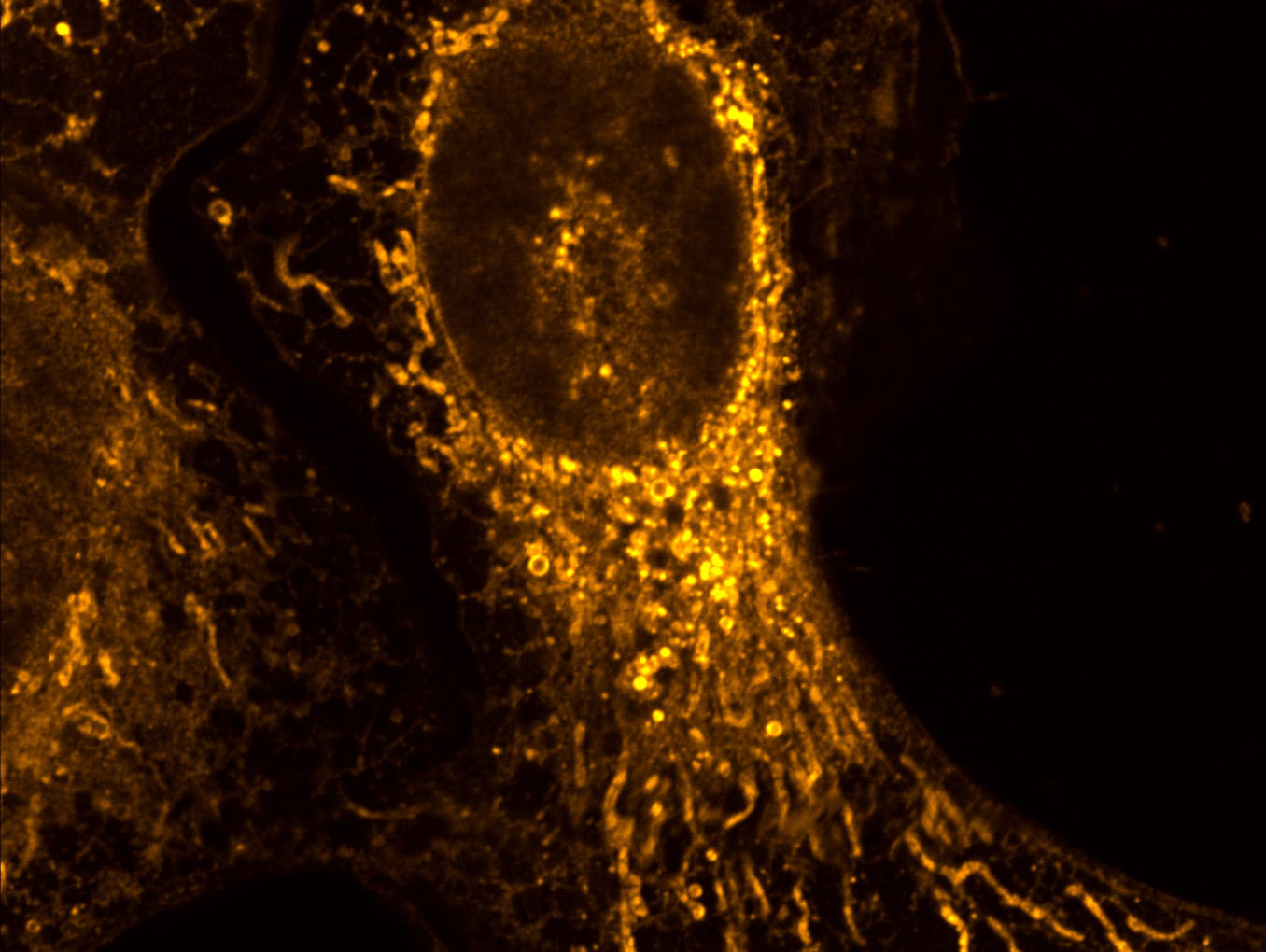
To get around this, other laboratories had developed lipid probes that carry no dye during the journey. They travel incognito, and are revealed only once the journey is over. We built a library of membrane-forming lipids with these probes, including near-identical variants. Then we combined imaging, mass spectrometry and mathematical modelling to measure how fast each species moves from the plasma membrane to the other organelles. The result is the first quantitative map of lipid flux inside cells.
This lipid flux map reveals that lipids are sorted mainly by fast transport that uses no vesicles. Mass spectrometry showed that this transport outruns chemical conversion by a factor of ten to sixty. Species differing only in saturation travel up to seven times faster than one another. The cell is not shipping lipids in bulk. It is choosing between molecules that look almost identical.
That selectivity makes the map useful. We can now ask how a mutation slows the delivery of a lipid, or whether a drug can restore it. Our probes also lock onto the proteins carrying each lipid, so the same experiment can name those carriers. These are the questions that stand between a disease of lipid transport and a treatment for it, and all three can now be measured.
What is the main goal of your research or project?
The main goal is to make the movement of individual lipids inside cells fully measurable, and to use that measurement to guide the development of drugs for lipid-related diseases.
The map we published covers a small set of lipid species travelling in one direction. A cell makes more than a thousand, and they move between every compartment. Extending it across the lipidome would show how a cell decides where each lipid belongs, and what goes wrong when that fails. Reaching this scale means a method that runs automatically rather than by hand, testing thousands of mutations and compounds rather than a handful.
That would also make the measurement useful beyond our own field. A drug developer can determine what a cell contains but not what it is doing with it. Closing that gap would let lipid-related side effects be caught early, and lipid-directed candidates be assessed directly.
Transfer rates have been measured for years, mostly with purified proteins and artificial membranes. Our contribution was to obtain them for individual lipid species inside intact cells, organelle by organelle. What we want is for the route a lipid takes through a cell to become as measurable as its abundance already is, so that diseases which have resisted treatment for decades become a tractable target.
What impact does your research or project have on society?
Roughly 130 human proteins move lipids between compartments, and only a handful have been pursued as drug targets. Part of the reason is that when a cell mishandles its lipids, the protein responsible is often unknown, so there is nothing specific to design a drug against. Measuring transport step by step helps. When we removed proteins involved in lipid handling from cells, particular lipids slowed down at particular points, and the place where a lipid stalls narrows the search to the machinery responsible for that step. Turning a diffuse metabolic problem into a named protein is what makes a disease druggable. The conditions involved are common. Fatty liver disease now affects close to a third of adults worldwide. Some inherited forms of Parkinson's disease are caused by faults in the proteins that move lipids around the cell. And many viruses, including hepatitis C and the coronaviruses, take over a cell's lipid transport to build themselves a place to multiply. In each of these the same question comes up. Which step has gone wrong, and can it be put right? Being able to measure the answer is what would turn these from problems we can only describe into problems we can treat.
What advice would you give to young scientists or students interested in pursuing a career in research, or to your younger self starting in science?
Since the beginning of my career I have been drawn to difficult projects, and this one was no exception. The idea of using these probes to follow lipid transport had been proposed years before I arrived, and by the time I picked it up it had been set aside. Taking it on meant accepting that it might not work at all. It became the most rewarding thing I have done.
That is the first thing I would say to someone starting out. A project with a guaranteed result will teach you very little. I have learned most when I put myself into situations I did not know how to handle, and I have looked for those situations deliberately, because that is when you are forced to acquire something you did not have. It is uncomfortable and it is slow, and I know of no substitute for it.
Aim to do good science. That has been my experience of how recognition actually works: it came when the work was worth doing, and never because I set out to collect it. If you get the science right, the rest follows. If you get it the wrong way round, it usually does not.
None of this makes a career comfortable. But the work I am proud of is the work nobody could promise me would succeed.